
Common Swift vs Fork-tailed Drongo
Apus apus versus Dicrurus adsimilis
Play a quiz with Common Swift and Fork-tailed Drongo
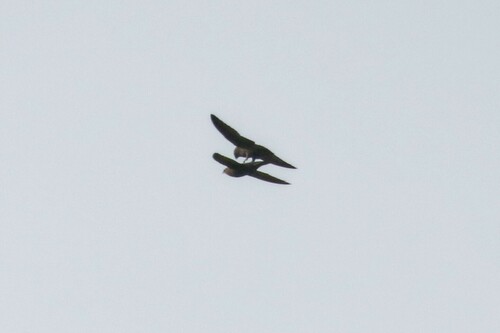 Common Swift
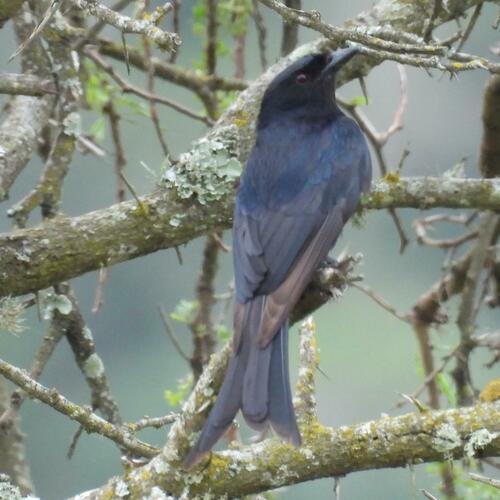 Fork-tailed Drongo
In short
The most reliable way to separate Common Swift from Fork-tailed Drongo is by overall structure and flight style: swifts are sickle-winged aerialists with a crescent-shaped silhouette and never perch upright, while drongos are perching birds with a robust body, strong bill, and a deeply forked tail. Juvenile drongos can be confusing due to their duller brownish plumage and less pronounced tail fork, but even then, their upright perching and thicker bill are clues. Swifts are uniformly dark with only a tiny pale throat spot, seen best up close, and are almost always seen in fast, agile flight. Drongos, in contrast, show a glossy black-blue upper body as adults, red eyes, and often sally from perches. If you see the bird perched upright on a branch, it is a drongo, not a swift.
Identification tips
- Perching vs. flight: If the bird is perched upright on a branch or wire, it is a Fork-tailed Drongo. Common Swifts are almost never seen perching in the open.
- Wing shape in flight: Swifts have long, narrow, sickle-shaped wings that form a crescent or boomerang outline. Drongos have shorter, broader wings with a more typical passerine shape.
- Tail shape: Drongos have a deeply forked tail, especially as adults, while swifts have a short, only slightly forked tail. Juvenile drongos have a less pronounced fork, but still more than a swift.
- Bill structure: Swifts have a tiny, almost invisible bill best seen in close-up; drongos have a robust, strong black bill visible even at a distance.
- Eye color: Adult drongos have striking red eyes; swifts have dark eyes that do not stand out.
- Plumage gloss: Adult drongos show a glossy blue-green sheen on the upperparts in good light, while swifts are a uniform blackish-brown with no iridescence.
- Juvenile confusion: Juvenile drongos are duller brown with buff tips and a less obvious tail fork, but still perch upright and show a thicker bill. Swifts, even as juveniles, are uniformly dark with only a pale throat spot.
- Throat patch: Swifts have a small pale or whitish throat spot, but this is hard to see except at close range and is not a reliable field mark from a distance.
- Flight style: Swifts are fast, agile, and rarely pause; drongos fly out from a perch to catch prey and return, with more direct, less acrobatic flight.
- Habitat: Swifts are seen in open airspace, often high above ground; drongos are usually in or near trees and often near water or farmland.
- Vocalization: Swifts give loud, piercing screams, especially in groups. Drongo calls are not described here but do not match the swift's scream.
- Legs and feet: Drongos have short but visible legs and feet for perching; swifts have tiny legs and are never seen standing upright in the open.
- Body shape: Swifts are slender and streamlined for continuous flight; drongos are bulkier and more robust, with a strong chest and head.
- Context: If you see a bird sallying out from a perch and returning, it is a drongo. If it is endlessly circling and never lands, it is a swift.
- Seasonal molt: Drongos undergo a complete molt after breeding; swifts do not show obvious molt in the field.
Size
Fork-tailed Drongo is heavier and more robust than Common Swift, with a body mass of about 43.4g [wikidata]. Common Swift is slightly longer in the body (16–17 cm) but is much more slender and built for continuous flight, with a wingspan of 38–40 cm. Drongo wingspan is much shorter (about 13.4 cm per wing; total wingspan not specified but clearly less than swift), and the bird is bulkier with a strong bill and legs for perching. In the field, the swift appears longer-winged and lighter-bodied, while the drongo looks stockier and more compact.
Plumage
- Juvenile drongos are dark brown with buff feather tips, a less obvious tail fork, and pale mouth and eyes; they lack the adult's glossy blue-black shine and red eyes. This can make them look duller and less contrasty, but the forked tail and upright perching remain clues.
- Adult drongos are glossy black with blue-green iridescence, red eyes, and a deeply forked black tail. The belly is uniformly black, matching the upperparts but with less gloss.
- Common Swift of all ages is blackish-brown overall, with a small pale throat patch that is hard to see except at close range. The wings are long and sickle-shaped, and the tail is short and only shallowly forked. There is no iridescence or red eye.
- Swifts do not show any pale feather tips, buff, or brownish tones, even as juveniles; their plumage is uniformly dark except for the throat spot.
Behaviour
Common Swifts are almost always seen in flight, rarely perching except at the nest (which is hidden). Their flight is fast, agile, and continuous, with rapid changes of direction and high aerial maneuverability. They never perch upright on exposed branches. Fork-tailed Drongos are often seen perched upright on branches, wires, or exposed snags, from which they sally out to catch insects. They are aggressive defenders of their territory and may mob larger birds. Their flight is more direct and less acrobatic than a swift's, with frequent returns to the perch.
Habitat
Common Swift is found in open skies over towns, lowlands, and near water during migration and breeding, rarely seen in wooded habitats or perching in trees. Fork-tailed Drongo is a bird of wooded habitats, woodlands, and savannas across sub-Saharan Africa, often near wetlands, farms, or forest edges. If the bird is seen in dense woodland or perched in a tree, it is almost certainly a drongo.
Voice
Common Swift gives a loud, piercing scream, often in groups, with two pitch levels (higher in females). Fork-tailed Drongo is not described in detail here, but does not give the swift's characteristic screaming calls. If you hear a high, sharp, repeated scream overhead, it is likely a swift.