
Common Starling vs Eurasian Blackbird
Sturnus vulgaris versus Turdus merula
Play a quiz with Common Starling and Eurasian Blackbird
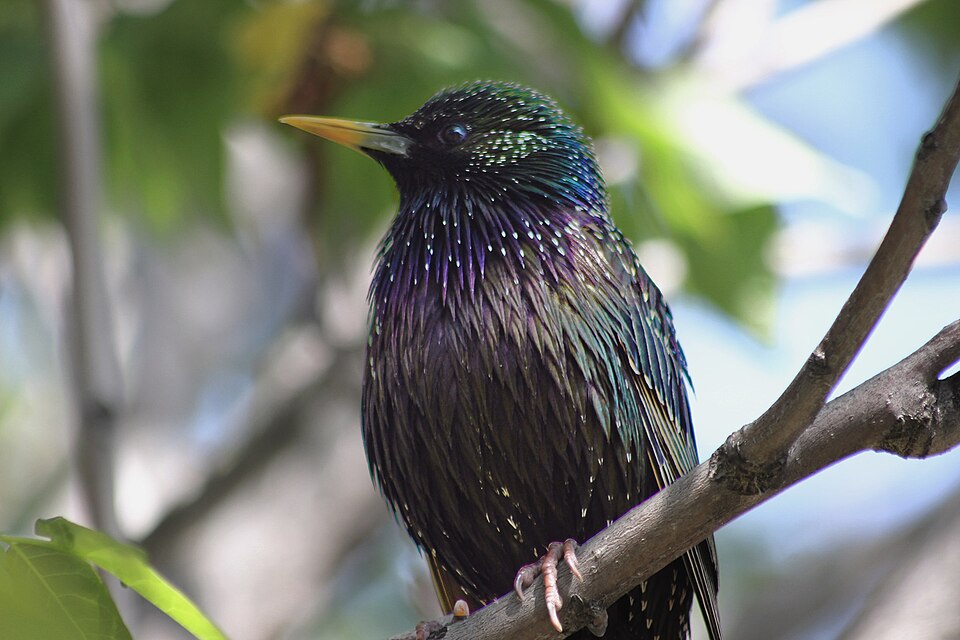 Common Starling
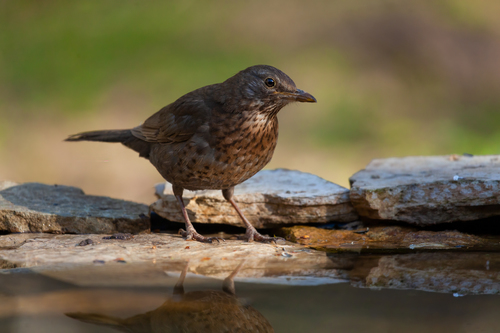 Eurasian Blackbird
In short
The most reliable way to separate Common Starling from Eurasian Blackbird is by structure: starlings have a short tail, pointed wings, and a sharp, slender bill, while blackbirds are longer-tailed, with a rounded body, and a thicker, straight bill. In flight, starlings show triangular, rapidly-beating wings and a compact shape; blackbirds appear more elongated with steady, direct flight. Adult male starlings are iridescent black with seasonal white spotting, while male blackbirds are matte black with a bright yellow-orange bill and eye-ring. Juveniles of both species are brown, but starling juveniles are more uniform and lack the pale spotting and mottled breast of young blackbirds. Bill color and leg color are also key in adults, especially in spring and summer.
Identification tips
- Tail length and shape: Starlings have a noticeably short tail, giving a compact, stubby look in flight and when perched. Blackbirds have a long, straight tail that extends well beyond the body, visible even at rest.
- Wing shape in flight: Starlings show sharply pointed, triangular wings and rapid, flickering wingbeats. Blackbirds have broader, more rounded wings and a steadier, less frenetic flight.
- Bill shape and color: Starlings have a slender, straight, blade-like bill that is yellow in summer (with blue-grey base in males, pink in females) and black in winter. Blackbirds have a thicker, blunt bill that is bright orange-yellow in adult males (duller in females, dark in first-year males), darkening in winter but never as slender as a starling's.
- Leg color: Starlings have pinkish or reddish legs, especially bright in breeding season; blackbirds have dark brown to blackish legs.
- Adult male plumage: Starling males are glossy black with a metallic purple-green sheen and white spots in winter; blackbird males are matte black with no sheen, a bright yellow-orange bill, and a yellow eye-ring.
- Adult female plumage: Female starlings are similar to males but with more spotting and less gloss. Female blackbirds are brownish, with a paler throat and mottled breast, and lack any iridescence.
- Juvenile plumage: Juvenile starlings are uniform grey-brown, lacking strong patterning, and may show some retained brown on the head into first winter. Juvenile blackbirds are brown with pale spots on the upperparts and a speckled breast, often appearing mottled and variable.
- Iris color (close views): In starlings, males have rich brown irises, females mouse-brown or grey; in blackbirds, adult males have a yellow eye-ring, which is weaker or absent in first-year males and females.
- Flock behavior: Starlings often form dense, synchronized flocks (murmurations), especially outside breeding season. Blackbirds are usually solitary or in loose groups, never forming tight flocks.
- Gait: Starlings walk or run with a waddling motion; blackbirds walk or run smoothly, without waddling.
- Perched posture: Starlings appear round-bellied and compact, often upright; blackbirds are more elongated and horizontal when perched.
- Habitat context: Large flocks in open fields, on wires, or swirling in the sky are almost always starlings. Solitary birds foraging under shrubs or in leaf litter are more likely blackbirds.
- Seasonal bill color: In spring/summer, a yellow bill on a black bird could be either species, but check for gloss and tail length. In winter, a black bill on a black bird with a short tail points to starling; a dark bill with a long tail suggests a first-year male blackbird.
- Spotting: White spots on the body are typical of starlings in winter; blackbirds never show this pattern.
- Upperwing in flight: No strong age-specific upperwing marks for either species, but starlings' wings are always pointed and triangular, while blackbirds' are rounded and broader.
Size
Common Starlings are smaller and more compact, measuring 19–23 cm in length with a wingspan of 31–44 cm and weighing 58–101 g [wikipedia][avonet]. Eurasian Blackbirds are noticeably larger and heavier: 23.5–29 cm long, with a longer tail, and weighing 80–125 g [wikipedia][avonet]. The blackbird's longer, more rounded body and tail are apparent even at a distance, while starlings appear shorter and rounder.
Plumage
-
Juveniles/First-years: Juvenile starlings are uniform grey-brown, lacking strong patterning, and by first winter may retain some brown on the head but otherwise resemble adults. Juvenile blackbirds are brown with pale spots on the upperparts and a speckled breast, and are generally more mottled and variable in shade. First-year male blackbirds have a dark bill and a weaker eye-ring, and their folded wings are brown, not black like the body.
-
Adult males: Starlings are iridescent black with a metallic sheen and, in winter, prominent white spots (from feather tips). In summer, the spotting wears off, leaving a glossy black appearance. Their bill is yellow in summer (blue-grey base in males, pink in females) and black in winter. Blackbird males are matte black, with a bright orange-yellow bill and a yellow eye-ring; their bill darkens in winter but remains thicker and more blunt than a starling's.
-
Adult females: Female starlings are similar to males but with more spotting and less gloss. Female blackbirds are sooty-brown, with a dull yellowish-brown bill, a brownish-white throat, and some weak mottling on the breast.
-
Legs: Starlings have pinkish or greyish-red legs (brighter in breeding season); blackbirds have blackish-brown legs.
-
In flight: Starlings show strongly pointed wings and a short tail; blackbirds have longer, more rounded wings and a noticeably longer tail.
Behaviour
Starlings move with a waddling walk or run on the ground, rarely hopping. In flight, they are agile, often flying in tight, coordinated flocks with rapid wingbeats and short glides. Blackbirds walk or run but do not waddle, and are usually solitary or in loose flocks. Their flight is direct and steady, with bursts of rapid wingbeats and level or diving movement, but lacks the tight, swirling flock behavior of starlings. Blackbirds are territorial, especially in the breeding season, and display aggressive behaviors such as the 'bow and run' threat display.
Habitat
Both species are widespread and can overlap in gardens, parks, and open countryside. Starlings are more likely to be seen in large, dense flocks, especially outside the breeding season, and are often found in urban areas, fields, and on wires. Blackbirds are more solitary or in pairs, preferring shrubby areas, woodland edges, and gardens, often foraging on the ground under cover. In winter, blackbirds may form loose feeding groups but do not form the dense murmurations typical of starlings.