

Common Shelduck vs Northern Shoveler
Tadorna tadorna versus Spatula clypeata
Play a quiz with Common Shelduck and Northern Shoveler
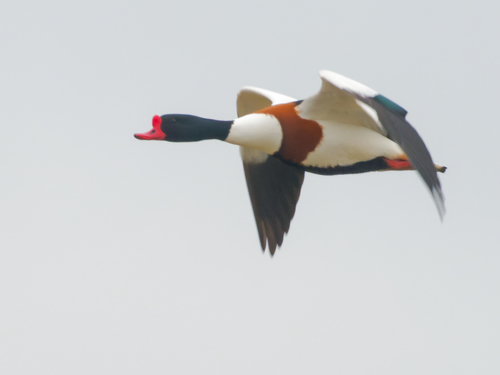 Common Shelduck
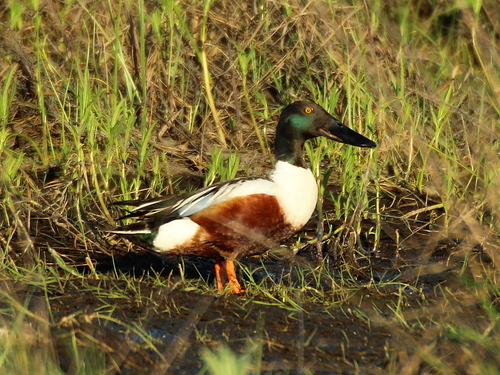 Northern Shoveler
In short
The most reliable field mark to separate Common Shelduck from Northern Shoveler is overall structure and bill shape: Shelduck is a large, short-necked, goose-like duck with a bright reddish-pink bill (bulbous in adult males), while Northern Shoveler is distinctly smaller, slimmer, and has a long, broad, spatula-shaped bill. In flight, both species show strong wing patterns, but Shelduck’s white coverts and black primaries with green-glossed secondaries contrast with the Shoveler’s pale blue forewing and green speculum. Juveniles of both species already show adult-like wing patterns. Sexes are similar in Shelduck, while Shoveler females are mottled brown with a large, pale-edged bill. Watch for habitat context: Shelduck favors open estuaries and saline pools, while Shoveler is more often in marshes and shallow lakes.
Identification tips
- Size and shape: Shelduck is much larger and bulkier, with a short neck and upright stance; Shoveler is smaller, slimmer, and sits lower on the water. This is reliable at any distance when both species are present.
- Bill shape: Shelduck’s bill is thick, short, and reddish-pink (with a prominent knob in adult males during breeding); Shoveler’s bill is long, broad, and spatulate, appearing oversized and flat, especially in profile. This is diagnostic at close range for all ages and sexes.
- Adult male plumage: Male Shelduck has a dark green head, white body, chestnut breast band, and black belly; male Shoveler (breeding) has a dark green head, white breast, chestnut flanks and belly, but the bill is black and much larger.
- Female and eclipse plumage: Female Shelduck is similar to male but smaller, with some white flecks on the face and a duller bill; female Shoveler is mottled brown (like a female Mallard) but with a long, broad, greyish bill tinged orange at the edges. In eclipse, male Shoveler resembles the female but keeps the blue forewing.
- Juvenile plumage: Juvenile Shelduck is greyish above, mostly white below, with the adult’s bold wing pattern; juvenile Shoveler is mottled brown like the female, with a duller, broad bill.
- Wing pattern in flight (all ages): Shelduck shows white coverts, black primaries, black secondaries with green gloss, and mostly white underwing except black flight feathers. Shoveler shows pale blue forewing (especially obvious in males), green speculum, and white border between them; female Shoveler’s forewing is grey.
- Underwing in flight: Shelduck’s underwing is mostly white with black flight feathers; Shoveler’s underwing is not described in detail but lacks this strong contrast.
- Bill color (close views): Shelduck’s bill is always reddish-pink (brighter in males); Shoveler’s is black (male) or greyish with orange edges (female).
- Leg color: Shoveler’s legs are bright orange-red; Shelduck’s are pink, but this is less obvious at a distance.
- Habitat context: Shelduck is more likely on open estuaries, tidal flats, and saline pools; Shoveler prefers shallow, vegetated marshes and lakes.
- Feeding behavior: Shoveler often swings its bill side-to-side to filter food; Shelduck grazes or dabbles more like a goose.
- Flock size: Large, dense flocks (hundreds or thousands) are more likely Shelduck, especially on mudflats; Shoveler usually in small groups.
- Voice: Shelduck gives a loud, deep honk; Shoveler’s call is less distinctive and not described here.
- Sexual dimorphism: Shelduck sexes are similar (female smaller, some white on face); Shoveler sexes differ strongly (female mottled brown, male with bold head and breast colors in breeding).
- Bill knob: Only adult male Shelduck in breeding season shows a prominent bill knob; Shoveler never does.
Size
Common Shelduck is much larger and heavier (body mass ~1150 g) than Northern Shoveler (typically 500–800 g). Shelduck measures 55–65 cm in length with a 100–120 cm wingspan, giving it a chunky, short-necked, goose-like silhouette. Northern Shoveler is more compact (44–52 cm long, 70–84 cm wingspan), appearing slim and low to the water. In direct comparison, Shelduck is bulkier and stands taller, while Shoveler is noticeably daintier and lighter.
Plumage
Juvenile and immature birds of both species already show most adult wing pattern features. In flight, Common Shelduck of all ages shows striking white upperwing coverts, black primaries, and black secondaries with a strong green iridescent sheen. The underwing is mostly white except for black flight feathers. Northern Shoveler in all plumages shows a pale blue forewing (less obvious in poor light), a green speculum bordered by white, and a duller grey forewing in females. Adult male Shelduck is crisply marked with a dark green head, white body, chestnut breast band, and black belly; the bill is bright red with a prominent knob in breeding males. Adult male Shoveler (breeding) has a dark green head, white breast, chestnut flanks and belly, and a huge black bill; in eclipse, it resembles the female but retains the blue forewing. Female Shelduck is similar to male but smaller, with some white flecks on the face and a duller bill; female Shoveler is mottled brown with a long, broad, greyish bill tinged orange on the edges. Juvenile Shelduck is greyish above, mostly white below, with the adult wing pattern; juvenile Shoveler is similar to adult female but with a duller bill and less contrast.
Behaviour
Common Shelduck is often seen in large, conspicuous flocks, especially during moult, and can be found grazing or swimming in open, exposed habitats. Both parents guard ducklings, which may be led long distances from the nest. Northern Shoveler is less gregarious outside breeding, usually in small groups, and feeds by dabbling and swinging its bill side-to-side to filter food. Shoveler’s unique feeding behavior—sifting water with its specialized bill—is distinctive. Shelduck may be seen walking on mudflats or grazing, while Shoveler is almost always dabbling in shallow water.
Habitat
Common Shelduck is strongly associated with open estuaries, tidal mudflats, saline pools, and increasingly, inland freshwater lakes and rivers in open country. It breeds in burrows or holes near water and winters mainly on estuaries. Northern Shoveler prefers shallow, mud-bottomed marshes, lakes, and wetlands rich in aquatic invertebrates, and is less likely to be found on exposed tidal flats. While both can occur in freshwater, Shelduck is more coastal and open-country, Shoveler more marshy and vegetated.
Voice
Common Shelduck gives a loud honk, which is deeper and more resonant than the typical dabbling duck quacks. Northern Shoveler’s calls are not described in the provided notes, but are generally softer and less distinctive than Shelduck’s honk.