
Motmot

Common Redpoll vs Lesser Redpoll

Acanthis flammea versus Acanthis cabaret

Play a quiz with Common Redpoll and Lesser Redpoll
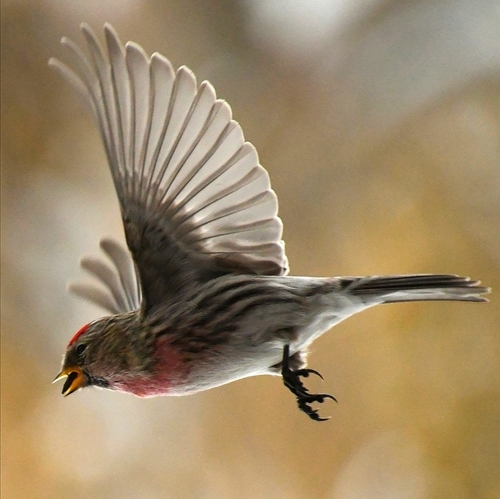
Common Redpoll (Acanthis flammea) Common Redpoll
Lesser Redpoll (Acanthis cabaret) Lesser Redpoll

Media

Loading…

In short

Common Redpoll and Lesser Redpoll are extremely similar finches, often confused even by experienced birders. The most reliable field mark—when visible—is overall size: Common Redpoll is distinctly larger and bulkier than Lesser, with a longer wingspan and slightly heavier build. Both species share the classic redpoll look: brownish-grey, heavily streaked, with a red forehead and black bib, but Lesser Redpoll is generally smaller, warmer-toned, and less heavily streaked below. Structural differences are subtle but can help: Common Redpoll appears longer-winged and longer-tailed, while Lesser Redpoll is more compact with a shorter tail. Separation is most challenging in immature and female birds, where plumage overlap is greatest.

Identification tips

  1. Size is the most reliable field mark: Common Redpoll is noticeably larger and bulkier than Lesser Redpoll. Use this when birds are together or with known species for scale.
  2. Structure: Common Redpoll has a longer tail and wings, giving it a more elongated look. Lesser Redpoll is more compact and short-tailed.
  3. Plumage tone: Lesser Redpoll is warmer brown above and buffier on the flanks, while Common Redpoll is colder grey-brown and more heavily streaked below.
  4. Rump pattern: Common Redpoll usually shows a paler, more distinctly streaked rump; Lesser Redpoll's rump is warmer and less obviously streaked. This is best seen in good light or in flight.
  5. Breast color (males): Adult male Common Redpolls have a more extensive and brighter pinkish-red flush on the breast; Lesser Redpoll males are duller and the red is more restricted.
  6. Underpart streaking: Common Redpolls (all ages) are more heavily streaked on the underparts, especially the flanks. Lesser Redpoll is less streaked and often appears cleaner below.
  7. Bill shape and color: Both have a yellowish bill with a dark tip, but Common Redpoll's bill may appear slightly stubbier and deeper at the base. This is subtle and not always reliable.
  8. Wingbars: Both species show two pale wingbars, but these are not diagnostic between them.
  9. Juvenile/first-winter birds: Both lack red on the breast, but Common Redpoll juveniles are paler and more streaked below. Lesser Redpoll juveniles are warmer and less streaked.
  10. Habitat: In Europe, Lesser Redpoll is more likely in lowland woodlands, scrub, and gardens, while Common Redpoll prefers northern or upland habitats. In winter, both can occur together in weedy or birch-rich areas.
  11. Flocking: Mixed flocks occur; use direct comparison for size and structure.
  12. Sex and season: Females and juveniles are duller and harder to separate; rely on size, structure, and underpart streaking.
  13. Flight views: No distinctive upperwing pattern differences are noted, so focus on size and rump pattern if visible.
  14. Voice: Not covered in the provided sources; do not rely on call for separation here.
  15. Pitfalls: Beware of variation within each species and overlap in plumage, especially in autumn and winter. Use a combination of marks, not just one.

Size

Adult Common Redpolls measure 11.5–14 cm in length, with a wingspan of 19–22 cm and weight of 12–16 g. Lesser Redpoll (A. cabaret) is smaller on average, though precise measurements are not given here, but field experience and references confirm it is noticeably more petite and compact than Common Redpoll. In mixed flocks, Common Redpolls stand out as larger, longer-bodied, and longer-tailed. This size difference is often the best clue when birds are side by side, but can be hard to judge on lone birds or at a distance.

Plumage

Both species show a red forehead, black bib, and two pale wingbars. Adult males of both can have a pinkish or red suffusion on the breast, but this is more intense and extensive in Common Redpoll. Lesser Redpoll tends to have warmer brown upperparts and buffier flanks, while Common Redpoll is colder grey-brown and more heavily streaked below. The rump of Common Redpoll is usually paler and more obviously streaked, whereas Lesser Redpoll's rump is warmer and less distinctly streaked. Juvenile and first-winter birds of both species lack the red breast and can be very similar, but Common Redpoll juveniles are generally paler and show heavier streaking on the underparts. No distinctive age-specific upperwing pattern differences are noted in the sources provided.

Behaviour

Both species are active, acrobatic feeders, often hanging from birch and alder catkins. Flocking behavior is similar, and both can form large winter flocks, sometimes together. Common Redpoll may appear slightly more robust and deliberate in movement, while Lesser Redpoll is more agile and restless, but this is subtle and unreliable for identification.

Habitat

Common Redpoll breeds in Arctic and subarctic tundra and taiga, favoring boreal forests of pine, spruce, and larch. Lesser Redpoll (A. cabaret) is more associated with temperate zones, especially in Europe, and is found in woodland edges, scrub, and sometimes gardens. In New Zealand, Lesser Redpoll is widespread across both main islands. In winter, both species move into weedy fields, alders, and birch stands, and can overlap in habitat, making separation by context alone unreliable.

Submit a better description

Use the same sections as the comparison. Your text is published immediately.

Common Redpoll and Lesser Redpoll are extremely similar finches, often confused even by experienced birders. The most reliable field mark—when visible—is overall size: Common Redpoll is distinctly larger and bulkier than Lesser, with a longer wingspan and slightly heavier build. Both species share the classic redpoll look: brownish-grey, heavily streaked, with a red forehead and black bib, but Lesser Redpoll is generally smaller, warmer-toned, and less heavily streaked below. Structural differences are subtle but can help: Common Redpoll appears longer-winged and longer-tailed, while Lesser Redpoll is more compact with a shorter tail. Separation is most challenging in immature and female birds, where plumage overlap is greatest.

  1. Size is the most reliable field mark: Common Redpoll is noticeably larger and bulkier than Lesser Redpoll. Use this when birds are together or with known species for scale.
  2. Structure: Common Redpoll has a longer tail and wings, giving it a more elongated look. Lesser Redpoll is more compact and short-tailed.
  3. Plumage tone: Lesser Redpoll is warmer brown above and buffier on the flanks, while Common Redpoll is colder grey-brown and more heavily streaked below.
  4. Rump pattern: Common Redpoll usually shows a paler, more distinctly streaked rump; Lesser Redpoll's rump is warmer and less obviously streaked. This is best seen in good light or in flight.
  5. Breast color (males): Adult male Common Redpolls have a more extensive and brighter pinkish-red flush on the breast; Lesser Redpoll males are duller and the red is more restricted.
  6. Underpart streaking: Common Redpolls (all ages) are more heavily streaked on the underparts, especially the flanks. Lesser Redpoll is less streaked and often appears cleaner below.
  7. Bill shape and color: Both have a yellowish bill with a dark tip, but Common Redpoll's bill may appear slightly stubbier and deeper at the base. This is subtle and not always reliable.
  8. Wingbars: Both species show two pale wingbars, but these are not diagnostic between them.
  9. Juvenile/first-winter birds: Both lack red on the breast, but Common Redpoll juveniles are paler and more streaked below. Lesser Redpoll juveniles are warmer and less streaked.
  10. Habitat: In Europe, Lesser Redpoll is more likely in lowland woodlands, scrub, and gardens, while Common Redpoll prefers northern or upland habitats. In winter, both can occur together in weedy or birch-rich areas.
  11. Flocking: Mixed flocks occur; use direct comparison for size and structure.
  12. Sex and season: Females and juveniles are duller and harder to separate; rely on size, structure, and underpart streaking.
  13. Flight views: No distinctive upperwing pattern differences are noted, so focus on size and rump pattern if visible.
  14. Voice: Not covered in the provided sources; do not rely on call for separation here.
  15. Pitfalls: Beware of variation within each species and overlap in plumage, especially in autumn and winter. Use a combination of marks, not just one.

Adult Common Redpolls measure 11.5–14 cm in length, with a wingspan of 19–22 cm and weight of 12–16 g. Lesser Redpoll (A. cabaret) is smaller on average, though precise measurements are not given here, but field experience and references confirm it is noticeably more petite and compact than Common Redpoll. In mixed flocks, Common Redpolls stand out as larger, longer-bodied, and longer-tailed. This size difference is often the best clue when birds are side by side, but can be hard to judge on lone birds or at a distance.

Both species show a red forehead, black bib, and two pale wingbars. Adult males of both can have a pinkish or red suffusion on the breast, but this is more intense and extensive in Common Redpoll. Lesser Redpoll tends to have warmer brown upperparts and buffier flanks, while Common Redpoll is colder grey-brown and more heavily streaked below. The rump of Common Redpoll is usually paler and more obviously streaked, whereas Lesser Redpoll's rump is warmer and less distinctly streaked. Juvenile and first-winter birds of both species lack the red breast and can be very similar, but Common Redpoll juveniles are generally paler and show heavier streaking on the underparts. No distinctive age-specific upperwing pattern differences are noted in the sources provided.

Both species are active, acrobatic feeders, often hanging from birch and alder catkins. Flocking behavior is similar, and both can form large winter flocks, sometimes together. Common Redpoll may appear slightly more robust and deliberate in movement, while Lesser Redpoll is more agile and restless, but this is subtle and unreliable for identification.

Common Redpoll breeds in Arctic and subarctic tundra and taiga, favoring boreal forests of pine, spruce, and larch. Lesser Redpoll (A. cabaret) is more associated with temperate zones, especially in Europe, and is found in woodland edges, scrub, and sometimes gardens. In New Zealand, Lesser Redpoll is widespread across both main islands. In winter, both species move into weedy fields, alders, and birch stands, and can overlap in habitat, making separation by context alone unreliable.

Discard your changes?

You have unsaved edits. If you leave now, those changes will be lost.

Common Redpoll · Lesser Redpoll · My Tricky Birds