
Common Quail vs Red-legged Partridge
Coturnix coturnix versus Alectoris rufa
Play a quiz with Common Quail and Red-legged Partridge
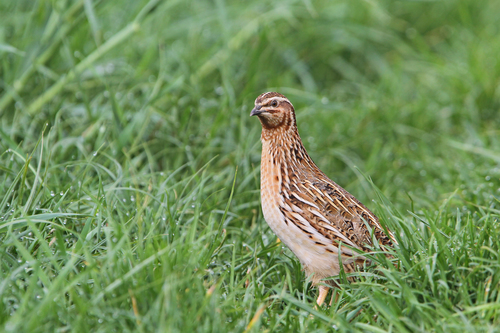 Common Quail
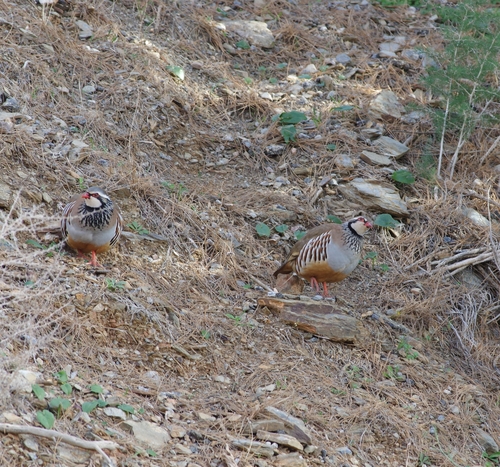 Red-legged Partridge
In short
The most reliable field mark to separate Common Quail from Red-legged Partridge is overall size and structure: Common Quail is a much smaller, compact, streaky brown bird with a short tail and long, pointed wings (adapted for migration), while Red-legged Partridge is larger, bulkier, and shows bold face and flank patterns with a red bill and legs. In flight, Common Quail appears small and fast with relatively long wings for its size, while Red-legged Partridge is heavier with broader wings and a more ponderous flight. Plumage is also key: Common Quail is cryptically streaked brown with a pale eyestripe and, in males, a white chin; Red-legged Partridge is sandy-brown above, pale below, and unmistakably patterned with a black-and-white face and bold rufous flank bars. Voice is very different: Common Quail gives a rapid, repeated three-note call, while Red-legged Partridge has a series of chattering, rolling notes.
Identification tips
- Size and shape: Red-legged Partridge is much larger and bulkier than Common Quail. If you see a chicken-sized bird, it is not a quail. Quail are sparrow-sized and compact.
- Face pattern: Red-legged Partridge has a striking face with a red bill, red eye-ring, black-and-white markings, and a bold black gorget bordering a creamy throat. Common Quail has a plain face with a pale eyestripe and, in males, a white chin, but never shows the partridge's dramatic facial pattern.
- Flank pattern: Look for the bold rufous and black bars on the flanks of Red-legged Partridge. Common Quail has plain, streaked brown flanks with no barring.
- Bill and legs: Red-legged Partridge has a bright red bill and pinkish-red legs, visible even at a distance. Common Quail's bill and legs are duller and less conspicuous.
- Upperparts: Common Quail is streaked brown above, blending into grassy backgrounds. Red-legged Partridge is sandy-brown and plain above, with no streaking.
- Flight style: Common Quail flies low and fast, with rapid wingbeats and a direct line, often dropping quickly into cover. Red-legged Partridge takes off noisily, flies with heavier wingbeats, and may glide before landing.
- Behavior: Quail are secretive, rarely seen in the open, and prefer to run or crouch when disturbed. Partridges are more confiding, often seen walking in the open or along tracks.
- Habitat: If you are in tall grass, meadows, or dense crops, think Quail; if in open farmland, heaths, or scrub with bare ground, Partridge is more likely.
- Vocalization: Learn the calls: Quail gives a rapid, repeated three-note whistle; Partridge gives a chattering, rolling call. They are not similar.
- Seasonality: Common Quail is migratory and may only be present in your area in spring/summer; Red-legged Partridge is resident in most of its range.
- Tail and wing shape: Quail has a short tail and long, pointed wings for its size (adapted for migration); Partridge has a longer tail and broader wings, with a heavier, less agile flight.
- Sex differences: Male Common Quail has a white chin, but this is subtle and not as obvious as the Partridge's facial pattern. Both sexes of Partridge show the bold face and flank patterns.
- Group size: Red-legged Partridge is often seen in pairs or small groups; Common Quail is usually solitary or in loose, hidden groups.
- Confusion risk: At a distance or in poor light, a flushed Quail might be mistaken for a small partridge, but the size, flight style, and lack of bold markings should quickly clarify the ID.
- Captive birds: Both species are kept in captivity, but wild sightings should always be judged in context—escaped gamebirds may appear in unexpected places.
Size
Common Quail is much smaller (16–18 cm length, 32–35 cm wingspan, 70–140 g) [wikipedia, avonet] than Red-legged Partridge, which is a robust, chicken-sized bird (noted as larger and bulkier, though precise measurements are not given in the notes). The Quail is compact and light, with a short tail and long wings for its size, while the Partridge is heavier, with a thick body, longer legs, and a proportionally larger head and bill. When seen together, the size difference is striking: Red-legged Partridge is roughly twice the length and several times the mass of Common Quail.
Plumage
- Juvenile/Immature flight: No specific juvenile or immature wing pattern is described for either species in the notes, so age-based flight marks are not diagnostic here.
- Adult plumage: Common Quail is streaked brown overall, with a white eyestripe and, in males, a white chin. Its plumage is cryptic and blends well with grass or stubble. Red-legged Partridge, by contrast, is boldly patterned: sandy-brown above, pale grey breast, pinkish-buff belly, cream throat bordered by a solid black gorget, and a face with a red bill, red eye-ring, and black-and-white markings. The flanks have prominent rufous and black bars. The upperparts are plain sandy-grey, and the tail is pinkish-rufous. These face and flank patterns are never shown by Common Quail.
Behaviour
Common Quail is secretive and rarely seen in the open, preferring to run or crouch rather than flush; it is most often detected by its distinctive call. When flushed, it flies low and fast, with rapid wingbeats and a direct, purposeful flight, quickly dropping back into cover. Red-legged Partridge is more likely to be seen walking in the open, often in small groups, and is less secretive. When flushed, it takes off with noisy wingbeats and a heavier, more labored flight, often gliding on outstretched wings before landing. The Partridge's behavior is more confiding, and it may even walk on tracks or open ground, unlike the elusive Quail.
Habitat
Common Quail favors open grasslands, meadows, and agricultural fields with plenty of cover, especially areas with tall grasses or crops where it can remain hidden. It is a migratory species, so presence is strongly seasonal. Red-legged Partridge prefers more open, dry farmland, heaths, and scrubby areas, often with bare ground or short vegetation. It is less dependent on dense cover and more likely to be seen in open country or along field margins. While both can occur in farmland, Red-legged Partridge is more tolerant of open, exposed habitats, and is often seen in places where Quail would remain hidden.
Voice
Common Quail is famous for its distinctive call: three short, repeated 'whit-whit-whit' notes, typically given in rapid succession and repeated several times. This call is often the only clue to its presence, as the bird is highly secretive. Red-legged Partridge has a completely different voice: a series of chattering, rolling, and sometimes accelerating notes, often described as 'churr-churr-churr' or 'karr-karr-karr', sometimes ending in a bubbling or laughing quality. The calls are not likely to be confused by ear.