

Common Pochard vs Greater Scaup
Aythya ferina versus Aythya marila
Play a quiz with Common Pochard and Greater Scaup
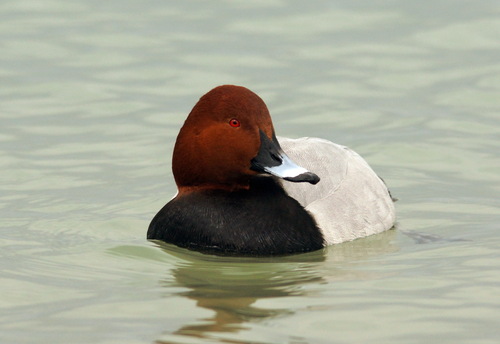 Common Pochard
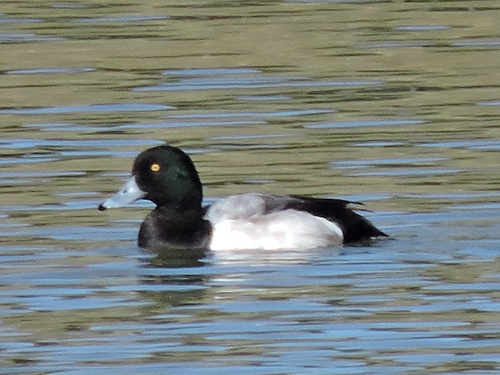 Greater Scaup
In short
The most reliable field mark to separate Common Pochard from Greater Scaup in all plumages is head and bill color: male pochards show a rich chestnut head with a dark bill and a blue-grey band, while male scaup have a dark, glossy greenish head and a pale blue bill. In flight, Greater Scaup of all ages show a strong white wing stripe extending from the speculum through the primaries to the wingtip; Common Pochard’s wing stripe is much less extensive and does not reach the primaries. Females and immatures are trickier, but scaup females have a distinctive white patch at the base of the bill and a more rounded head, while female pochards are plainer brown with a sloping forehead. Both are medium-sized diving ducks, but scaup are slightly bulkier and broader-billed. Careful attention to head shape, bill color, and wing pattern in flight will resolve most confusion, especially among non-breeding birds.
Identification tips
- White wing stripe in flight: Greater Scaup of all ages show a strong, broad white stripe extending from the speculum through the primaries to the wingtip. Common Pochard’s white stripe is limited to the secondaries and does not reach the primaries. This is the single best mark on flying birds, especially immatures and females.
- Head color (adult males): Male Common Pochard has a rich chestnut head and neck, while male Greater Scaup has a dark head with a greenish (sometimes purplish) gloss. In poor light, scaup’s head may look blackish, but never chestnut.
- Bill color and pattern: Male pochard has a dark grey bill with a broad blue-grey band across the middle; scaup has a pale blue bill with a small black nail at the tip. Female scaup’s bill is also blue-toned, while female pochard’s is duller and lacks the clear blue band.
- Female/juvenile face pattern: Female and juvenile Greater Scaup have a distinct white patch at the base of the bill, often oval or crescent-shaped. Female and juvenile Common Pochard lack this, showing a plain brown face.
- Head shape: Greater Scaup has a more rounded, high crown and steeper forehead, especially noticeable in males. Common Pochard has a sloping forehead and a more wedge-shaped head profile. This is visible in both perched and swimming birds.
- Eye color: Male pochard’s iris is yellow-orange to red (brightest in breeding season); female’s is brown. Scaup of both sexes have yellow eyes, though females may be duller. Juvenile pochard’s iris is yellow-olive, becoming adult color in first winter. Use with caution at distance.
- Body color (adult males): Male scaup’s flanks and belly are bright white, contrasting with the black breast and tail. Male pochard’s body is pale grey with fine vermiculations, not pure white.
- Tail and rear end: Both species have black tails, but scaup’s rear end often looks cleaner and more sharply defined against the white flanks.
- Leg and foot color: Both species have grey legs and feet; not useful for separation.
- Group size and context: In winter, scaup often form large, dense rafts on open water, especially at sea or on large lakes. Pochard is more likely to be in smaller groups on freshwater.
- Habitat: Scaup is more marine in winter, often on coastal bays and estuaries; pochard is almost always on freshwater.
- Eclipse and juvenile confusion: Male scaup in eclipse plumage can look duller but retain the white wing stripe and blue bill. Juvenile scaup resemble females but always show the white face patch and wing stripe. Juvenile pochard is plain brown with no strong face pattern.
- Pitfalls: In poor light, the head color of both species can look dark; rely on bill color and face pattern. Immature and female scaup can be confused with pochard, but the white face patch and wing stripe are reliable. Beware of hybrid Aythya ducks, which can show intermediate features.
- Bill size and shape: Scaup’s bill is broader and slightly longer, especially at the base, giving a more ‘broad-billed’ look compared to pochard’s narrower bill.
- Seasonal changes: Male pochard’s iris and head color are brightest in breeding season; scaup’s head gloss varies with light angle. Use multiple marks for best results.
Size
Greater Scaup is generally larger and heavier than Common Pochard, with a length of 39–56 cm and a wingspan of 71–84 cm, compared to the pochard’s 42–49 cm length and 72–82 cm wingspan [wikipedia][avonet]. Scaup averages about 20% heavier. However, there is overlap, and size alone is not diagnostic in the field unless birds are side by side. Both species are stocky, but scaup tends to look a bit broader and more robust, especially in the body and bill.
Plumage
-
Juvenile and female plumage: Female and juvenile Greater Scaup are brown with a clear white patch at the base of the bill and a white wing stripe in flight that extends through the primaries. Female and juvenile Common Pochard are plainer brown, lacking the white face patch, and have a less extensive white wing stripe that does not reach the primaries. Both have grey legs and feet.
-
Adult male plumage: Male Common Pochard has a rich chestnut head and neck, black breast and tail, and pale grey body with fine vermiculations. The bill is dark grey with a wide blue-grey band. Male Greater Scaup has a dark, glossy greenish (sometimes purplish) head, black breast, bright white belly and flanks, and a pale blue bill with a black nail. The scaup’s upperwing shows a strong white stripe from the speculum through the primaries, while the pochard’s is limited to the secondaries.
-
Iris color: Male pochard’s iris is yellow-orange to red (brightest in breeding season); female’s is brown. Scaup of both sexes have yellow eyes, though female’s may be duller. Juvenile pochard’s iris is yellow-olive, becoming adult color in first winter.
Behaviour
Both are diving ducks, often seen feeding by diving for aquatic plants and invertebrates. Greater Scaup often form very large, dense rafts on open water, sometimes numbering in the thousands, especially on coastal waters in winter. Common Pochard is more likely to be seen in smaller groups on freshwater lakes and slow rivers. Both species can be wary, but scaup are especially gregarious in winter.
Habitat
Greater Scaup favors large, open lakes and coastal bays, especially in winter, and is more likely to be found on saltwater or brackish habitats. Common Pochard prefers freshwater lakes, reservoirs, and slow-moving rivers, and is less likely to be found on open sea. Overlap occurs on large inland waters, but scaup is more marine in winter.