

Common Nightingale vs Common Redstart
Luscinia megarhynchos versus Phoenicurus phoenicurus
Play a quiz with Common Nightingale and Common Redstart
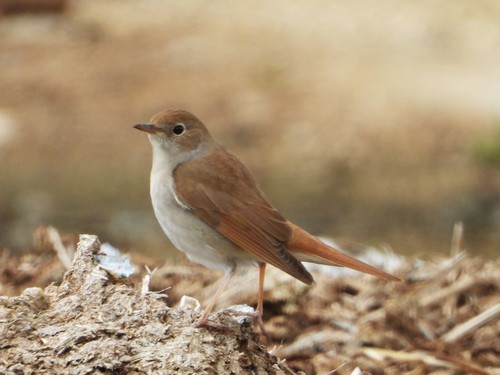 Common Nightingale
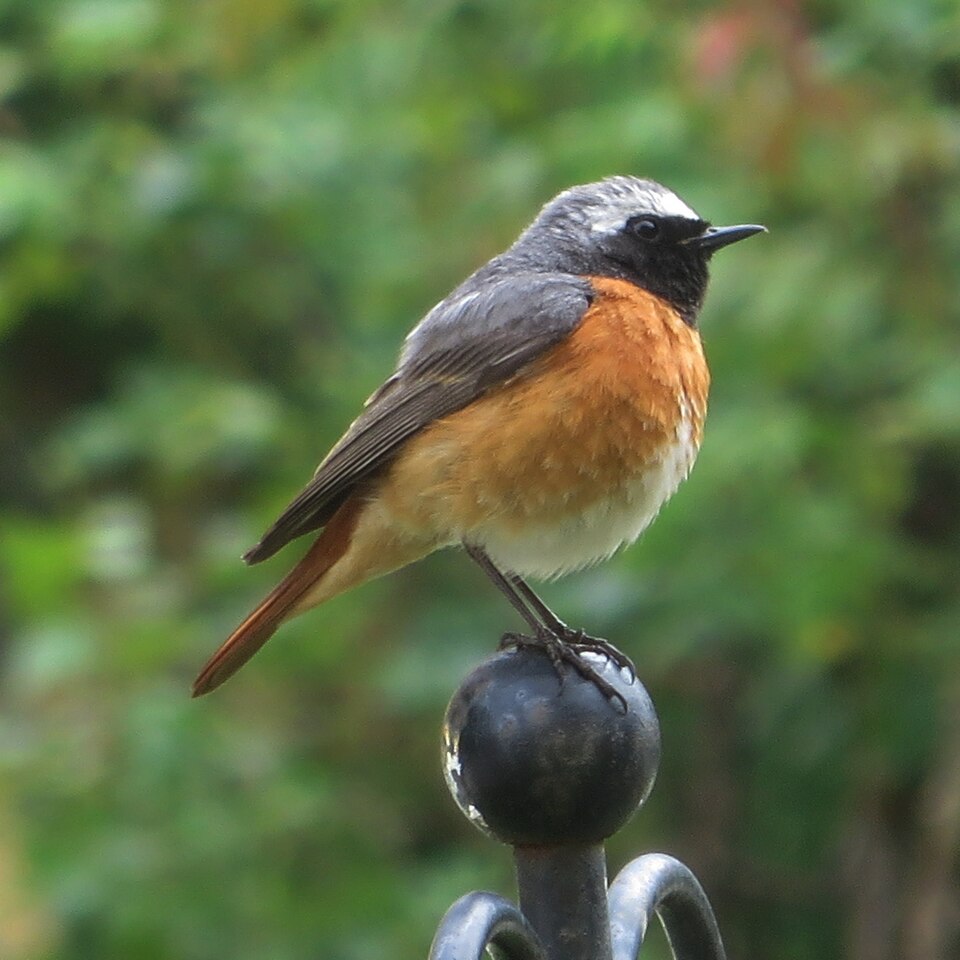 Common Redstart
In short
The most reliable field mark to separate Common Nightingale from Common Redstart is the presence of a bold pale wing patch in male (and some female) Redstarts, especially visible in flight or when perched with wings closed; Nightingales never show this. If you see a plain brown bird with a rufous tail and no wing panel, you likely have a Nightingale. Redstarts, especially adult males, are much more colorful overall, with a striking orange-red tail, contrasting slate-grey upperparts, and black face. Females and immatures of both species can be confusing, but the Redstart’s tail is brighter and more frequently quivered, and even drab Redstarts often show a hint of the pale wing panel. Nightingales are plain brown above and buff below, with no strong contrasts or wing marks.
Identification tips
- Look for a pale wing patch: Adult male Common Redstarts (especially the southeastern subspecies) show a prominent pale to whitish wing patch, visible in flight and often when perched. Some immature males and even some females show a faint version. Nightingales never show a wing patch at any age.
- Tail color and behavior: Both species have reddish tails, but the Redstart’s is brighter orange-red and is frequently quivered up and down. Nightingale tails are rufous but not as vivid, and tail quivering is rare.
- Overall coloration: Male Redstarts are strikingly colorful with a slate-grey head, white forehead, black face/throat, and orange flanks. Nightingales are plain brown above and buff to white below, with no strong contrasts.
- Facial pattern: Redstart males have a white forehead and black face. Nightingales have a plain face, though some eastern subspecies show a faint pale supercilium.
- Female/immature confusion: Female Redstarts are grey-brown above, often with a hint of a pale wing patch and sometimes a dark throat bib. Nightingale females are plainer, with no wing patch or bib.
- Underpart color: Redstarts show orange on the flanks and a paler belly; Nightingales are buff to white below, with little contrast.
- Bill and structure: Both species have similar slender bills, but Redstarts are slimmer and more upright in posture, while Nightingales are bulkier and more horizontal.
- Habitat context: Nightingales are almost always in dense, tangled vegetation; Redstarts are more likely in open woodland, parks, or gardens.
- Song: Nightingale song is loud, rich, and complex, often at night and from cover. Redstart song is softer, shorter, and more melancholy, usually from a visible perch.
- Call notes: Redstart calls are rising 'huid' or monosyllabic 'heed' notes, sometimes with ticking alarms. Nightingale calls are less distinctive and rarely heard compared to their song.
- Seasonal appearance: In autumn, male Redstarts may look duller but retain the orange tail and (in some) the pale wing patch. Nightingales remain plain.
- Jizz: Redstarts often perch upright and sally for insects; Nightingales skulk low in dense cover.
- Flight views: In flight, Redstarts may flash the pale wing panel (if present) and the bright tail; Nightingales show plain brown wings and a rufous tail.
- Range overlap: Both species can occur together in parts of Europe, but Nightingale is more southerly and tied to dense scrub, while Redstart is widespread in open woodlands.
- Pitfalls: Immature Redstarts lacking a clear wing patch can be confused with Nightingales, but look for the brighter tail, upright stance, and habitat. Nightingales never show a pale wing patch or strong face pattern.
Size
Both species are similar in length, but the Common Nightingale is slightly larger (15–16.5 cm) than the Common Redstart (13–14.5 cm) [wikipedia]. The Nightingale is also a bit heavier and bulkier, whereas the Redstart is slimmer and lighter [wikipedia][avonet]. In the field, this difference is subtle and rarely diagnostic unless both are seen side by side.
Plumage
- Juvenile/immature birds: The most diagnostic mark is the pale to whitish wing patch on the Common Redstart, present in adult males, some immature males, and occasionally females (especially in the southeastern subspecies). Nightingales of all ages lack any pale wing panel and are plain brown above with a reddish tail.
- Adult males (breeding): Redstart males are unmistakable with a slate-grey head and upperparts, white forehead, black face and throat, orange-chestnut tail and flanks, and a pale belly. The pale wing patch is prominent in the southeastern subspecies and visible in some nominate males. Nightingales are plain brown above, with a rufous tail and buff to white underparts, lacking any strong facial or wing contrasts.
- Females and non-breeding birds: Female Redstarts are grey-brown above, buff-white or light orange below, sometimes with a faint wing patch and occasionally a dark throat bib. Female Nightingales are plainer, uniformly brown above and buff below, with no wing patch or bib. Both sexes of Nightingale are similar. In autumn, male Redstarts may appear duller due to pale feather fringes, but the tail remains bright.
Behaviour
Redstarts often feed by making short sallies from a perch to catch insects, frequently quivering their orange-red tails, a behavior much less common in Nightingales. Nightingales are more terrestrial, moving through dense undergrowth, and are less likely to be seen flycatching in the open. Both species can be secretive, but Redstarts are more likely to perch in the open, especially males during the breeding season.
Habitat
Nightingales prefer dense scrub, thickets, and low woodland, often near water, and are rarely seen in open spaces. In the UK, they are most often found in lowland coppice and scrub habitats. Redstarts are more versatile, breeding in open woodlands, edges, parks, and gardens, often using nest boxes or tree holes. If you see a bird in dense, tangled undergrowth, Nightingale is more likely; in open woodland or parkland, Redstart is more likely.
Voice
The Nightingale is famous for its rich, powerful, and varied song, often delivered from deep cover and at night. Redstart song is softer, shorter, and more melancholy, with a distinctive three-part structure. Redstart calls are rising 'huid' or monosyllabic 'heed' notes, sometimes combined with ticking alarms, while Nightingale calls are less distinctive in the field. If you hear a remarkable, far-carrying, complex song from deep cover, suspect Nightingale; if the song is softer and the bird is visible, suspect Redstart.