

Motmot

Common Moorhen vs Western Swamphen

Gallinula chloropus versus Porphyrio porphyrio

Play a quiz with Common Moorhen and Western Swamphen

Common Moorhen (Gallinula chloropus) Common Moorhen
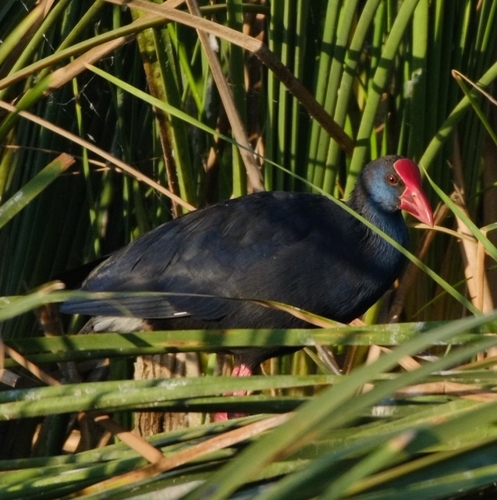
Western Swamphen (Porphyrio porphyrio) Western Swamphen

Media

Loading…

In short

The most reliable field mark to separate Common Moorhen from Western Swamphen is overall size and structure: swamphens are much larger, bulkier, and more vividly colored, with massive feet and a striking purple-blue sheen, while moorhens are smaller, slimmer, and darker with a white undertail and flanks. Both have red bills and frontal shields, but the swamphen's shield is proportionally larger and more prominent. Juvenile moorhens are duller and browner, lacking the red shield, while swamphens remain bright even as young birds. In flight, the swamphen appears heavy and slow with broad wings, whereas the moorhen is more agile and compact. If you see a chicken-sized, bright blue-purple bird with huge feet, it's a swamphen; a smaller, dark waterbird with white flanks and undertail is a moorhen.

Identification tips

  1. Size and bulk: Western Swamphen is much larger and heavier than Common Moorhen; if the bird looks chicken-sized or towers over ducks, it's a swamphen. Moorhen is only slightly larger than a coot.
  2. Feet and legs: Swamphens have massive, long, pinkish-red feet and legs, often held out behind in flight or used to grasp reeds. Moorhens have yellowish-green legs and much smaller feet.
  3. Plumage color: Adult swamphens are vivid blue to purple with a glossy sheen, while moorhens are dark brownish-black with a slight greenish or bluish cast, but never as bright or glossy.
  4. White highlights: Moorhens show bold white streaks on the flanks and a white undertail, which they often flick up. Swamphens lack these white markings entirely; their undertail is dark or only slightly paler.
  5. Bill and shield: Both have red bills and frontal shields, but the swamphen's is larger, more bulbous, and extends higher up the forehead. Moorhen's shield is smaller, rounded, and the bill tip is yellow.
  6. Juvenile plumage: Young moorhens are dull brown with no red shield, making them look even more different from the always-bright swamphen. Juvenile swamphens are still blueish, though a bit duller than adults.
  7. Flight silhouette: Swamphens look heavy and slow in flight, with broad wings and trailing legs; moorhens are more compact, with rapid wingbeats and a shorter-tailed look.
  8. Behavior: Moorhens are more secretive, often skulking or swimming in cover, and flick their tails frequently. Swamphens are bolder, walk upright, and are often seen climbing or feeding in the open.
  9. Habitat preference: If in a small urban pond or canal, it's almost certainly a moorhen; swamphens prefer larger, reed-filled wetlands or rice fields.
  10. Leg color: Moorhen legs are yellowish-green; swamphen legs are pink to reddish.
  11. Voice: Moorhen calls are more varied, including gargles and hisses; swamphen calls are deeper and less sharp.
  12. Association with other birds: Moorhens often mix with ducks and coots; swamphens are more likely to be seen alone or in small family groups.
  13. Geographic range: In most of Europe and Asia, only moorhen is present; swamphens are restricted to southwestern Europe and northwest Africa.
  14. Tail flicking: Moorhens constantly flick their tails, flashing white; swamphens rarely do this.
  15. Bill tip color: Moorhen has a yellow tip to the bill; swamphen's bill is all red.

Size

Size is a key difference: the Common Moorhen is a medium-sized rail, with an average body mass around 348 g [wikidata], while the Western Swamphen is much larger, described as 'chicken-sized' [wikipedia]. The swamphen's bulk, long legs, and especially its enormous feet are immediately obvious, making it look almost twice the size of a moorhen at a distance. Moorhens are noticeably slimmer and more compact, both on water and on land.

Plumage

Juvenile and immature Common Moorhens are browner overall and lack the adult's red frontal shield, making them look plainer and less contrasting than any age of Western Swamphen. Adult moorhens are mostly dark brownish-black with a white undertail, white streaks on the flanks, yellow legs, and a red bill with a yellow tip. The frontal shield is rounded and smooth-edged. In contrast, Western Swamphens of all ages show vivid blue to purple plumage, with a large, bright red bill and shield, and lack the moorhen's white flank streaks and undertail. Swamphens' plumage is much more saturated and glossy, and their legs are pinkish to reddish, not yellow. In flight, moorhens show a compact, dark profile with white undertail and flanks flashing; swamphens look bulkier, with broad wings and trailing legs, but do not show the same white highlights.

Behaviour

Moorhens are agile swimmers and walkers, often seen flicking their tails to show off the white undertail, and are more likely to be seen mixing with ducks or skulking in dense vegetation. Swamphens are less shy, often striding boldly in the open, using their huge feet to climb or grasp vegetation, and sometimes feeding in paddy fields. Swamphens appear heavier and less agile in flight, often reluctant to fly far, while moorhens flush more readily and fly with rapid wingbeats.

Habitat

Both species are found in well-vegetated wetlands, but Western Swamphen is more localized, mainly in southwestern Europe and northwest Africa, often in larger reedbeds or marshes, and sometimes in rice fields. Common Moorhen is much more widespread across Europe, Asia, and Africa, and is found in a wider range of wetland habitats, including smaller ponds, canals, and urban waterbodies. Where both occur, swamphens tend to dominate larger, more open marshes.

Voice

Common Moorhens give a wide range of gargling calls and loud hisses, especially when threatened [wikipedia]. Western Swamphens are also vocal, but their calls are deeper, more resonant, and less sharp than the moorhen's. In the field, call alone is rarely diagnostic, but the moorhen's repertoire is more varied and includes higher-pitched, rapid notes.

Submit a better description

Use the same sections as the comparison. Your text is published immediately.

The most reliable field mark to separate Common Moorhen from Western Swamphen is overall size and structure: swamphens are much larger, bulkier, and more vividly colored, with massive feet and a striking purple-blue sheen, while moorhens are smaller, slimmer, and darker with a white undertail and flanks. Both have red bills and frontal shields, but the swamphen's shield is proportionally larger and more prominent. Juvenile moorhens are duller and browner, lacking the red shield, while swamphens remain bright even as young birds. In flight, the swamphen appears heavy and slow with broad wings, whereas the moorhen is more agile and compact. If you see a chicken-sized, bright blue-purple bird with huge feet, it's a swamphen; a smaller, dark waterbird with white flanks and undertail is a moorhen.

  1. Size and bulk: Western Swamphen is much larger and heavier than Common Moorhen; if the bird looks chicken-sized or towers over ducks, it's a swamphen. Moorhen is only slightly larger than a coot.
  2. Feet and legs: Swamphens have massive, long, pinkish-red feet and legs, often held out behind in flight or used to grasp reeds. Moorhens have yellowish-green legs and much smaller feet.
  3. Plumage color: Adult swamphens are vivid blue to purple with a glossy sheen, while moorhens are dark brownish-black with a slight greenish or bluish cast, but never as bright or glossy.
  4. White highlights: Moorhens show bold white streaks on the flanks and a white undertail, which they often flick up. Swamphens lack these white markings entirely; their undertail is dark or only slightly paler.
  5. Bill and shield: Both have red bills and frontal shields, but the swamphen's is larger, more bulbous, and extends higher up the forehead. Moorhen's shield is smaller, rounded, and the bill tip is yellow.
  6. Juvenile plumage: Young moorhens are dull brown with no red shield, making them look even more different from the always-bright swamphen. Juvenile swamphens are still blueish, though a bit duller than adults.
  7. Flight silhouette: Swamphens look heavy and slow in flight, with broad wings and trailing legs; moorhens are more compact, with rapid wingbeats and a shorter-tailed look.
  8. Behavior: Moorhens are more secretive, often skulking or swimming in cover, and flick their tails frequently. Swamphens are bolder, walk upright, and are often seen climbing or feeding in the open.
  9. Habitat preference: If in a small urban pond or canal, it's almost certainly a moorhen; swamphens prefer larger, reed-filled wetlands or rice fields.
  10. Leg color: Moorhen legs are yellowish-green; swamphen legs are pink to reddish.
  11. Voice: Moorhen calls are more varied, including gargles and hisses; swamphen calls are deeper and less sharp.
  12. Association with other birds: Moorhens often mix with ducks and coots; swamphens are more likely to be seen alone or in small family groups.
  13. Geographic range: In most of Europe and Asia, only moorhen is present; swamphens are restricted to southwestern Europe and northwest Africa.
  14. Tail flicking: Moorhens constantly flick their tails, flashing white; swamphens rarely do this.
  15. Bill tip color: Moorhen has a yellow tip to the bill; swamphen's bill is all red.

Size is a key difference: the Common Moorhen is a medium-sized rail, with an average body mass around 348 g [wikidata], while the Western Swamphen is much larger, described as 'chicken-sized' [wikipedia]. The swamphen's bulk, long legs, and especially its enormous feet are immediately obvious, making it look almost twice the size of a moorhen at a distance. Moorhens are noticeably slimmer and more compact, both on water and on land.

Juvenile and immature Common Moorhens are browner overall and lack the adult's red frontal shield, making them look plainer and less contrasting than any age of Western Swamphen. Adult moorhens are mostly dark brownish-black with a white undertail, white streaks on the flanks, yellow legs, and a red bill with a yellow tip. The frontal shield is rounded and smooth-edged. In contrast, Western Swamphens of all ages show vivid blue to purple plumage, with a large, bright red bill and shield, and lack the moorhen's white flank streaks and undertail. Swamphens' plumage is much more saturated and glossy, and their legs are pinkish to reddish, not yellow. In flight, moorhens show a compact, dark profile with white undertail and flanks flashing; swamphens look bulkier, with broad wings and trailing legs, but do not show the same white highlights.

Moorhens are agile swimmers and walkers, often seen flicking their tails to show off the white undertail, and are more likely to be seen mixing with ducks or skulking in dense vegetation. Swamphens are less shy, often striding boldly in the open, using their huge feet to climb or grasp vegetation, and sometimes feeding in paddy fields. Swamphens appear heavier and less agile in flight, often reluctant to fly far, while moorhens flush more readily and fly with rapid wingbeats.

Both species are found in well-vegetated wetlands, but Western Swamphen is more localized, mainly in southwestern Europe and northwest Africa, often in larger reedbeds or marshes, and sometimes in rice fields. Common Moorhen is much more widespread across Europe, Asia, and Africa, and is found in a wider range of wetland habitats, including smaller ponds, canals, and urban waterbodies. Where both occur, swamphens tend to dominate larger, more open marshes.

Common Moorhens give a wide range of gargling calls and loud hisses, especially when threatened [wikipedia]. Western Swamphens are also vocal, but their calls are deeper, more resonant, and less sharp than the moorhen's. In the field, call alone is rarely diagnostic, but the moorhen's repertoire is more varied and includes higher-pitched, rapid notes.

Discard your changes?

You have unsaved edits. If you leave now, those changes will be lost.

Common Moorhen · Western Swamphen · My Tricky Birds