

Common Kestrel vs Peregrine Falcon
Falco tinnunculus versus Falco peregrinus
Play a quiz with Common Kestrel and Peregrine Falcon
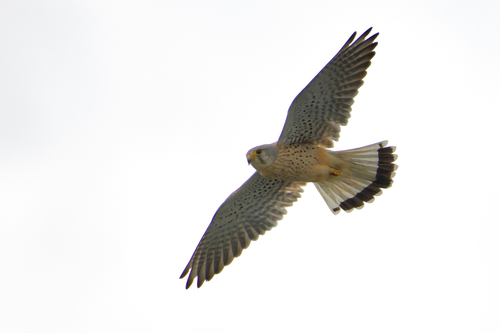 Common Kestrel
 Peregrine Falcon
In short
The most reliable field mark to separate Common Kestrel from Peregrine Falcon is overall plumage and structure: kestrels show a pale, heavily spotted or streaked brown appearance with a long tail and slim wings, while peregrines are bulkier, with a blue-grey back, bold black head, and strong dark barring below. Juvenile kestrels resemble adult females but are browner and streakier, whereas juvenile peregrines are darker and more heavily marked than adults. In flight, kestrels often hover with wings held in a shallow V, while peregrines use powerful, level wingbeats and rarely hover. Size is also a clue: peregrines are markedly larger and more robust than kestrels.
Identification tips
- Size and bulk: Peregrine Falcons are much larger and heavier than Common Kestrels. If the bird looks crow-sized and powerful, it's likely a peregrine; kestrels are noticeably smaller and slimmer.
- Tail shape and length: Kestrels have a long, narrow tail with black bars (female/juvenile) or blue-grey (male), often fanned in flight or when hovering. Peregrines have a shorter, more squared tail, never as long or as obviously barred as a kestrel's.
- Wing shape and flight style: Kestrels have long, narrow wings and often hold them in a shallow V when hovering. Peregrines have broader, more pointed wings, and their flight is strong, direct, and level; they rarely, if ever, hover.
- Hovering behavior: If you see a falcon hovering in place, it's almost certainly a kestrel. Peregrines do not hover in the typical kestrel fashion.
- Head pattern: Peregrines have a bold black "helmet" and thick moustachial stripe, giving the face a striking contrast. Kestrels have a paler head with a thinner black malar stripe and lack the full helmeted look.
- Back and upperparts color: Adult male kestrels have a blue-grey cap and tail, with chestnut brown upperparts and black spots. Females and juveniles are more uniformly brown. Peregrines are blue-grey above, never chestnut or spotted.
- Underparts: Kestrels are buff or pale with fine black streaks; peregrines are white with bold black barring (adults) or heavy streaking (juveniles). Kestrels never show the crisp barring of a peregrine.
- Bare parts color: Kestrels have bright yellow cere, feet, and eye-ring; peregrines also have yellow bare parts, but this is not a strong separator.
- Perched posture: Kestrels often appear slim and upright, with a long tail hanging down. Peregrines perch more horizontally, looking deep-chested and compact.
- Sexual dimorphism: Both species show size differences between sexes, but only kestrels show strong color differences (male blue-grey, female brown). Peregrines are similar in color between sexes.
- Juvenile confusion: Young kestrels resemble adult females but are streakier below; juvenile peregrines are darker and more heavily marked than adults, with a strong facial pattern already present.
- Habitat context: Kestrels are more likely in farmland, open country, and roadside settings; peregrines are more likely near cliffs or tall buildings, especially in cities.
- Hunting style: Kestrels hunt small mammals and insects, often from a hover; peregrines hunt birds in flight, using high-speed stoops.
- Tail barring: Kestrel tails (especially females and juveniles) show multiple black bars; peregrine tails are more uniform and less obviously barred.
- Facial expression: The peregrine's face looks fierce and bold due to the helmet and moustache; kestrels have a softer, less contrasting face.
Size
Common Kestrel is a small falcon, averaging around 184 g in body mass, with a length of 32–39 cm and a wingspan of 65–82 cm. Peregrine Falcon is significantly larger, described as crow-sized, with a noticeably heavier build and bulkier proportions. While exact mass for peregrine is not provided here, the difference is obvious in the field: peregrines appear much more powerful and deep-chested, with broader wings and a shorter, blunter tail compared to the kestrel's slim, long-tailed silhouette.
Plumage
-
Juvenile/immature plumage: Juvenile Common Kestrels look like adult females but with broader streaks below and paler yellow bare parts. Their upperparts are brown with blackish spots, and the tail is brown with black bars. Juvenile Peregrine Falcons are darker overall, with brownish upperparts and heavily streaked or barred underparts, and already show the strong facial pattern (dark helmet) typical of the species.
-
Adult plumage: Adult male kestrels have a blue-grey cap and tail, with a chestnut brown back and black spots; females and juveniles lack the blue-grey and are more uniformly brown. Both sexes have a clear black malar stripe. Peregrines of all ages have a blue-grey back, bold black head and moustachial stripe, and white underparts with strong black barring (adults) or streaking (juveniles). The peregrine's tail is shorter and more square-tipped, and the underparts are much cleaner white with crisp barring, never the buffy, streaked look of a kestrel.
Behaviour
Common Kestrel is famous for its hovering hunting style, often seen stationary in the air with rapid wingbeats and tail fanned, scanning for prey. Peregrine Falcon rarely hovers; instead, it hunts by high-speed stoops from altitude or fast, direct flight. Kestrels often perch on wires or posts in open country, while peregrines prefer high perches such as cliffs or tall buildings and are more likely to be seen flying high or chasing birds in open airspace.
Habitat
Both species can be found in a wide range of open habitats, but kestrels are more often seen in farmland, grassland, and urban edges, frequently hunting over fields and roadsides. Peregrines prefer open landscapes with cliffs or tall structures for nesting, and are especially common in cities where they use skyscrapers as substitute cliffs. Kestrels are more tolerant of close human presence and are often seen in suburban and rural settings, while peregrines are more specialized in their choice of nest sites.