

Common Kestrel vs Gyr Falcon
Falco tinnunculus versus Falco rusticolus
Play a quiz with Common Kestrel and Gyr Falcon
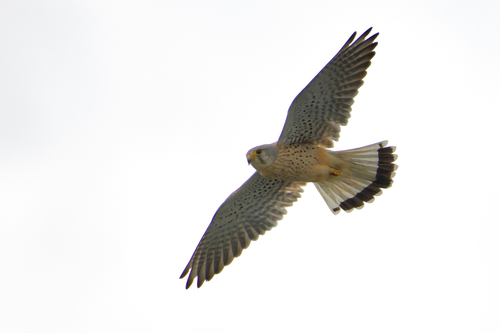 Common Kestrel
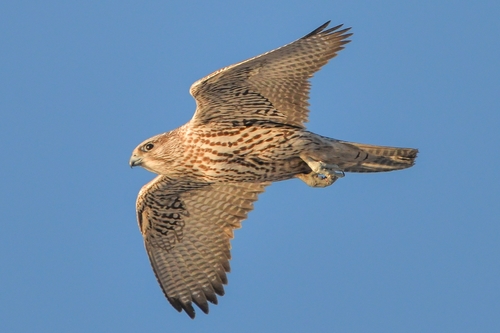 Gyr Falcon
In short
The most reliable way to separate Common Kestrel from Gyr Falcon is by size and structure: Gyr Falcon is vastly larger and bulkier, with a much broader wingspan, while Common Kestrel is a slim, small falcon with a long tail. In flight, Gyr Falcon appears powerful and heavy, whereas Common Kestrel is light and agile, often seen hovering. Plumage is also helpful: Common Kestrel is always warm brown above with black spots and a distinct black malar stripe, while Gyr Falcon is highly variable, ranging from nearly all white to dark brown or blackish, and lacks a strong malar stripe. Juvenile Common Kestrels resemble adult females, but Gyr Falcon juveniles are darker and browner than adults. If you see a falcon perched or in flight and are unsure, focus first on overall size and bulk, then check for the kestrel's long tail and warm brown tones versus the Gyr's massive build and variable, often paler or streaked plumage.
Identification tips
- Size is decisive: Gyr Falcon is massive, with a wingspan and bulk more like a buzzard or small eagle; Common Kestrel is slim and small, only slightly larger than a thrush. If the bird looks huge, it's not a kestrel.
- Structure in flight: Kestrel has long, narrow wings and a long tail, giving it a slim, agile look; Gyr Falcon is broad-winged, barrel-chested, and heavy-bodied, with a proportionally shorter tail.
- Hovering behavior: Common Kestrel frequently hovers in place while hunting; Gyr Falcon almost never hovers, instead using strong, direct flight.
- Tail shape and markings: Kestrel's tail is long, with multiple black bars and a black tip edged in white. Gyr Falcon's tail is longer than a peregrine's but not as long as kestrel's, and the pattern varies by morph but is never as cleanly barred or tipped as kestrel's.
- Facial pattern: Kestrel always shows a strong black malar stripe (mustache mark); Gyr Falcon lacks a well-defined malar stripe, especially in brown and white morphs.
- Plumage color: Kestrel is always warm chestnut brown above with black spots; Gyr Falcon is highly variable, from all white to dark brown/blackish, but never warm rufous.
- Juvenile differences: Juvenile kestrels look like adult females but with broader underside streaks; juvenile Gyr Falcons are darker and browner than adults but still lack the kestrel's warm tones and facial markings.
- Sexual dimorphism: Male kestrels have blue-grey caps and tails; Gyr Falcon shows no sex-based color differences, though black morphs are more common in females.
- Perching habits: Kestrel often perches on wires, posts, or buildings; Gyr Falcon prefers cliffs or large rocks, rarely using man-made structures.
- Habitat context: Kestrel is common in open country, farmland, and urban areas; Gyr Falcon is restricted to Arctic tundra and cliffs, rarely seen in settled areas.
- Relative abundance: In most of Europe and temperate Asia, any small falcon is almost certainly a kestrel; Gyr Falcon is extremely rare outside its Arctic range.
- Flight jizz: Kestrel's flight is buoyant and fluttery, often with hovering; Gyr Falcon is powerful, steady, and direct, rarely pausing in the air.
- Bare part color: Kestrel has bright yellow cere, eye ring, and feet; Gyr Falcon's bare parts are less conspicuous and vary with age and morph.
- Plumage variability: Gyr Falcon can be nearly all white (unique among falcons), silvery, brown, or blackish; kestrel never shows these extremes.
- Mistaken identity: If you see a large, pale falcon in the far north, consider Gyr Falcon; if you see a small, hovering, warm brown falcon in farmland or city, it's a kestrel.
Size
Size is the most striking difference. Common Kestrel is a small falcon, averaging around 184 g in mass, with a body length of 32–39 cm and a wingspan of 65–82 cm. Gyr Falcon is the largest falcon in the world: males are 48–61 cm long and 110–130 cm in wingspan (females even larger), with average masses over 1,100 g and up to 2,100 g or more. In the field, Gyr Falcon is closer in size to a large buzzard or small eagle, while Common Kestrel is only slightly bigger than a thrush and much more delicate. Even at a distance, Gyr Falcon's bulk and broad wings are obvious, while kestrel is slim and long-tailed.
Plumage
Juvenile and adult female Common Kestrels are warm chestnut brown above with blackish spots and streaks, buff below with narrow dark streaks, and always show a prominent black malar stripe. Males have a blue-grey cap and tail, but all ages and sexes show a long, barred tail with a black tip and narrow white rim. Juveniles have broader underside streaks and paler bare parts. Gyr Falcon plumage is highly variable: it can be nearly all white (white morph), pale silvery-grey (silver), brown, or blackish. Brown morphs have cream streaking on the nape and crown and lack a well-defined malar stripe. Black morphs have heavily spotted underparts. Juveniles are darker and browner than adults, but never show the warm chestnut tones or strong malar stripe of kestrel. Gyr Falcon never shows the combination of warm brown, black spotting, and distinct facial markings of kestrel. In flight, Gyr Falcon's upperparts are broad and often paler or streaked, while kestrel's are always rufous with black spots.
Behaviour
Common Kestrel is famous for its hovering flight, often seen stationary in the air while searching for prey. It is agile, with quick wingbeats and a tendency to perch on wires or posts. Gyr Falcon is a powerful, direct flier, rarely hovers, and typically hunts with strong, fast flight over open tundra or cliffs. Gyr Falcon perches on large rocks or cliffs and is much less likely to be seen hovering or using man-made perches. Socially, kestrels may nest in loose colonies, while Gyr Falcons are more solitary and territorial.
Habitat
Common Kestrel is widespread across Eurasia and Africa, found in open country, farmland, towns, and even city centers. It often nests on buildings or in tree holes. Gyr Falcon is a high-latitude species, breeding on Arctic tundra and cliffs in northern North America and Siberia, rarely venturing far south except as a vagrant. If you see a falcon in a city or farmland in temperate Europe, it is almost certainly a kestrel; Gyr Falcon is restricted to remote, open, northern landscapes and is very rare outside its breeding range.