
Common Kestrel vs Eurasian Hobby
Falco tinnunculus versus Falco subbuteo
Play a quiz with Common Kestrel and Eurasian Hobby
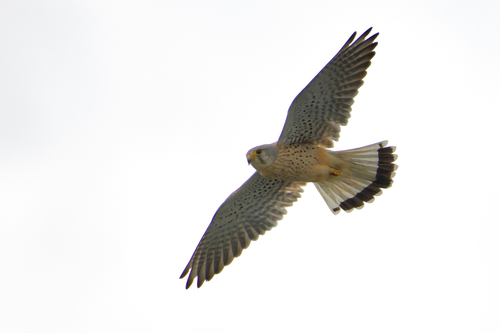 Common Kestrel
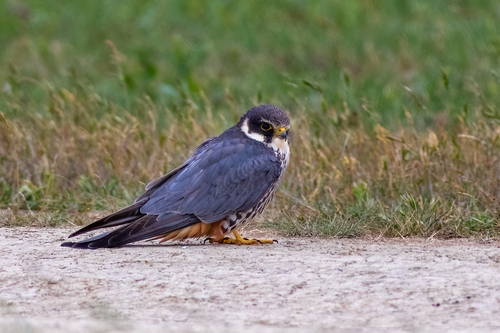 Eurasian Hobby
In short
The most reliable field mark between Common Kestrel and Eurasian Hobby is the Hobby's distinctive rufous-red 'trousers' (thighs and undertail coverts) and unstreaked white throat, which contrast with the Kestrel's streaked buff underparts and lack of rufous on the thighs. In flight, the Hobby appears sickle-winged and swift-like, while the Kestrel shows broader wings and a longer, more obviously barred tail. Juvenile Hobbies are browner above with streaked buffy thighs, but still show a different underpart pattern from juvenile Kestrels, which resemble adult females with heavy streaking below. Both species are similar in size, but the Hobby is slightly heavier and more streamlined. Perched, the Kestrel's upright posture and long tail differ from the Hobby's more horizontal stance and shorter, squarer tail.
Identification tips
- Rufous 'trousers' (thighs and undertail coverts): Adult Eurasian Hobby always shows rich rufous-red on the thighs and undertail coverts, visible both perched and in flight. Common Kestrel never shows this; its underparts are streaked buff or pale, with no rufous restricted to the thighs.
- Throat pattern: Hobby has a clean, unstreaked white throat, contrasting with its dark crown and moustache stripes. Kestrel's throat is buff with narrow blackish streaks, blending into the streaked underparts.
- Underpart streaking: Kestrel (all ages) shows heavy, narrow streaks on the buff underparts; Hobby's underparts are white with bold black streaks, but the effect is less dense and lacks the overall buff wash.
- Upperpart color: Adult Hobby is slate-grey above; Kestrel is light chestnut-brown with blackish spots. Juvenile Hobby is browner above but still lacks the Kestrel's chestnut tone and pattern of spots.
- Tail pattern and shape: Kestrel has a long tail with black bars (female/juvenile) or blue-grey with a black tip (male), always with a narrow white rim. Hobby's tail is shorter, squarer, and lacks strong barring; it appears more uniform grey or brownish in juveniles.
- Wing shape in flight: Hobby's wings are long, narrow, and pointed, giving a sickle or swift-like silhouette. Kestrel's wings are broader and less pointed, with a more rectangular profile.
- Flight style: Hobby is fast, agile, and often chases prey in open air, sometimes eating on the wing. Kestrel typically hovers or glides with steady wingbeats, rarely showing the same aerial agility.
- Perched posture: Kestrel sits upright with a long tail drooping below the perch. Hobby perches more horizontally, with a shorter, squarer tail.
- Facial pattern: Both have a dark moustache stripe, but Hobby's is shorter and paired with a dark crown, while Kestrel's is more prominent and isolated against a paler head (especially in males).
- Sexual dimorphism: Kestrel males have a blue-grey cap and tail, females and juveniles are browner. Hobby sexes are similar, making sex less useful for field ID.
- Bare parts color: Both have yellow cere and feet, but Kestrel's are brighter; juveniles of both have paler bare parts.
- Juvenile confusion: Juvenile Kestrels look like adult females but with heavier streaking below; juvenile Hobbies are browner above and have streaked buffy thighs, but always check for the rufous 'trousers' and cleaner throat in Hobby.
- Habitat context: Kestrel is more likely in urban areas and farmland, often seen hovering over fields; Hobby prefers open country with scattered trees and is more likely to be seen hunting flying insects or birds.
- Behavioral cues: Hovering almost always indicates Kestrel; aerial chases and eating on the wing point to Hobby.
- Size and jizz: Hobby is slightly heavier and more streamlined, but size overlap is considerable; rely on structure and plumage more than bulk.
Size
Both species are small falcons, but the Eurasian Hobby averages slightly heavier (211 g vs. 184 g for Kestrel adults [wikidata]). The Kestrel is marginally longer (32–39 cm vs. 29–36 cm) but has a slightly shorter wingspan (65–82 cm for Kestrel, 74–84 cm for Hobby [wikipedia]). In the field, the Hobby appears slimmer and more streamlined, with longer, narrower wings relative to its body, while the Kestrel looks bulkier and longer-tailed. Female Kestrels are noticeably larger than males, but sex differences in Hobby are minimal.
Plumage
Juvenile and immature birds are a common source of confusion. Juvenile Common Kestrels resemble adult females, with heavily streaked buff underparts, brown upperparts with blackish spots, and a barred brown tail. Their bare parts are a paler yellow. Juvenile Eurasian Hobbies are generally much browner above, with a scaled appearance, and have streaked buffy thighs and undertail coverts, but their underparts are less heavily streaked than Kestrels. Adult Hobbies are slate-grey above with a dark crown and two short black moustache stripes, a clean white throat, and striking rufous-red thighs and undertail coverts. Their underparts are white with bold black streaks but lack the overall buff tone of Kestrel. Adult male Kestrels have a blue-grey cap and tail, fewer black spots, and a prominent black malar stripe; females and juveniles lack the blue-grey and have more barring and streaking. The Kestrel's tail is longer, brown with black bars (female/juvenile) or blue-grey with a black subterminal band (male), always with a narrow white tip.
Behaviour
Common Kestrels are often seen hovering in place while hunting, a behavior rarely shown by Hobbies. Kestrels also perch upright on posts or wires, scanning for prey. Eurasian Hobbies are fast, agile fliers, frequently seen chasing insects or small birds on the wing, and often eat prey while flying. In flight, Hobbies appear swift-like, with long, pointed wings and rapid, agile movements. Kestrels have a steadier, more buoyant flight with broader wings and a longer tail, and rarely pursue prey in open air as acrobatically as Hobbies.
Habitat
Both species use open country, but the Common Kestrel is more often found in farmland, grassland, and urban areas, frequently nesting on buildings or cliffs. Eurasian Hobby prefers open lowlands with scattered woods, marshes, and taiga, and is less likely to be seen in dense urban settings. Hobbies are more associated with areas supporting large flying insects and small birds, while Kestrels focus on small mammals and are more tolerant of human-altered landscapes.