

Common Hoopoe vs Lesser Spotted Woodpecker
Upupa epops versus Dryobates minor
Play a quiz with Common Hoopoe and Lesser Spotted Woodpecker
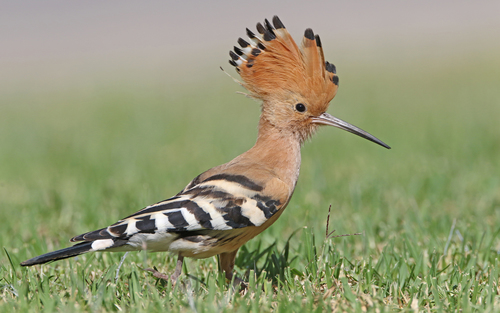 Common Hoopoe
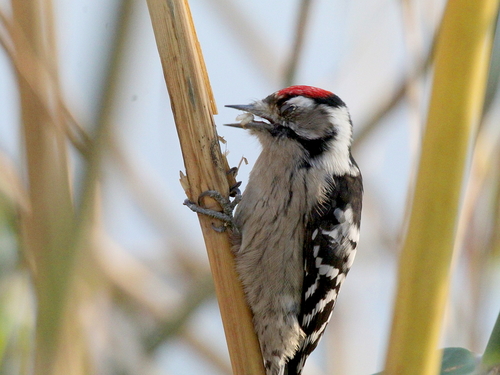 Lesser Spotted Woodpecker
In short
The most reliable field mark for separating Common Hoopoe from Lesser Spotted Woodpecker is the combination of the hoopoe’s long, slender, downcurved bill and bold black-and-white wings with a broad white tail band, versus the woodpecker’s short, straight bill and barred black-and-white upperparts. Juvenile and adult woodpeckers show strong black-and-white barring across the wings and back, while the hoopoe’s wings are boldly patterned but lack the fine barring. In flight, the hoopoe’s undulating, butterfly-like flight and prominent crest are distinctive, unlike the woodpecker’s bounding, stumpy appearance. Structural differences—especially bill shape and crest—are diagnostic at all ages and seasons. Both species are similar in overall color contrast, but their shapes, flight styles, and head patterns are unmistakably different.
Identification tips
- Bill shape: Hoopoe has a long, slender, downcurved bill; woodpecker’s bill is short, straight, and chisel-shaped. This is diagnostic at all ages and distances.
- Crest: Hoopoe shows a tall, erectile crest with black tips, often raised when excited or alarmed. Lesser Spotted Woodpecker lacks any crest or head plumes.
- Wing pattern in flight: Hoopoe’s wings are broad, rounded, and boldly patterned with large black and white patches; woodpecker’s wings are narrower with fine, regular black-and-white barring. Works for all ages.
- Tail pattern: Hoopoe has a black tail with a broad white band; woodpecker’s tail is barred, with the outer feathers showing black-and-white bars, never a single broad band.
- Upperparts: Hoopoe’s back and head are cinnamon/rufous and unmarked; woodpecker’s upperparts are black with white barring across the lower back and wings.
- Underparts: Hoopoe is warm cinnamon below; woodpecker is white with dark streaks on the flanks.
- Head pattern: Male woodpecker has a crimson crown, female has a white crown, both with black superciliary stripes; hoopoe’s head is plain cinnamon with a crest, lacking strong facial stripes.
- Flight style: Hoopoe flies with a distinctive, undulating, butterfly-like motion, wings half-closing at each beat; woodpecker flies in short, bounding arcs, appearing stumpy and compact.
- Perched posture: Hoopoe stands upright or slightly horizontal, often on the ground or open perches; woodpecker clings vertically to trunks or branches, rarely on the ground.
- Habitat: Hoopoe is usually seen in open areas, fields, or parkland; woodpecker is almost always in mature woodland or parks with old trees.
- Feeding behavior: Hoopoe probes soil or leaf litter with its bill; woodpecker chips at wood, often leaving chips at the base of trees.
- Voice: Hoopoe’s soft "oop-oop-oop" is very different from the woodpecker’s sharp "keek" and drumming. Listen for these calls in season.
- Size: Hoopoe is much larger and heavier; woodpecker is tiny and easily overlooked, especially high in trees.
- Juvenile confusion: Young woodpeckers may show some crimson on the head, but always retain the fine barring on back and wings; hoopoe juveniles look like adults but may have a less developed crest.
- Sex differences: Only male woodpecker has a crimson crown; hoopoe sexes are similar in the field.
Size
Common Hoopoe is significantly larger, measuring 25–32 cm in length with a 44–48 cm wingspan and weighing 46–89 g. In contrast, Lesser Spotted Woodpecker is much smaller: 14–16.5 cm long, 24–29 cm wingspan, and 17–25 g in weight. The hoopoe appears medium-sized and elongated, while the woodpecker is small and compact, often described as stumpy or almost triangular in profile. These size differences are obvious in direct comparison or with experience, but may be less apparent if seen singly at a distance.
Plumage
- Juvenile/immature woodpeckers (both sexes) show some crimson on the head, but always have strong black-and-white barring across the wings and back, and white underparts with flank streaks. The pattern is consistent across ages, with only the crown color shifting (crimson in males, white in females, variable in juveniles).
- Common Hoopoe of all ages shows bold black-and-white wings, but the pattern is broad and patchy, not finely barred. The cinnamon or rufous body and prominent erectile crest (with black tips) are present in adults and most immatures. The tail is black with a broad white band, unlike the woodpecker’s barred outer tail feathers.
- In flight, the hoopoe’s wings are broad and rounded with a striking, high-contrast pattern, while the woodpecker’s wings show narrower, more regular barring. The hoopoe’s upperparts are mostly plain cinnamon, never barred or streaked like the woodpecker.
- The woodpecker’s underparts are white with dark flank streaks; the hoopoe’s underparts are warm cinnamon, matching the head and back.
Behaviour
Common Hoopoe often feeds on the ground, probing with its long bill, and is frequently seen in open areas or perched conspicuously with crest raised. Its flight is undulating and butterfly-like, with wings half-closing at the end of each beat. Lesser Spotted Woodpecker is almost always found in trees, especially high in the canopy, and rarely comes to the ground. It moves with short, bounding flights from trunk to trunk, and is often overlooked due to its small size and preference for upper branches. The woodpecker frequently drums or chips at wood, leaving telltale chips at the base of trees.
Habitat
Common Hoopoe prefers open habitats such as grasslands, fields, orchards, and parkland, and is often seen on the ground or perched in open view. It nests in cavities but is not restricted to dense woodland. Lesser Spotted Woodpecker is a woodland specialist, favoring mature deciduous woods, parks, and gardens with old trees, especially where there are dead branches or decaying wood. It is rarely seen away from trees and is most often detected by its activity high in the canopy.
Voice
Common Hoopoe gives a soft, trisyllabic "oop-oop-oop" call, sometimes two or four notes, which is low-pitched and carries well. It also produces rasping croaks and hisses when alarmed. Lesser Spotted Woodpecker’s main call is a repeated, sharp "keek" and a vibrating rattle (drumming), which is loud for its size and can be distinguished from larger woodpecker species with experience. The hoopoe’s call is unique and unlikely to be confused with the woodpecker’s sharp, mechanical sounds.