

Common Hoopoe vs Belted Kingfisher
Upupa epops versus Megaceryle alcyon
Play a quiz with Common Hoopoe and Belted Kingfisher
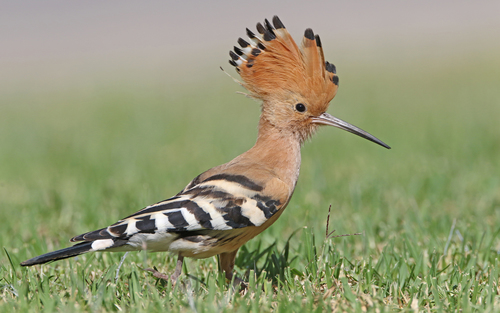 Common Hoopoe
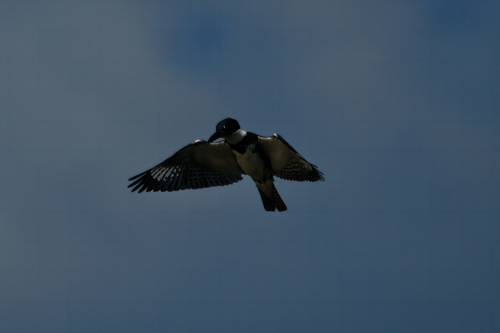 Belted Kingfisher
In short
The most reliable field mark is the overall color and pattern: Common Hoopoe is a cinnamon-buff bird with bold black-and-white wings and tail, plus a tall, fan-shaped crest, while Belted Kingfisher is slate-blue above with a shaggy crest, white underparts, and a blue breast band (plus a rufous belly band in females and all juveniles). In flight, Hoopoe shows broad, rounded wings with striking black-and-white barring and a distinctive undulating, butterfly-like flight; Kingfisher has straight, strong wingbeats and a more compact, stocky look. Bill shape is also key: Hoopoe has a long, slender, decurved bill, while Kingfisher’s bill is thick, straight, and dagger-like. Juvenile kingfishers always show a rufous belly band, which is never present on Hoopoe. Both species have crests, but Hoopoe’s is much taller and more dramatic. Voice and habitat are also very different: Hoopoe gives a soft 'oop-oop-oop' in open country, Kingfisher a loud rattle near water.
Identification tips
- Rufous belly band: Any bird with a rufous band across the upper belly (adult female or any juvenile Belted Kingfisher) is not a Hoopoe. Hoopoe never shows this mark at any age.
- Overall color: Hoopoe is cinnamon-buff with black-and-white wings and tail; Kingfisher is slate-blue above with white underparts and blue (plus rufous) breast bands.
- Crest shape: Hoopoe’s crest is tall, fan-shaped, and can be raised into a dramatic crown; Kingfisher’s is a shaggy, bushy crest, never as tall or neatly fanned.
- Bill shape: Hoopoe has a long, thin, strongly decurved bill; Kingfisher’s bill is thick, straight, and dagger-like, suited for catching fish.
- Wing pattern in flight: Hoopoe’s wings are broad, rounded, and show bold black-and-white barring, especially obvious in flight; Kingfisher’s wings are blue with black tips and small white spots, lacking bold bars.
- Tail pattern: Hoopoe has a broad white band across a black tail; Kingfisher’s tail is blue with white spots, lacking a bold white band.
- Flight style: Hoopoe flies with a distinctive undulating, butterfly-like motion, wings half-closing at the end of each beat; Kingfisher’s flight is direct, fast, and strong, with rapid wingbeats and occasional hovering.
- Habitat: Hoopoe is found in open fields, grasslands, and scattered trees, usually away from water; Kingfisher is almost always near water, perched above or diving into it.
- Voice: Hoopoe’s call is a soft 'oop-oop-oop'; Kingfisher gives a loud, rattling call. If you hear a dry rattle, it’s a kingfisher.
- Perched posture: Kingfisher perches upright, often on wires or branches over water; Hoopoe is more often seen on the ground or perched low, with a more horizontal stance.
- Sex and age: Only female and juvenile Belted Kingfishers show the rufous belly band; adult males lack it but still have the blue breast band. Hoopoe shows no sexual dimorphism in plumage.
- Bill color: Hoopoe’s bill is black with a fawn base; Kingfisher’s is black with a gray base, but this is subtle and rarely diagnostic at distance.
- Size and bulk: Kingfisher is heavier and stockier; Hoopoe is lighter, slimmer, and more elongated, especially in the bill and wings.
- Context: If the bird is seen diving for fish or hovering over water, it is a kingfisher; Hoopoe never behaves this way.
- Crest use: Hoopoe frequently raises and lowers its crest, especially when excited; Kingfisher’s crest is always somewhat shaggy but less expressive.
Size
Belted Kingfisher is noticeably heavier (adult mass ~147 g) and slightly longer (28–35 cm) with a broader wingspan (48–58 cm), compared to Common Hoopoe’s lighter build (46–89 g, 25–32 cm length, 44–48 cm wingspan) [wikidata]. Kingfisher appears stockier and more robust, while Hoopoe is lighter, slimmer, and more elongated, especially in the bill and wings.
Plumage
Juvenile and adult Belted Kingfishers of both sexes show a rufous band across the upper belly, which is always absent in Common Hoopoe. Juvenile male kingfishers have a mottled rufous band, juvenile females a thinner version of the adult female’s broad rufous band. Hoopoe of all ages is cinnamon-buff overall with bold black-and-white barring on the wings and tail, and never shows any blue or rufous belly band. Kingfisher is slate-blue above, with a large white collar, blue breast band, and (in females and juveniles) a rufous belly band. In flight, Hoopoe’s wings are broad, rounded, and strongly patterned black-and-white, while Kingfisher’s wings are blue with black tips and small white spots. Crest shape is also distinctive: Hoopoe’s is tall and fan-shaped, Kingfisher’s is shaggy and bushy. Bill color also differs: Hoopoe’s is long, thin, and black with a fawn base; Kingfisher’s is thick, straight, and black with a gray base.
Behaviour
Common Hoopoe often forages on the ground, probing with its long bill, and shows a unique undulating, butterfly-like flight with wings half-closing at the end of each beat. It is territorial and monogamous, with males calling frequently and sometimes engaging in aggressive fights. Belted Kingfisher is almost always seen near water, perching upright on branches or wires, and dives headfirst to catch fish. Its flight is direct and strong, with rapid wingbeats, and it often hovers briefly before plunging. Kingfisher’s jizz is compact and purposeful, while Hoopoe is more languid and erratic in movement.
Habitat
Common Hoopoe is found in open country, grasslands, and areas with scattered trees, often away from water. It nests in holes in trees or walls. Belted Kingfisher is tightly associated with water—rivers, lakes, ponds, and coasts—and is rarely seen far from aquatic habitats. If you see the bird perched over water or diving for fish, it is almost certainly a kingfisher.
Voice
Hoopoe gives a soft, trisyllabic 'oop-oop-oop' (sometimes two or four notes), which is low and mellow. Other calls include rasping croaks and hisses when alarmed. Belted Kingfisher gives a loud, dry, rattling call, very different from the Hoopoe’s soft notes. Voice is a strong separator, especially when the bird is not in view.