
Common Greenshank vs Ruff
Tringa nebularia versus Calidris pugnax
Play a quiz with Common Greenshank and Ruff
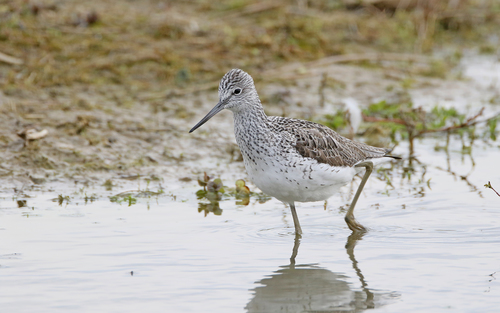 Common Greenshank
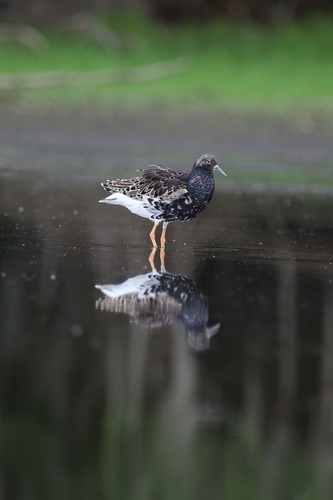 Ruff
In short
The most reliable field mark to separate Common Greenshank from Ruff is the bill: Greenshank has a long, slightly upturned bill with a grey base, while Ruff shows a shorter, straight, and finer bill. In flight, Greenshank reveals a bold white wedge up the back, whereas Ruff shows only a thin, indistinct white wing bar and white ovals at the tail sides. Structurally, Greenshank is larger, longer-legged, and less pot-bellied than Ruff, which appears round-bellied and small-headed. Juvenile and non-breeding plumages can be confusing, but Greenshank’s greenish legs and upturned bill remain distinctive, while Ruff’s scaly-patterned upperparts and variable leg color (often orange or pink in adults) are key. Both species may be found in similar wetland habitats, but their shape and flight patterns are notably different.
Identification tips
- Bill shape: Greenshank has a long, slightly upturned bill with a grey base; Ruff’s bill is shorter, straight, and finer. This is the single most reliable mark at any age or season.
- Flight pattern: In all ages, Greenshank shows a bold white wedge up the back in flight, while Ruff only shows a thin, indistinct white wing bar and white ovals at the tail sides. Use this when birds flush or fly past.
- Leg color: Greenshank’s legs are always greenish. Ruff’s legs are variable: dark greenish in juveniles, pink to orange in adults, and sometimes reddish-orange in breeding males. Leg color alone can be misleading, but greenish legs in a large wader suggest Greenshank.
- Body shape: Greenshank is taller, longer-legged, and more slender. Ruff is pot-bellied, with a small head and a rounder, heavier body. This is especially noticeable when both species are together.
- Head and neck: Greenshank has a proportionally larger head and longer neck. Ruff’s head is small and round, neck is long but often appears hunched.
- Plumage (juvenile/non-breeding): Juvenile Ruff has a neat, scaly upperpart pattern with dark feather centers and buffy underparts. Greenshank juveniles are plainer, grey-brown above, lacking the scaly look.
- Plumage (breeding): Male Ruff in breeding plumage is unmistakable with ornate ruffs and tufts, but female and non-breeding Ruff can be confused with Greenshank. Look for the bill and leg color to separate them.
- Breast pattern: Greenshank in breeding plumage shows a coarse, dark, crisp breast pattern and black on shoulders/back. Ruff females and non-breeding birds have variable black blotching, but not as crisp or extensive.
- Foraging behavior: Greenshank often feeds alone or in small groups, wading deeper and moving with steady, purposeful steps. Ruff is usually in flocks, feeding in shallower water or wet meadows.
- Flight style: Greenshank has a more direct, purposeful flight; Ruff’s wingbeats are deeper and slower, and the bird appears heavier in the air.
- Voice: If you hear a rapid, fluty 'teu-teu-teu,' it is Greenshank. Ruff’s call is not described here, so absence of this call is not diagnostic.
- Context: Large flocks in open wet meadows are more likely Ruff; single, tall birds in deeper water are more likely Greenshank.
- Sexual dimorphism: Only Ruff shows strong sexual dimorphism (ornate males, plain females); Greenshank sexes are similar.
- Pitfalls: Non-breeding and juvenile Ruffs can look very plain and may be mistaken for Greenshank, especially at a distance. Always check bill shape and flight pattern.
- When in doubt: Wait for flight views to see the white wedge (Greenshank) or check for the pot-bellied, small-headed jizz (Ruff).
Size
Adult Common Greenshank is noticeably heavier (173 g vs. 136 g for Ruff) and appears larger and longer-legged in the field. Greenshank is also more robust and stands taller, while Ruff is pot-bellied, shorter-necked, and has a smaller head. Female Ruffs (reeves) are smaller than males, but even the largest female Ruff is generally lighter and more compact than Greenshank. When seen together, Greenshank’s size and elongated proportions stand out against the more rounded, squat appearance of Ruff.
Plumage
- Juvenile and non-breeding plumage: Ruff juveniles have neat, scale-like patterned upperparts with dark feather centers and a strong buff tinge to the underparts. Greenshank juveniles and non-breeding birds are grey-brown above and lack the scaly pattern, appearing plainer overall.
- In flight: Greenshank of all ages shows a bold white wedge up the back, which is diagnostic. Ruff in flight shows a thin, indistinct white wing bar and white ovals on the tail sides, but lacks the bold white wedge.
- Breeding plumage: Greenshank is brown above with a coarse, dark, crisp breast pattern and much black on the shoulders and back. Ruff males in breeding plumage are highly variable and ornate, with colored ruffs and tufts, but females and non-breeding birds are more subdued, with grey-brown upperparts and variable black blotching on the breast and flanks.
- Leg color: Greenshank has long, greenish legs year-round. Ruff’s leg color is variable: dark greenish in juveniles, pink to orange in adults, and sometimes reddish-orange in breeding males.
Behaviour
Greenshank typically forages alone or in small groups, moving with deliberate, steady steps and often wading in deeper water. Its feeding style is active, probing with its long bill and sometimes chasing prey. Ruff is highly gregarious, especially outside the breeding season, often forming large flocks. Ruffs have a pot-bellied, upright stance and a slower, deeper wingbeat in flight compared to Greenshank’s more direct, purposeful flight. During the breeding season, male Ruffs display elaborate courtship behavior with ornate plumage, but this is not seen in Greenshank.
Habitat
Both species use marshes, wet meadows, and shallow wetlands, but Ruff is more likely to be seen in large, dense flocks, especially on migration or wintering grounds. Greenshank prefers more open, sometimes deeper water and is less gregarious. If you see a single, tall, green-legged wader in deeper water, it is more likely to be a Greenshank; a tight flock of round-bellied, variable-legged birds in shallow water or wet meadows may be Ruff.
Voice
Greenshank’s call is a rapid series of three short, fluty notes, syllabized as 'teu-teu-teu.' Ruff’s vocalizations are not described in the provided notes, so voice is only a reliable separator if you hear the Greenshank’s distinctive call.