

Common Greenshank vs Red Knot
Tringa nebularia versus Calidris canutus
Play a quiz with Common Greenshank and Red Knot
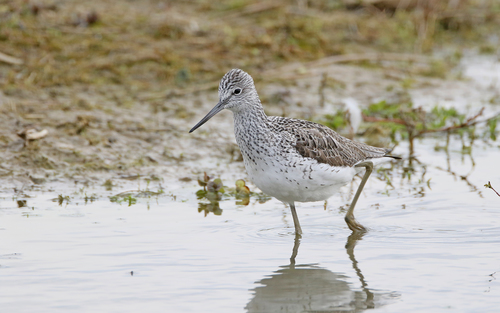 Common Greenshank
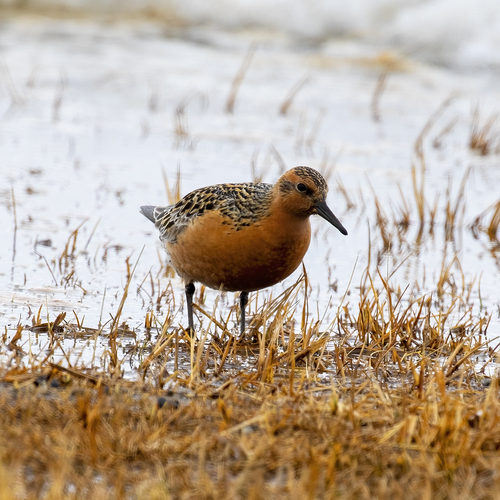 Red Knot
In short
The most reliable way to separate Common Greenshank from Red Knot is by structure: Greenshank has a distinctly longer, slightly upturned bill and long greenish legs, while Red Knot is compact with a short, straight, dark bill and short dark legs. In flight, Greenshank shows a white wedge up the back, whereas Red Knot has a white wing bar and grey rump/tail. Juvenile Red Knots have brownish coverts with submarginal lines, a feature not seen in Greenshank. Both species can appear greyish in non-breeding plumage, so focus on bill, leg color, and flight pattern for the quickest field separation.
Identification tips
- Bill shape and length: Greenshank has a long, slightly upturned bill with a grey base; Red Knot's bill is short, straight, and dark. This is the most consistent field mark at all ages and seasons.
- Leg color and length: Greenshank's legs are long and greenish, making it look tall and elegant; Red Knot's legs are short and dark, giving a squat, low-slung look when feeding.
- Flight pattern: In flight, Greenshank shows a white wedge up the back (all ages), while Red Knot has a bold white wing bar and a grey rump/tail. Use this especially when birds flush or fly past.
- Juvenile/first-year plumage: Juvenile Red Knots have brown coverts with submarginal lines and a scaly look to the upperparts. Greenshank juveniles lack this, appearing plainer above.
- Breeding plumage: Red Knot in breeding dress is unmistakable with rufous underparts and mottled grey above; Greenshank is brown above with a coarsely marked breast but never rufous below.
- Non-breeding (winter) plumage: Both are pale grey above, but Greenshank is often browner or greyer, and structural differences (bill, legs) remain key.
- Size and jizz: Greenshank is larger, longer-necked, and stands taller; Red Knot is compact, round-bodied, and appears heavier relative to its leg length.
- Feeding behavior: Greenshank often wades in deeper water, sometimes running or chasing prey; Red Knot feeds by probing or picking, usually in tight flocks on mudflats.
- Habitat: Greenshank is more likely at freshwater or brackish wetlands; Red Knot is almost always coastal on migration and wintering grounds.
- Voice: Greenshank's 'teu-teu-teu' is distinctive and often given in flight; Red Knot's calls are softer, more limited to flocks in flight.
- Bill base color: Greenshank's bill base is grey, sometimes paler; Red Knot's bill is uniformly dark.
- Leg length in flight: Greenshank's long legs project well beyond the tail in flight; Red Knot's short legs barely extend past the tail.
- Group size: Red Knot is often in large, dense flocks; Greenshank is more solitary or in small groups.
- Posture: Greenshank stands upright and alert; Red Knot is hunched and low to the ground when feeding.
- Pitfalls: In dull light or at a distance, both can look grey and similar in size, but bill and leg structure will still separate them if seen well.
Size
Common Greenshank is noticeably larger and heavier (body mass ~173g) than Red Knot (~137g) [wikidata]. Greenshank is also longer-legged and longer-billed, giving it a lanky appearance, while Red Knot is more compact and 'low-slung' due to its short legs and neck. In direct comparison, Greenshank stands taller and appears more elongated, especially when wading or walking.
Plumage
Juvenile Red Knots show distinctive brown coverts with submarginal lines in their first year, which is not present in Greenshank. In flight, Greenshank of all ages displays a white wedge up the back, while Red Knot shows a prominent white wing bar and a grey rump and tail. In non-breeding (winter) plumage, both species become pale grey above, but Greenshank retains a slightly browner or greyer cast, while Red Knot is more uniformly pale grey. Breeding Red Knots are unmistakable with their cinnamon face, throat, and breast, but this is absent outside the breeding season. Greenshank in breeding plumage is brown above with a coarsely marked breast, while Red Knot is mottled grey above with rich rufous below. Leg color is a consistent separator: Greenshank's legs are greenish, Red Knot's are short and dark.
Behaviour
Greenshank often feeds in deeper water, wading actively with long strides, and may be seen chasing small fish or amphibians, sometimes probing with its slightly upturned bill. Red Knot usually feeds by probing or picking on mudflats, often in tight flocks, using a rapid, low-slung gait. Greenshank is more solitary or loosely associated, while Red Knots are gregarious, especially on migration and wintering grounds.
Habitat
Common Greenshank favors marshes, muddy margins, and shallow wetlands, often in freshwater or brackish habitats. Red Knot is most often found on coastal mudflats, estuaries, and sandy shores, especially during migration and winter. While both can be seen on migration, Greenshank is more likely inland or at freshwater sites, whereas Red Knot is almost exclusively coastal outside the breeding season.
Voice
Greenshank gives a distinctive rapid series of three fluty notes, 'teu-teu-teu', often when flushed or in flight. Red Knot is generally quiet when foraging singly, but in flight flocks gives a low monosyllabic 'knutt' or disyllabic 'knuup-knuup'. The Greenshank's call is more ringing and carries farther; Red Knot's is softer and less distinctive.