

Motmot

Common Goldeneye vs Red-breasted Merganser

Bucephala clangula versus Mergus serrator

Play a quiz with Common Goldeneye and Red-breasted Merganser

Common Goldeneye (Bucephala clangula) Common Goldeneye
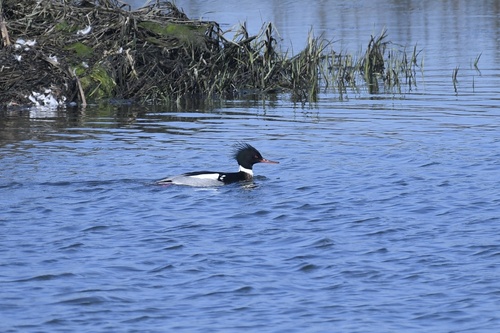
Red-breasted Merganser (Mergus serrator) Red-breasted Merganser

Media

Loading…

In short

The most reliable field mark between Common Goldeneye and Red-breasted Merganser is the bill: goldeneye has a short, neat, dark bill, while merganser shows a long, thin, red bill with a spiky crest. In flight or at rest, goldeneye is compact and round-headed, while merganser is longer, slimmer, and more ragged, especially around the head. Adult males are easily separated by the goldeneye’s white face spot and the merganser’s rusty breast and long bill, but females and immatures are trickier, with both showing brownish heads and grayish bodies. Focus on bill shape, head structure, and overall jizz, especially for non-breeding or young birds.

Identification tips

  1. Bill shape is key: Goldeneye has a short, neat, dark bill; Red-breasted Merganser has a long, thin, red bill with a slightly hooked tip and visible serrations (best at close range). This is reliable for all ages and sexes.
  2. Head shape and crest: Goldeneye shows a rounded, smooth head with no crest; Merganser has a spiky, ragged crest, especially obvious in females and immatures. Use this in all plumages, but especially for females/immatures.
  3. Face pattern in adult males: Male goldeneye has a bright white circular spot below the eye on a dark green-glossed head; male merganser lacks this spot and instead has a rusty breast and a white neck. This is diagnostic in breeding males.
  4. Female/immature head color and contrast: Female goldeneye has a chocolate-brown head with a sharp line to the gray body; female merganser’s head is rusty and blends more gradually into the body, with less sharp contrast.
  5. Leg color (when visible): Goldeneye females have orange-yellow legs and feet, which can be seen when perched or taking off; merganser’s leg color is not distinctive in the field.
  6. Body shape and posture: Goldeneye is compact, bull-headed, and sits high on the water; merganser is longer, slimmer, and sits lower, with a more elongated neck and body.
  7. Flight jizz: Goldeneye appears compact and fast, with rapid wingbeats and a short neck; merganser is longer, more pointed, with a thinner neck and a more streamlined look.
  8. Juvenile confusion: Juvenile mergansers look like females but with a shorter crest and smaller white wing patches; goldeneye juveniles resemble females but are always compact and round-headed. Use bill and head shape for separation.
  9. Habitat context: If seen on open saltwater, especially in winter, merganser is more likely; goldeneye prefers freshwater but can occur on sheltered coasts. Not diagnostic alone.
  10. Courtship behavior: Merganser males may show elaborate neck-stretching and crest-fanning displays in late winter/spring; goldeneye courtship is less conspicuous and not usually a field mark.
  11. Plumage pitfalls: Both species’ females and immatures are gray-bodied with brownish heads, but only goldeneye has a neat, round head and short bill; merganser always looks shaggier and longer-billed.
  12. Size: Merganser is larger and longer-bodied, but this is subtle unless both species are side by side.
  13. No unique wing pattern: Neither species has a distinctive upperwing pattern for quick separation in flight; rely on structure and head/bill shape.
  14. Voice: Not a reliable field mark for separation based on available sources.
  15. When in doubt: Focus on bill length/shape and head structure, especially for females and immatures—these are the most consistent differences year-round.

Size

Red-breasted Merganser is distinctly larger and heavier than Common Goldeneye. Merganser averages about 1020 g, with a length of 51–64 cm and a wingspan of 66–74 cm. Goldeneye is smaller and more compact, averaging 900 g, with a length of 40–51 cm and a wingspan of 77–83 cm. Despite the slightly longer wingspan of goldeneye, merganser’s longer body and neck make it appear much lankier and larger in the field. This size difference is most obvious when the two species are side by side, but can be subtle at a distance.

Plumage

Juvenile and female plumages are the most challenging. Both species show brownish heads and grayish bodies, but goldeneye females and immatures have a more uniform, rounded head and a neat, compact look, while mergansers have a scruffier, spiky crest and a longer, thinner head and neck. In flight, neither species has a unique upperwing pattern described in the sources, so focus on structure and head/bill shape. Adult male goldeneye is unmistakable with a dark green-glossed head and a round white spot below the eye, while male merganser has a green head, spiky crest, white neck, and rusty breast. Female goldeneye has a chocolate-brown head with a sharply demarcated gray body, orange-yellow legs, and a short bill; female merganser has a rusty head, less contrast with the body, a long thin red bill, and a shaggier crest. Juvenile mergansers resemble females but with a shorter crest and smaller white wing patches (not diagnostic against goldeneye).

Behaviour

Both species dive for food, but merganser is more specialized for catching fish, using its serrated bill. Goldeneye dives for aquatic invertebrates and small fish, and often appears more buoyant and compact on the water. Merganser’s courtship display is elaborate and involves neck-stretching and crest-fanning, but this is rarely seen outside the breeding season. In flight, goldeneye is fast and direct, with rapid wingbeats and a compact profile; merganser is swift but appears longer, with a more pointed, streamlined silhouette.

Habitat

Both species can overlap in winter, especially in coastal or estuarine waters. Red-breasted Merganser is much more likely to be found on saltwater, especially in winter, while Common Goldeneye is more often seen on freshwater lakes and rivers but also occurs in sheltered coastal areas. Habitat alone is not diagnostic but can support identification when combined with other marks.

Submit a better description

Use the same sections as the comparison. Your text is published immediately.

The most reliable field mark between Common Goldeneye and Red-breasted Merganser is the bill: goldeneye has a short, neat, dark bill, while merganser shows a long, thin, red bill with a spiky crest. In flight or at rest, goldeneye is compact and round-headed, while merganser is longer, slimmer, and more ragged, especially around the head. Adult males are easily separated by the goldeneye’s white face spot and the merganser’s rusty breast and long bill, but females and immatures are trickier, with both showing brownish heads and grayish bodies. Focus on bill shape, head structure, and overall jizz, especially for non-breeding or young birds.

  1. Bill shape is key: Goldeneye has a short, neat, dark bill; Red-breasted Merganser has a long, thin, red bill with a slightly hooked tip and visible serrations (best at close range). This is reliable for all ages and sexes.
  2. Head shape and crest: Goldeneye shows a rounded, smooth head with no crest; Merganser has a spiky, ragged crest, especially obvious in females and immatures. Use this in all plumages, but especially for females/immatures.
  3. Face pattern in adult males: Male goldeneye has a bright white circular spot below the eye on a dark green-glossed head; male merganser lacks this spot and instead has a rusty breast and a white neck. This is diagnostic in breeding males.
  4. Female/immature head color and contrast: Female goldeneye has a chocolate-brown head with a sharp line to the gray body; female merganser’s head is rusty and blends more gradually into the body, with less sharp contrast.
  5. Leg color (when visible): Goldeneye females have orange-yellow legs and feet, which can be seen when perched or taking off; merganser’s leg color is not distinctive in the field.
  6. Body shape and posture: Goldeneye is compact, bull-headed, and sits high on the water; merganser is longer, slimmer, and sits lower, with a more elongated neck and body.
  7. Flight jizz: Goldeneye appears compact and fast, with rapid wingbeats and a short neck; merganser is longer, more pointed, with a thinner neck and a more streamlined look.
  8. Juvenile confusion: Juvenile mergansers look like females but with a shorter crest and smaller white wing patches; goldeneye juveniles resemble females but are always compact and round-headed. Use bill and head shape for separation.
  9. Habitat context: If seen on open saltwater, especially in winter, merganser is more likely; goldeneye prefers freshwater but can occur on sheltered coasts. Not diagnostic alone.
  10. Courtship behavior: Merganser males may show elaborate neck-stretching and crest-fanning displays in late winter/spring; goldeneye courtship is less conspicuous and not usually a field mark.
  11. Plumage pitfalls: Both species’ females and immatures are gray-bodied with brownish heads, but only goldeneye has a neat, round head and short bill; merganser always looks shaggier and longer-billed.
  12. Size: Merganser is larger and longer-bodied, but this is subtle unless both species are side by side.
  13. No unique wing pattern: Neither species has a distinctive upperwing pattern for quick separation in flight; rely on structure and head/bill shape.
  14. Voice: Not a reliable field mark for separation based on available sources.
  15. When in doubt: Focus on bill length/shape and head structure, especially for females and immatures—these are the most consistent differences year-round.

Red-breasted Merganser is distinctly larger and heavier than Common Goldeneye. Merganser averages about 1020 g, with a length of 51–64 cm and a wingspan of 66–74 cm. Goldeneye is smaller and more compact, averaging 900 g, with a length of 40–51 cm and a wingspan of 77–83 cm. Despite the slightly longer wingspan of goldeneye, merganser’s longer body and neck make it appear much lankier and larger in the field. This size difference is most obvious when the two species are side by side, but can be subtle at a distance.

Juvenile and female plumages are the most challenging. Both species show brownish heads and grayish bodies, but goldeneye females and immatures have a more uniform, rounded head and a neat, compact look, while mergansers have a scruffier, spiky crest and a longer, thinner head and neck. In flight, neither species has a unique upperwing pattern described in the sources, so focus on structure and head/bill shape. Adult male goldeneye is unmistakable with a dark green-glossed head and a round white spot below the eye, while male merganser has a green head, spiky crest, white neck, and rusty breast. Female goldeneye has a chocolate-brown head with a sharply demarcated gray body, orange-yellow legs, and a short bill; female merganser has a rusty head, less contrast with the body, a long thin red bill, and a shaggier crest. Juvenile mergansers resemble females but with a shorter crest and smaller white wing patches (not diagnostic against goldeneye).

Both species dive for food, but merganser is more specialized for catching fish, using its serrated bill. Goldeneye dives for aquatic invertebrates and small fish, and often appears more buoyant and compact on the water. Merganser’s courtship display is elaborate and involves neck-stretching and crest-fanning, but this is rarely seen outside the breeding season. In flight, goldeneye is fast and direct, with rapid wingbeats and a compact profile; merganser is swift but appears longer, with a more pointed, streamlined silhouette.

Both species can overlap in winter, especially in coastal or estuarine waters. Red-breasted Merganser is much more likely to be found on saltwater, especially in winter, while Common Goldeneye is more often seen on freshwater lakes and rivers but also occurs in sheltered coastal areas. Habitat alone is not diagnostic but can support identification when combined with other marks.

Discard your changes?

You have unsaved edits. If you leave now, those changes will be lost.

Common Goldeneye · Red-breasted Merganser · My Tricky Birds