
Common Black Hawk vs Roadside Hawk
Buteogallus anthracinus versus Rupornis magnirostris
Play a quiz with Common Black Hawk and Roadside Hawk
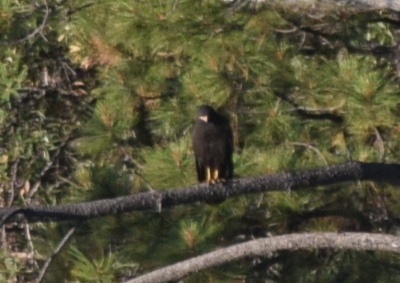 Common Black Hawk
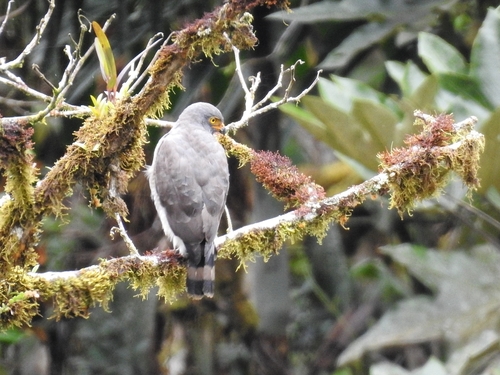 Roadside Hawk
In short
The most reliable field mark between Common Black Hawk and Roadside Hawk is overall size and structure: Common Black Hawk is much larger and bulkier, with broad wings and a short tail showing a single bold white band, while Roadside Hawk is noticeably smaller, slimmer, and has a longer tail with multiple narrow bars. Immature Common Black Hawks are blotchy below and have several tail bands, but still appear larger and chunkier than any Roadside Hawk. In flight, Roadside Hawk's short, rounded wings and long, banded tail contrast with the Black Hawk's broad wings and short tail. Perched, Roadside Hawk often shows rufous on the wings and a more finely barred underpart pattern, while Black Hawk is uniformly dark as an adult.
Identification tips
- Size is the first check: If the bird looks large, bulky, and heavy, it's likely a Common Black Hawk; if small, slim, and agile, it's probably a Roadside Hawk. This works at all ages.
- Tail pattern is crucial: Adult Common Black Hawk has a short tail with a single broad white band and white tip; Roadside Hawk (all ages) shows a longer tail with 4–5 narrow grey bars. Immature Black Hawk may show several tail bands, but these are broader and fewer than Roadside Hawk's.
- Wing shape in flight: Common Black Hawk has very broad wings; Roadside Hawk's wings are short and rounded, giving a different flight profile.
- Plumage color: Adult Common Black Hawk is nearly uniform black or dark gray, while Roadside Hawk is brown or grey above with barred underparts. Immature Black Hawk is brown above with blotchy, streaked underparts; Roadside Hawk is always more finely barred below.
- Rufous on wings: Roadside Hawk often shows a touch of rufous on the wings, especially in flight, which never appears on Black Hawk.
- Bill and cere color: Black Hawk has a black bill with yellow cere and legs; Roadside Hawk has a relatively large bill and yellow or whitish eyes.
- Perched posture: Black Hawk appears massive and blocky when perched, with a short tail; Roadside Hawk is slim, upright, and often perches in exposed spots.
- Habitat context: Black Hawk is usually near water (rivers, streams, mangroves); Roadside Hawk is common along roads, in open country, and at forest edges.
- Vocalization: A high-pitched, squeaky call is diagnostic for Roadside Hawk; Black Hawk is not notably vocal.
- Frequency/abundance: Roadside Hawk is often the most common raptor in its range; Black Hawk is less frequently encountered.
- Immature confusion: If you see a blotchy, streaky, brownish raptor with a banded tail, check size and structure—if it's large and chunky, it's an immature Black Hawk; if small and slim, it's a Roadside Hawk.
- Flight style: Black Hawk soars on broad wings and appears heavy; Roadside Hawk is more buoyant and agile, with quick wingbeats and a long tail.
- Underpart pattern: Roadside Hawk always shows brown and white barring below; Black Hawk (adult) is solid dark, and (immature) is blotchy and streaked, not finely barred.
- Leg color: Both can show yellow legs, so this is not a strong separator.
- Sex differences: Both species are similar between sexes; size difference in Roadside Hawk (female 20% larger) is not usually useful in the field.
Size
Common Black Hawk is nearly three times heavier than Roadside Hawk (996 g vs. 250–300 g) and significantly longer (43–53 cm vs. 31–41 cm). In the field, this translates to a much bulkier, more imposing bird for the Black Hawk, with broad wings and a compact, square tail. Roadside Hawk is small and slim, with a proportionally long tail and short, rounded wings, giving it a lighter, more agile appearance. Even immature Black Hawks are much larger than any Roadside Hawk.
Plumage
- Immatures/Juveniles: Immature Common Black Hawks are dark brown above with heavy spotting and streaks below, and their tails have several black and white bars. This can superficially resemble Roadside Hawk, which also shows barred underparts and a banded tail, but the Black Hawk is always much larger and bulkier, and its tail bands are broader and fewer (adults: single broad white band; immatures: several, but still fewer than Roadside Hawk's 4–5 narrow bars). Roadside Hawk immatures are not described in detail here, but the adult pattern (brown or grey above, barred brown and white below, 4–5 narrow grey tail bars) is similar across ages.
- Adults: Adult Common Black Hawk is almost entirely black or dark gray, with a short black tail featuring a single broad white band and a white tip. Roadside Hawk adults are brown or grey above, with brown and white barring below, and a tail with 4–5 narrow grey bars. Roadside Hawk often shows rufous on the wings, especially in flight, which never appears on Black Hawk. Bill and cere are yellow in Black Hawk; Roadside Hawk has a relatively large bill and yellow or whitish eyes.
Behaviour
Common Black Hawk is more likely to be seen soaring on broad wings or perched near water, often appearing sluggish and heavy in flight. Roadside Hawk is much more active and vocal, frequently perching on wires or exposed branches along roadsides, and often soars but does not hover. Its flight is lighter and more agile, with quick, shallow wingbeats and a long tail used for maneuvering.
Habitat
Roadside Hawk is often the most common raptor in its range, especially in open areas, edges, and along roads, where it perches conspicuously. Common Black Hawk is less common and more tied to water, often found near rivers, streams, or mangroves. If you see a small hawk perched along a road or in open country, it's much more likely to be a Roadside Hawk; a large, dark raptor near water is more likely a Common Black Hawk.
Voice
Roadside Hawk is very vocal, with a high-pitched, piercing squeak that is often heard before the bird is seen. Common Black Hawk is not described as vocal in these notes, so voice is a strong clue: a loud, squeaky call points to Roadside Hawk.