

Collared Forest-Falcon vs Slaty-backed Forest-Falcon
Micrastur semitorquatus versus Micrastur mirandollei
Play a quiz with Collared Forest-Falcon and Slaty-backed Forest-Falcon
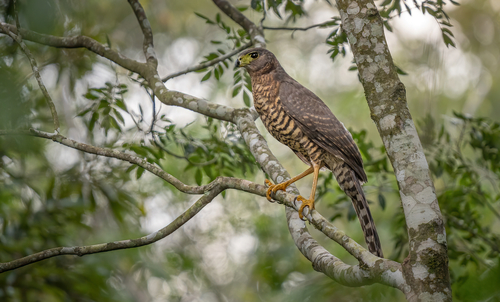 Collared Forest-Falcon
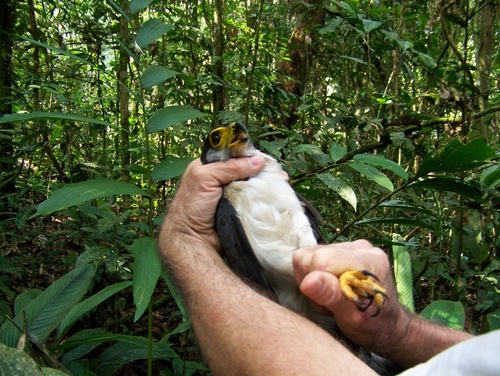 Slaty-backed Forest-Falcon
In short
The most reliable way to separate Collared Forest-Falcon from Slaty-backed Forest-Falcon is by size and structure: Collared is distinctly larger and bulkier, with a longer tail and shorter, rounder wings, while Slaty-backed is noticeably smaller and more compact. Both can show similar dark upperparts and pale underparts, but Collared often has a contrasting pale collar (in most morphs) and a heavier, more powerful build. Juvenile plumages are not strongly differentiated in the field, so focus on size, tail pattern, and subtle plumage cues. Both species are secretive forest raptors, but careful attention to these details—especially in perched or low-flight views—will usually clinch the ID.
Identification tips
- Size and bulk: Collared is much larger and heavier than Slaty-backed; use this when you have a good view or reference objects.
- Tail length and shape: Collared has a longer, more flexible tail, often appearing proportionally longer than the wings; Slaty-backed's tail is shorter and less prominent.
- Wing shape: Collared shows shorter, more rounded wings (adapted for maneuvering in dense forest); Slaty-backed's wings are shorter than most falcons but relatively longer and less rounded than Collared.
- Pale collar: Most Collared Forest-Falcons (pale and tawny morphs) have a distinct pale collar at the nape, contrasting with the dark back; Slaty-backed lacks this feature and is more uniformly slate-gray above.
- Upperparts color: Collared is dark-backed but can show brownish tones in some morphs; Slaty-backed is a more uniform, cold slate-gray, darker on the crown, paler on the cheeks.
- Underparts: Both have pale underparts, but Collared's are clean white, while Slaty-backed's are white to cream with faint dark shaft streaks.
- Tail pattern: Slaty-backed's tail has a white tip and three narrow, often indistinct, white bars; Collared's tail is less distinctly barred and appears longer.
- Leg and cere color: Both have yellow legs, but Slaty-backed's are described as bright yellow with a greenish yellow cere; Collared's are light yellow, but this is subtle in the field.
- Juvenile plumage: Juvenile Slaty-backed is dark brownish-gray above and off-white to yellowish buff below with a scaly look; Collared juveniles are less distinctly marked, transitioning from down to juvenile feathers by six weeks.
- Behavior: Collared may be seen running or hopping on the ground more often than Slaty-backed, which sometimes follows ant swarms.
- Habitat context: Both are in dense forest, but Collared is more likely in a wider range of forest types, while Slaty-backed may prefer deeper, less disturbed forest.
- Flight style: Both are agile in dense cover, but Collared's longer tail and bulkier build give it a different jizz in flight—slower, more powerful, and with more tail steering.
- Sexual dimorphism: Collared shows strong size dimorphism (females much larger), but this is only useful if sex is known.
- Voice: Calls are important for detection but not reliably diagnostic for separation unless you are very familiar with both species' vocalizations.
- Pitfalls: Beware of morph variation in Collared (pale, tawny, dark); dark morphs can look more like Slaty-backed, but size, structure, and tail pattern still separate them.
Size
Collared Forest-Falcon is the largest Micrastur, with males averaging about 523 g and females 740 g, and a length of 46–58 cm with a wingspan of 72–86 cm. Slaty-backed Forest-Falcon is smaller, with males about 420 g, females 500–556 g, length 40–45 cm, and wingspan 65–71 cm. In the field, Collared appears bulkier and longer-tailed, while Slaty-backed is more compact and shorter-tailed. If you see both together or have a good sense of scale, Collared should stand out as nearly the size of a Peregrine Falcon, while Slaty-backed is closer to a female Merlin or small male Peregrine.
Plumage
Juvenile plumages are not sharply differentiated in the field, but some cues exist. Juvenile Slaty-backed shows dark brownish-gray upperparts and off-white to yellowish buff underparts with a scaly appearance, while Collared juveniles transition from white natal down to juvenile feathers by six weeks, but field marks for this age are subtle. In adults, Collared (especially pale and tawny morphs) shows a distinct pale collar at the nape, a white neck and breast, and a dark back. Slaty-backed adults have uniformly slate-gray upperparts (darker on the crown, paler on the cheeks), white to cream underparts with faint dark shaft streaks, and a tail with a white tip and three narrow, often indistinct, white bars. Collared's tail is longer and less distinctly barred. Both have yellow legs, but Slaty-backed's are described as bright yellow, and its cere is greenish yellow.
Behaviour
Both species are secretive, often remaining hidden in dense forest canopy and more often detected by voice than seen. Collared Forest-Falcon hunts by ambush, sometimes running or hopping on the forest floor, and is noted for its powerful, flexible tail aiding pursuit in dense cover. Slaty-backed also hunts from the understorey to mid-levels and will go to the ground, sometimes following army ant swarms to catch prey flushed by the ants. Both are versatile predators, but Collared's larger size allows it to take a wider range of prey, including larger mammals and birds.
Habitat
Both species inhabit tropical rainforests in Central and South America, but Collared Forest-Falcon is more widespread and is the most common large forest falcon in its range. Slaty-backed overlaps in much of the same region but is absent from southernmost South America. Both prefer dense, mature forest, but Slaty-backed may be more restricted to primary forest interiors, while Collared can be found in a wider range of forest types.
Voice
Both species are secretive and often detected by their calls, but the sources do not provide detailed vocal descriptions for either species. In practice, voice is important for detection but not reliably diagnostic for separation without experience.
Collared Forest-Falcon · Slaty-backed Forest-Falcon · My Tricky Birds