

Cockatiel vs Little Corella
Nymphicus hollandicus versus Cacatua sanguinea
Play a quiz with Cockatiel and Little Corella
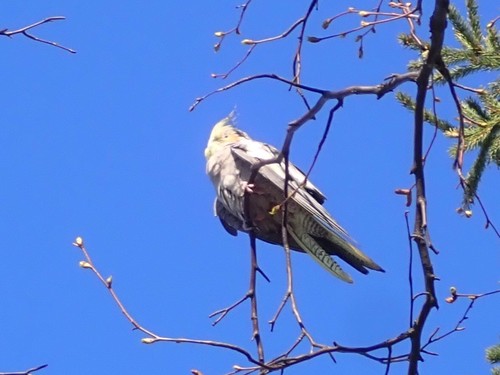 Cockatiel
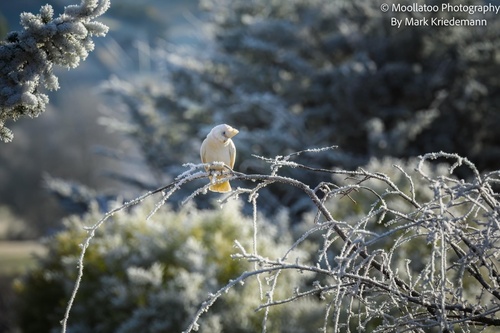 Little Corella
In short
The most reliable field mark to separate Cockatiel from Little Corella is overall structure and coloration: Cockatiel is a slim, long-tailed parrot with a pointed, expressive crest and variable plumage (often grey with yellow face and orange cheek patch), while Little Corella is a much heavier, all-white cockatoo with a short, broad tail and a blue eye-ring. Juvenile Cockatiels show yellow barring and spots under the tail and wings, which Little Corella never shows at any age. In flight or at rest, the Cockatiel’s long tail and small size are instantly distinctive compared to the stocky, broad-winged, short-tailed Little Corella. If you see a white cockatoo in a flock, especially in urban or open country, it is almost certainly a Little Corella; Cockatiels are rarely truly white except in domestic or aviary birds.
Identification tips
- Size and bulk: Little Corella is about six times heavier than Cockatiel and much bulkier. If the bird looks chunky and almost pigeon- or crow-sized, it is a Corella; Cockatiel is slim and delicate.
- Tail length and shape: Cockatiel has a very long, narrow, pointed tail, often nearly as long as its body. Little Corella has a short, broad, squared tail. This is obvious both perched and in flight.
- Crest: Cockatiel has a long, pointed, expressive crest, often held erect or swept back. Little Corella has a short, rounded crest that is barely noticeable.
- Bill shape: Cockatiel has a small, fine, parakeet-like bill. Little Corella has a large, deep, curved cockatoo bill, with upper and lower mandibles of similar length (not long-billed like Long-billed Corella).
- Plumage color: Wild Cockatiel is mostly grey with yellow face (male) or grey face (female) and a bright orange cheek patch. Little Corella is all white with a pale blue eye-ring and a faint pinkish tinge at the lores; never any orange cheek patch.
- Juvenile/immature marks: Juvenile and female Cockatiels show yellow barring under the tail and yellow spots under the wings. Little Corella never shows these marks at any age.
- Domestic Cockatiel confusion: White or yellow Cockatiels (lutino, albino, pied, etc.) can be confused with Little Corella, but always have a long tail, pointed crest, and (often) orange cheek patch. Little Corella never shows orange cheeks or a long tail.
- Eye-ring: Little Corella has a conspicuous pale blue (sometimes darker blue) bare skin eye-ring. Cockatiel has feathered skin around the eye, with no bare ring.
- Cheek patch: Cockatiel always has a distinct orange cheek patch (wild and most domestic types), which is never present in Little Corella.
- Flight style: Cockatiel flies with rapid, direct wingbeats and a long tail trailing. Little Corella flies with slower, deeper wingbeats, often in tight flocks, and the short tail is obvious.
- Flock size: Little Corella is often in large, noisy flocks of dozens to thousands. Cockatiel is rarely in large flocks in the wild; usually seen singly or in small groups.
- Habitat context: Little Corella is common in urban parks, sports fields, and farmland, often feeding on the ground. Cockatiel prefers open country with scattered trees and is less likely in dense urban settings.
- Bill color: Both have pale bills, but Cockatiel’s is smaller and more delicate, while Little Corella’s is large and robust.
- Sexual dimorphism: Cockatiel males (wild type) have a bright yellow face and crest; females and juveniles are greyer with yellow barring under the tail. Little Corella shows only slight size difference between sexes, no color difference.
- Subspecies variation: Some Little Corella subspecies show a faint yellow wash on lower ear coverts or brownish tinge under wings/tail, but never approach the bright colors or patterns of Cockatiel mutations.
Size
Cockatiel is far smaller and lighter than Little Corella. Cockatiel averages 86 g [wikidata], making it a small parrot, while Little Corella is much heavier (mean 525 g [wikipedia]), about six times the mass. In the field, Cockatiel looks slim and delicate, with a long, narrow tail, while Little Corella is chunky, broad-bodied, and short-tailed. Even at a distance, the size and bulk difference is striking: Little Corella is close to a Sulphur-crested Cockatoo in size, while Cockatiel is closer to a budgerigar or small dove.
Plumage
Juvenile Cockatiels (and adult females) have distinctive horizontal yellow bars under the tail and yellow spots under the wings, which are absent in Little Corella of any age. Cockatiel wild-type adults are mostly grey with a yellow face (male) or grey face (female), and both sexes have a bright orange cheek patch. Domestic Cockatiels can be white, yellow, cinnamon, pied, or show pearling, but always retain the long tail and pointed crest. Little Corella is always white overall, with a pale blue eye-ring and sometimes a faint yellow wash on the lower ear coverts (in some subspecies). The only color on Little Corella is a subtle pinkish tinge at the lores and base of the bill, never the bright orange cheek of Cockatiel. In flight, Little Corella shows all-white wings and tail, while Cockatiel’s flight feathers are dark in wild-types and variable in domestic birds. No Cockatiel, wild or domestic, ever shows the blue eye-ring of Little Corella.
Behaviour
Cockatiel is typically seen singly, in pairs, or small groups, often perching quietly or flying with rapid, direct wingbeats and a long, pointed tail trailing behind. They are sociable but not usually in large flocks in the wild. Little Corella is highly gregarious, often forming flocks of hundreds or thousands, flying noisily and wheeling together. Corellas are much more likely to be seen feeding on the ground in open fields, lawns, or agricultural areas, and are notorious for destructive chewing behavior. Cockatiels are more delicate in their feeding and perching habits.
Habitat
Cockatiel is native to arid and semi-arid Australia, favoring open country with scattered trees, and is less common in dense urban areas. Little Corella is widespread in open habitats, including savanna, farmland, lawns, and urban parks, and is especially common and conspicuous in cities and agricultural regions. If you see a white cockatoo in a city park or on a sports field in a large flock, it is almost certainly a Little Corella. Cockatiels are rarely seen in such urban flocks.