

Coal Tit vs Japanese Tit
Periparus ater versus Parus minor
Play a quiz with Coal Tit and Japanese Tit
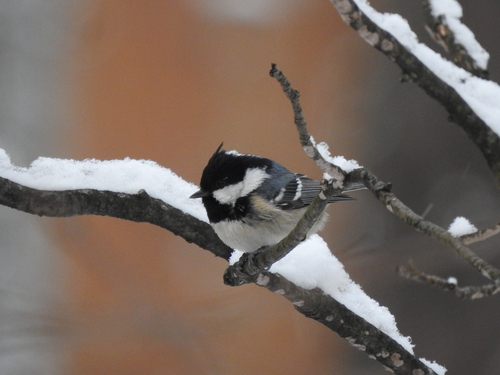 Coal Tit
 Japanese Tit
In short
The most reliable field mark to separate Coal Tit from Japanese Tit is the large white nape spot on the Coal Tit's black head, which is never present on Japanese Tit. In all ages, Coal Tit also shows two clear white wingbars, while Japanese Tit has only one. Japanese Tit stands out with its broad black ventral line running down the white underparts and a solid grey back, whereas Coal Tit has buff to rufous flanks and a more subdued, off-white underside. Juvenile Coal Tits are duller and may lack the crispness of adults, but the nape spot remains a key feature. Both species have black hoods and white cheeks, but the Coal Tit's head pattern is more contrasting and compact.
Identification tips
- White nape spot (Coal Tit only): Look for a large, clear white patch on the nape—diagnostic for Coal Tit of all ages and never present on Japanese Tit.
- Number of wingbars: Coal Tit shows two distinct white wingbars (from white-tipped coverts), while Japanese Tit has only a single white wingbar. This is visible both perched and in flight.
- Black ventral line (Japanese Tit only): Japanese Tit has a broad black stripe running down the center of the white underparts (broadest in males, narrower in females), absent in Coal Tit.
- Back color: Japanese Tit has a clean, ashy-grey back, while Coal Tit's back is more olive or greyish and less uniform.
- Cheek and face pattern: Both have white cheeks, but Coal Tit's face is more compact, with off-white cheeks and a more contrasting black head and throat. Japanese Tit's white cheek patch is larger and more rectangular.
- Flank color: Coal Tit's flanks are tinged buff to rufous, especially in some subspecies, while Japanese Tit's underparts are pure white except for the black ventral line.
- Tail pattern: Japanese Tit has a black tail with ashy outer webs and white tips (outermost pair all white with black shaft), while Coal Tit's tail is plainer and shorter.
- Bill size and shape: Coal Tit has a finer, smaller bill; Japanese Tit's bill is stouter, but this is a subtle mark and best used in direct comparison.
- Size and jizz: Coal Tit is noticeably smaller and more delicate, often appearing more active and agile, especially in conifers. Japanese Tit is bulkier and more robust, with a longer tail.
- Juvenile confusion: Juvenile Coal Tits are duller but still show the nape spot; juvenile Japanese Tits may show some green on the back and yellowish below but never have a nape spot or two wingbars.
- Voice: Coal Tit's calls are short, high-pitched, and clipped; Japanese Tit's are richer, more whistled, and melodic. If you hear a rapid, high 'if-he, if-he' song, it's Coal Tit; a repeated 'titiweesi' points to Japanese Tit.
- Habitat context: In dense coniferous forests, Coal Tit is more likely; in broadleaf woods, parks, or gardens, Japanese Tit is more expected, though overlap can occur.
- Foraging behavior: Coal Tit is more likely to be seen hanging upside down or hovering at branch tips; Japanese Tit often manipulates food with its feet or wedges seeds in bark.
- Sex differences (Japanese Tit): Males have a broader black ventral line; females are slightly duller and have a narrower stripe, but both sexes lack the Coal Tit's nape spot.
- Pitfalls: In poor light or at distance, the black head and white cheeks can look similar; always check for the nape spot and number of wingbars before relying on overall color or size.
Size
Coal Tit is smaller (10–11.5 cm length [wikipedia]) and more delicate in build compared to Japanese Tit, which is closer in size to Great Tit and appears chunkier. Japanese Tit's proportions are more robust, with a broader body and longer tail, while Coal Tit is noticeably petite and agile. Bill size is also slightly smaller and finer in Coal Tit, but this is subtle in the field.
Plumage
- Juvenile/Immature: Juvenile Coal Tits are duller than adults, lacking the glossy black head and with yellowish tinges to the nape and cheeks, but still show the white nape spot. Japanese Tit juveniles may show some green on the back and yellowish on the underside, but never have a nape spot or two wingbars.
- Adults: Coal Tit has a black head, throat, and neck with a large white nape spot and two white wingbars (from tips of wing coverts). Underparts are off-white, with buff to rufous flanks. Japanese Tit has a black hood, white cheek patch, grey back, and a single white wingbar. The underparts are white with a bold black central stripe (broader in males, narrower in females). Japanese Tit's tail is black with ashy outer webs and white tips, and the undertail coverts are black centrally and white on the sides. Coal Tit's upperparts are more olive or greyish, lacking the clean grey back of Japanese Tit.
Behaviour
Both species forage actively in trees and join mixed-species flocks, but Coal Tit is particularly agile and often feeds high in conifers, frequently hanging upside down or hovering. Japanese Tit is more likely to be seen in pairs or small groups, sometimes holding prey with its feet or wedging seeds in bark to hammer them open. Coal Tit maintains near-constant contact with short 'dee' or 'see-see' calls, while Japanese Tit's calls are more varied and whistled.
Habitat
Coal Tit is most often found in coniferous and mixed forests throughout the Palearctic, especially in temperate and montane zones. Japanese Tit prefers a wider range of wooded habitats, including deciduous and mixed forests, parks, and gardens, but is less strictly tied to conifers. Overlap is possible in mixed woodlands, but Coal Tit is more specialized for coniferous settings.
Voice
Coal Tit gives short, high-pitched 'dee' or 'see-see' calls and a rapid, high 'if-he, if-he, if-he' song, faster and higher than Great Tit. Japanese Tit's song is a whistled 'titiweesi...titiweesi...' or 'witsi-seesee', repeated several times, and its calls are more varied and melodic. Coal Tit's calls are more clipped and less musical, while Japanese Tit's are richer and more complex.