

Chipping Sparrow vs Field Sparrow
Spizella passerina versus Spizella pusilla
Play a quiz with Chipping Sparrow and Field Sparrow
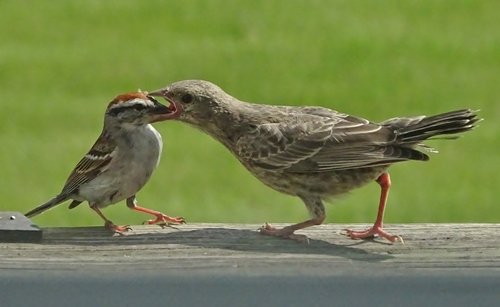 Chipping Sparrow
 Field Sparrow
In short
The most reliable field mark to separate Chipping Sparrow and Field Sparrow is the facial pattern: Chipping Sparrow in breeding plumage shows a crisp white supercilium and black eye-line, while Field Sparrow always has a plain gray face with a bold white eye-ring and a pink bill. Juvenile Chipping Sparrows are heavily streaked below, unlike Field Sparrows, which are never strongly streaked underneath. In nonbreeding plumage, Chipping Sparrow’s face becomes less distinct, but the dark eye-line persists, whereas Field Sparrow’s face remains plain and open. Bill color is a strong clue: Field Sparrow’s bill is always pink, while Chipping Sparrow’s is dark. Both are small, slim sparrows, but subtle differences in structure and tail shape may help in good views.
Identification tips
- Juvenile plumage: Juvenile Chipping Sparrows are heavily streaked below, especially on the breast and flanks; Field Sparrows never show strong ventral streaking at any age. This is the best mark for separating immatures.
- Facial pattern (breeding Chipping Sparrow): Look for a sharp white supercilium and a crisp black eye-line through the eye on Chipping Sparrow, with a bright rufous cap. Field Sparrow lacks these sharp contrasts, showing a plain gray face.
- Eye-ring: Field Sparrow always has a bold, complete white eye-ring, making the eye look large and open. Chipping Sparrow lacks a strong eye-ring in all plumages.
- Bill color: Field Sparrow’s bill is always pink, both upper and lower mandibles. Chipping Sparrow’s bill is dark (blackish or gray), especially the upper mandible.
- Crown color and borders: Chipping Sparrow’s rufous crown in breeding plumage is sharply bordered by the white supercilium and black eye-line. Field Sparrow’s crown is rusty but not as sharply defined, blending into the gray face.
- Nonbreeding/immature facial marks: Chipping Sparrow in nonbreeding or juvenile plumage has a brownish cap, dusky eyebrow, and a dark eye-line, but still shows some facial contrast. Field Sparrow’s face remains plain gray with a white eye-ring and rusty mark behind the eye.
- Underpart color: Chipping Sparrow is pale gray below in all plumages. Field Sparrow has a buffy breast and a white belly, sometimes giving a warmer look.
- Wing bars: Field Sparrow shows two pale whitish wing bars, which can be visible at rest. Chipping Sparrow may show faint wing bars but they are less prominent.
- Tail shape: Field Sparrow’s tail is slightly longer and more deeply notched (forked) than Chipping Sparrow’s, which is more square-tipped. This can be subtle and hard to judge unless the tail is fanned.
- Habitat context: In open, brushy fields and grasslands, Field Sparrow is more likely; in parks, gardens, or woodland edges, Chipping Sparrow is more likely.
- Behavior: Chipping Sparrow is often tamer and more likely to be seen in flocks, especially in winter. Field Sparrow tends to be more solitary or in small groups.
- Color morphs: Field Sparrow comes in gray and rufous morphs, but both retain the white eye-ring and pink bill. Chipping Sparrow does not show such variation.
- Sex differences: Both species are similar between sexes; size difference is negligible in the field.
- Flight views: If you see a small sparrow with a plain face, white eye-ring, and pink bill in flight, suspect Field Sparrow. If you see a streaky juvenile with a dark eye-line, think Chipping Sparrow.
- Pitfalls: Nonbreeding Chipping Sparrow can look washed out and less distinct, but the bill remains dark and the face never shows a strong white eye-ring or pink bill. Field Sparrow never shows a sharp black eye-line or crisp white supercilium.
Size
Both species are very similar in size and mass, with Chipping Sparrow measuring 12–15 cm (4.7–5.9 in) in length and Field Sparrow about 14 cm (6 in). Their average weights overlap (Chipping: 11–17 g; Field: ~12.5 g). These differences are too slight to be useful in the field. Structure is more helpful: Field Sparrow often appears slightly longer-tailed and rounder-headed, while Chipping Sparrow is a bit more compact.
Plumage
Juvenile Chipping Sparrows are distinctly streaked below, a feature never shown by Field Sparrow at any age. In all plumages, Field Sparrow has a plain gray face with a white eye-ring and pink bill, and a rusty crown that lacks strong borders. Chipping Sparrow in breeding plumage has a bright rufous cap, crisp white supercilium, and a sharp black eye-line; in nonbreeding plumage, the cap turns brown and facial markings blur, but the dark eye-line remains. Field Sparrow’s upperparts are brown with black and buff streaks, and it shows two pale wing bars and a forked tail. Chipping Sparrow is grayer below and above, with less contrast between back and face, and lacks the strong white eye-ring and pink bill of Field Sparrow. Both have rusty crowns, but only Chipping Sparrow’s is sharply defined in breeding plumage.
Behaviour
Both species forage on the ground or low in vegetation for seeds and insects. Chipping Sparrow is often more confiding around people and can be seen in parks and gardens, especially where House Sparrows are absent. In winter, Chipping Sparrows are gregarious and may join mixed flocks. Field Sparrow is more likely to be found in brushy, open country and grasslands, often away from human habitation. Neither species shows strong behavioral differences useful for quick field separation.
Habitat
Chipping Sparrow is highly adaptable, found in woodlands, farmland, parks, gardens, and even coniferous forests in the west. It is common in suburban and urban settings, especially in the absence of House Sparrows. Field Sparrow prefers bushy fields, grasslands, and shrubby areas, usually avoiding dense forests and urban areas. If you encounter a Spizella in a grassy field with scattered shrubs, Field Sparrow is more likely; in a city park or woodland edge, Chipping Sparrow is more probable.
Voice
Chipping Sparrow’s song is a dry, mechanical trill, and its flight call is a sharp, piercing chip, often heard at night during migration. Field Sparrow’s song is not described in the provided notes, so voice is not a reliable separator here. Both species have high-pitched calls, but only Chipping Sparrow’s nocturnal flight call is specifically mentioned.