

Chipping Sparrow vs Black-chinned Sparrow
Spizella passerina versus Spizella atrogularis
Play a quiz with Chipping Sparrow and Black-chinned Sparrow
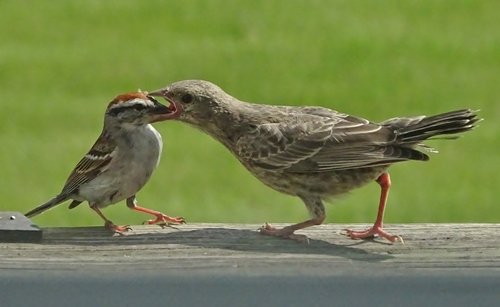 Chipping Sparrow
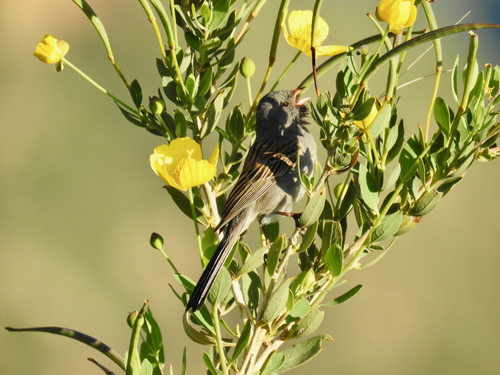 Black-chinned Sparrow
In short
The most reliable field mark to separate Chipping Sparrow from Black-chinned Sparrow is the head and face pattern in adults: breeding Chipping Sparrows show a bright rufous cap, crisp white eyebrow, and a sharp black line through the eye, while Black-chinned Sparrows (especially breeding males) have a gray head and body with a distinctive black chin and throat, lacking the rufous cap. Juvenile and nonbreeding birds are trickier, but Chipping Sparrow juveniles are heavily streaked below, whereas Black-chinned Sparrow juveniles have only faint streaking and a brownish wash. Structure also helps: Black-chinned Sparrow is slimmer, with a proportionately longer, notched tail and a pink bill. Both species can look similar in dull plumages, but careful attention to these marks, especially the face and underpart pattern, will separate them in most situations.
Identification tips
- Juvenile underpart streaking: Juvenile Chipping Sparrows are boldly streaked below, while Black-chinned Sparrow juveniles show only faint, indistinct streaking. If you see a heavily streaked juvenile sparrow, Chipping is much more likely.
- Head and face pattern (adults): Breeding Chipping Sparrow has a bright rufous crown, crisp white eyebrow, and a sharp black line through the eye. Black-chinned Sparrow (especially breeding males) has a gray head and body with a black chin and throat, lacking any rufous cap or strong supercilium.
- Nonbreeding/immature head pattern: Chipping Sparrow in nonbreeding plumage has a brownish cap, dusky eyebrow, and a dark eye-line, but still shows some contrast. Black-chinned Sparrow in basic plumage (both sexes) is overall gray-headed and gray-bodied, with a less contrasting face; females lack black on the chin entirely.
- Back and upperparts: Both species have reddish-brown backs streaked with black, but Black-chinned Sparrow has a more extensive gray on the head and body, and its back may appear more streaked and contrasting with the gray rump.
- Tail shape and length: Black-chinned Sparrow has a longer, more notched tail than Chipping Sparrow. In flight or when perched with the tail spread, this can be a useful clue.
- Bill color: Black-chinned Sparrow has a small, stout, pink bill; Chipping Sparrow's bill is less distinctly colored but not as obviously pink. This is subtle and best used at close range.
- Body structure: Black-chinned Sparrow is slimmer, longer-tailed, and rounder-headed, often appearing more delicate than the compact Chipping Sparrow.
- Underparts color: Adult Chipping Sparrow is clean gray below; Black-chinned Sparrow is also gray below, but the overall gray extends to the head and body, giving a more uniform look, especially in females and nonbreeding birds.
- Presence of black chin/throat: Only Black-chinned Sparrow males in breeding plumage show a black chin and throat. Chipping Sparrow never shows black on the chin or throat in any plumage.
- Supercilium (eyebrow): Chipping Sparrow's white supercilium is prominent in breeding plumage, while Black-chinned Sparrow lacks a strong supercilium in all plumages.
- Wingbars: Juvenile Black-chinned Sparrow shows two faint wingbars; Chipping Sparrow juveniles do not have obvious wingbars, but this is subtle and often hard to see.
- Habitat context: Chipping Sparrow is common in open, grassy, or park-like areas, often near people. Black-chinned Sparrow is most often found in arid, brushy, or chaparral habitats in the southwest. Use habitat as supporting evidence, not as a primary separator.
- Flocking behavior: Chipping Sparrows are more likely to be seen in flocks, especially in winter; Black-chinned Sparrows are usually solitary or in pairs.
- Flight style: Black-chinned Sparrow's longer tail may be noticeable in flight, giving a more elongated, fluttery appearance compared to the more compact Chipping Sparrow.
- Pitfalls: In dull light or nonbreeding plumage, both species can look plain and grayish. Focus on the presence or absence of a rufous cap, the extent and crispness of the face pattern, and the presence or absence of a black chin/throat for the most reliable separation.
Size
Both species are similar in length (Chipping Sparrow: 12–15 cm; Black-chinned Sparrow: 13–15 cm) and weight (Chipping Sparrow: 11–17 g; Black-chinned Sparrow: 9–14.8 g) [wikipedia][avonet]. Chipping Sparrow averages a slightly broader wingspan (21 cm vs. 19–20 cm for Black-chinned). In the field, Black-chinned Sparrow often appears slimmer and more elongated, with a longer, more notched tail, while Chipping Sparrow is a bit more compact. These differences are subtle and best used in combination with plumage and structure.
Plumage
- Juvenile/immature birds: Chipping Sparrow juveniles are boldly streaked below, with a brownish cap and a dark eye-line; the streaking is strong and extensive. Black-chinned Sparrow juveniles have only indistinct streaking on the underparts, a brownish wash to the head and underparts, and two faint wingbars; their outer scapulars are tawny. Both lack the adult's crisp head pattern, but Chipping Sparrow is always more obviously streaked below.
- Adult breeding (alternate) plumage: Chipping Sparrow shows a bright rufous crown, white supercilium, and a sharp black eye-line; underparts are plain gray. Black-chinned Sparrow males have a gray head and body, with a reddish-brown, black-streaked back, and a distinctive black chin, throat, and front of face; females lack most or all black, but still show the overall gray head and body. Chipping Sparrow never shows a black chin or throat.
- Adult nonbreeding (basic) plumage: Chipping Sparrow becomes duller, with a brownish cap and less distinct facial markings, but still shows a dark eye-line and gray underparts. Black-chinned Sparrow loses most of the black on the chin (especially females), but the overall gray head and body, with a reddish-brown streaked back, remains distinctive. Both can look similar in poor light, but Chipping Sparrow retains a more contrasting face pattern and lacks the all-gray look of Black-chinned.
Behaviour
Chipping Sparrows are often seen foraging on the ground or low in vegetation, sometimes in flocks, especially in winter. They are relatively tame and may be found in parks, gardens, and open woodlands. Black-chinned Sparrows are more likely to be seen singing from exposed perches in shrubby or arid habitats, often alone or in pairs. Their longer tail and slimmer build may be noticeable when they move or fly. Both species may clamber in low vegetation, but Chipping Sparrow is more gregarious, especially outside the breeding season.
Habitat
Chipping Sparrow is widespread and common across much of North America, found in a wide range of open habitats including woodlands, farmland, parks, and gardens, especially near human habitation. Black-chinned Sparrow is more restricted to the southwestern US and northern/central Mexico, favoring arid, brushy hillsides and chaparral. Overlap is limited, but in the southwest, both can occur in open, shrubby areas; context can help, but is not diagnostic on its own.
Voice
Chipping Sparrow gives a dry, mechanical trill as its song, and a sharp, piercing flight call, especially at night during migration. Black-chinned Sparrow's song and calls are not described in the provided notes, so vocalization is not a reliable separator here.