

Chilean Skua vs Brown Skua
Stercorarius chilensis versus Stercorarius antarcticus
Play a quiz with Chilean Skua and Brown Skua
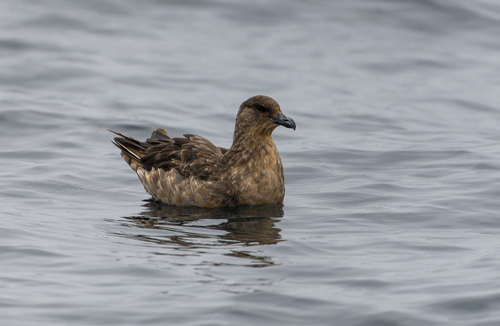 Chilean Skua
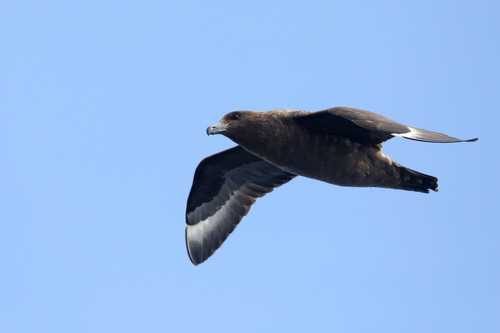 Brown Skua
In short
The most reliable field mark between Chilean Skua and Brown Skua is the Chilean's distinctive dark cap and cinnamon-colored throat and underwings, especially obvious in flight or at rest. Juvenile Chilean Skuas are brighter overall, with a strong cap and often lack the adult's pectoral collar, while Brown Skuas are heavier, bulkier, and lack these contrasting facial and underwing colors. Brown Skuas are the largest skuas, with a more uniform brown plumage and a heavier jizz both perched and in flight. Both species can overlap in southern South America, but Chilean Skua is more compact and shows more color contrast, while Brown Skua is bulkier and plainer.
Identification tips
- Dark cap and cinnamon throat (Chilean Skua): Look for a sharply defined dark cap contrasting with a cinnamon-colored throat and lower face, especially in adults. Brown Skua lacks this feature and is uniformly brown. Works for adults and most immatures.
- Cinnamon underwing (Chilean Skua): In flight, check for cinnamon or reddish tones on the underwing, sometimes dull but usually visible, especially on juveniles and adults. Brown Skua's underwing is plain brown, lacking this contrast.
- Facial streaking (Chilean Skua adult): Pale gold streaking on the face and neck is present in adult Chilean Skuas, absent in Brown Skuas.
- Pectoral collar (Chilean Skua adult): Adults show a dark band across the upper chest; juveniles may lack this. Brown Skua does not show a pectoral collar at any age.
- Juvenile brightness (Chilean Skua): Juvenile Chilean Skuas are brighter overall, with a strong cap and no pale streaking. Brown Skua juveniles are uniformly brown and lack strong contrasts.
- Overall jizz and structure: Chilean Skua is more slender and compact, especially in flight, while Brown Skua is heavier, bulkier, and more powerful-looking both perched and flying.
- Bill color and shape: Chilean Skua has a small, bluish bill with a dark tip; Brown Skua's bill is heavier and less distinctly colored (details not provided for Brown Skua in notes, but overall impression is heavier).
- Leg color: Chilean Skua has black legs; Brown Skua's leg color is not specified, but this is not a primary field mark.
- Upperwing pattern in flight: Chilean Skua may show white crescents on the wings (per Wikipedia), while Brown Skua's wing is plain brown. This is most useful on fresh-plumaged birds.
- Plumage uniformity: Brown Skua is plain brown throughout, with little contrast or pattern, at all ages. Chilean Skua always shows some contrast, especially on the face and underwing.
- Habitat context: In temperate South American coastal habitats, Chilean Skua is more likely. In subantarctic islands or Antarctic waters, Brown Skua is expected.
- Size and bulk: Use size as a supporting mark—Brown Skua is the largest skua, noticeably heavier and bulkier than Chilean Skua, but overlap and perspective can make this unreliable at distance.
- Hybrid confusion: Be aware that Chilean Skua can hybridize with Falkland (Brown) Skua in southern Argentina, potentially producing birds with intermediate features. If a bird shows mixed characters, consider location and the possibility of hybridization.
- Seasonal movement: Chilean Skua ranges north to Brazil and Peru outside the breeding season; Brown Skua is more southerly year-round. Out-of-range birds should be scrutinized carefully.
- Behavioral context: In breeding colonies, Chilean Skua may show complex social displays, but these are rarely diagnostic in the field.
Size
Brown Skua is notably larger and heavier than Chilean Skua. Brown Skua measures 52–64 cm in length with a wingspan of 126–160 cm and a body mass ranging from 1.2–2.18 kg, making it the heaviest skua species and rivaling the largest gulls. Chilean Skua is slightly smaller and more compact, with a wingspan of 130–138 cm (no length or mass given in the notes, but clearly less massive than Brown Skua). In the field, Brown Skua appears bulkier and more powerful, while Chilean Skua is more slender and compact, especially in flight.
Plumage
Juvenile and immature Chilean Skuas are brighter than adults, with a strong dark cap and lacking the pale streaking and pectoral collar of older birds. Their underwings are cinnamon-colored, sometimes dull, but still contrasting with the rest of the plumage. Adults have a dark cap, pale gold streaking on the face and neck, a cinnamon throat and lower face, and a pectoral collar. The upperparts, flanks, and cheeks are dark, while the underparts are uniformly light. Brown Skua, in contrast, is uniformly brown overall at all ages, lacking the strong facial contrasts, cinnamon tones, or pale streaking of Chilean Skua. Brown Skuas do not show a dark cap or a cinnamon throat/underwing, and their plumage is much less contrasting, appearing plain and heavy-set in all plumages.
Behaviour
Both species are aggressive and predatory seabirds, but Chilean Skua is noted for forming dense breeding colonies on sandy coasts with beached kelp, and for its association with fisheries in southern Chile. Brown Skua breeds in subantarctic and Antarctic zones and is known for its bold, sometimes playful interactions with humans in those regions. In breeding colonies, Chilean Skuas show complex social behaviors, including aerial attacks and submissive displays, while Brown Skuas are less described in this regard in the notes.
Habitat
Chilean Skua breeds along the coasts of southern Chile and Argentina, often on sandy beaches with kelp and freshwater streams, and ranges north to Peru and Brazil in the nonbreeding season. Brown Skua breeds in subantarctic and Antarctic zones and moves north outside the breeding season, but is generally more southerly than Chilean Skua. In South America, Chilean Skua is the expected skua in temperate coastal habitats, while Brown Skua is more likely in subantarctic islands and Antarctic waters. Overlap may occur in southernmost South America, but context and location can help separate them.