

Chestnut Forest Rail vs Chestnut-breasted Munia
Rallicula rubra versus Lonchura castaneothorax
Play a quiz with Chestnut Forest Rail and Chestnut-breasted Munia
 Chestnut Forest Rail
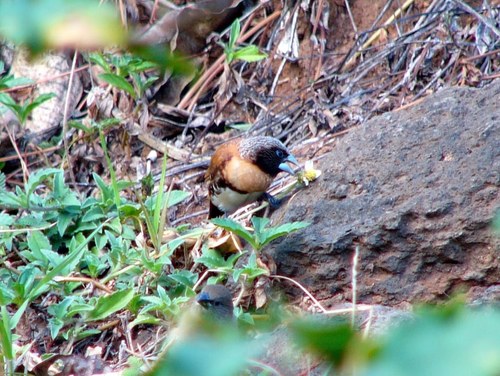 Chestnut-breasted Munia
In short
The Chestnut Forest Rail and Chestnut-breasted Munia are both small, chestnut-toned birds of New Guinea, but they differ dramatically in structure, behavior, and plumage. The rail is a secretive, ground-dwelling bird of dense montane forest, while the munia is a small, seed-eating finch often seen in flocks and open areas. The rail has a much more robust, rounded body and longer legs, whereas the munia is compact and short-tailed with a conical bill. Munias show a sharp black face and a contrasting white belly, while the rail is more uniformly chestnut. If you see a bird perched in the open or feeding on grass seeds, it's almost certainly a munia; a skulking bird in thick forest undergrowth points to the rail.
Identification tips
- Head pattern: Munia always shows a sharp black face and throat with a contrasting pale or white belly and a rich chestnut breast band. The rail is uniformly chestnut or reddish-brown without strong contrasts or a black face.
- Bill shape: Munia has a short, thick, conical bill adapted for seed-eating. The rail's bill is longer, more slender, and slightly decurved, typical of rails.
- Legs and posture: Rails have long, strong legs and walk with a horizontal posture. Munias are short-legged and perch upright on grass stems or wires.
- Body shape: Rails are robust and rounded, with a heavier, bulkier build. Munias are compact, slim, and sparrow-like.
- Tail: Munias have a short, squared tail. The rail's tail is less prominent, often hidden, and not a key field mark.
- Plumage contrasts: Munia shows crisp, contrasting plumage with a black face, chestnut breast band, and pale belly. Rail is more uniform in color, lacking sharp contrasts.
- Sex/age variation: Female and immature munias retain the face and breast pattern, though sometimes duller. No strong age or sex differences are described for the rail.
- Habitat: Munias are found in open grasslands, fields, and edges, often in flocks. Rails are strictly forest birds, solitary or in pairs, and rarely seen in the open.
- Behavior: Munias feed on seeds in the open, often perching conspicuously. Rails forage on the ground, hidden in dense vegetation.
- Flight: Munias have a bounding, undulating flight typical of small finches. Rails are reluctant fliers, usually running or walking away when disturbed.
- Flocking: Munias are highly social, often in groups. Rails are secretive and solitary.
- Geographic context: If seen in the Arfak Mountains or highland forests, consider rail. In lowland or disturbed areas, especially in Australia or open New Guinea, it's almost always munia.
- Upperwing/flight marks: No distinctive juvenile or flight patterns are described for either species; rely on plumage and structure.
- Vocalization: Not described in the notes; do not use for separation here.
- Size impression: Rails appear heavier and more robust; munias are dainty and light.
Size
The Chestnut-breasted Munia is a small finch, with a body mass of about 13 grams [wikidata], typical of small estrildids. The Chestnut Forest Rail's mass is not specified, but as a rail, it is likely to be noticeably heavier and bulkier than the delicate munia. The rail's body is more robust, with longer legs and a less compact profile, while the munia is petite and short-legged. In the field, the rail will appear much rounder and heavier-set compared to the slim, sparrow-like munia.
Plumage
No age-specific flight or wing pattern marks are noted for either species. For adults, the Chestnut-breasted Munia is strikingly patterned: it has a black face and throat, a rich chestnut breast band, and a white or pale belly, with brown upperparts and a greyish crown and nape. Some subspecies show pale grey or orange tones on the head and tail coverts, and faint scalloping on the nape or flanks. The Chestnut Forest Rail, in contrast, is more uniformly chestnut or reddish-brown overall, lacking the sharp black-and-white contrasts of the munia. The rail does not show the black face, pale belly, or the crisp breast band that are diagnostic for the munia. Juvenile and immature plumages are not described for either species, but the strong head and breast pattern of the munia is present even in females and is a reliable field mark.
Behaviour
Chestnut Forest Rails are secretive, ground-dwelling birds that skulk in dense undergrowth of montane forests. They are rarely seen in the open and move quietly through leaf litter. In contrast, Chestnut-breasted Munias are highly social, often seen in flocks, and feed openly on grass seeds in fields, edges, and sometimes gardens. Munias are active, frequently perching on grass stems or wires, and are much more likely to be observed in open or semi-open habitats. The rail's behavior is more furtive and terrestrial, while the munia is conspicuous and aerial.
Habitat
The Chestnut Forest Rail is restricted to subtropical or tropical moist montane forests in the Arfak Mountains and western-central New Guinea Highlands [wikipedia]. It is a bird of dense, humid forest interiors. The Chestnut-breasted Munia, on the other hand, occupies a much broader range, including open country, grasslands, agricultural fields, and sometimes forest edges across Australia, Indonesia, and Papua New Guinea. If the bird is seen in thick, high-elevation forest, rail is more likely; in open or disturbed habitats, especially in flocks, it is almost certainly a munia.
Chestnut Forest Rail · Chestnut-breasted Munia · My Tricky Birds