

Chestnut-collared Swift vs Costa Rican Swift
Streptoprocne rutila versus Chaetura fumosa
Play a quiz with Chestnut-collared Swift and Costa Rican Swift
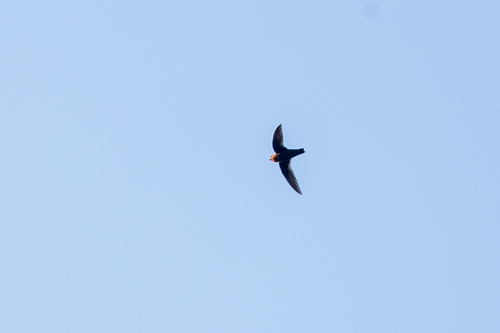 Chestnut-collared Swift
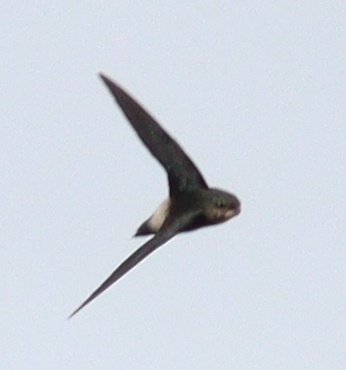 Costa Rican Swift
In short
The most reliable field mark between Chestnut-collared Swift and Costa Rican Swift is the presence of a broad, rufous collar on the lower throat and nape of most adult Chestnut-collareds, which is never shown by Costa Rican Swift. In addition, Chestnut-collared is distinctly larger and bulkier, with a broader wing and a slightly notched tail, while Costa Rican Swift is smaller, more compact, and has a paler grayish rump and throat. Juvenile and female Chestnut-collareds can be trickier, as their collar is reduced or absent, but the overall size, structure, and lack of strong pale on the rump help. Both species are aerial insectivores and may be seen in mixed flocks, but their ranges only overlap in southern Central America.
Identification tips
- Rufous collar (Chestnut-collared Swift): Look for a broad, rich rufous band across the lower throat and nape in adult males. This is the single most reliable mark and is never present on Costa Rican Swift.
- Collar reduced or absent (female/juvenile Chestnut-collared): Females and juveniles may show only a faint or missing collar, so do not rely solely on this mark in all individuals.
- Pale grayish rump (Costa Rican Swift): Costa Rican Swift always shows a distinctly pale grayish rump contrasting with darker upperparts, a useful mark from above or behind. Chestnut-collared's rump is only slightly paler than its back and never strongly gray.
- Throat and breast color: Costa Rican Swift has a pale grayish throat and breast, often contrasting with the darker head and back. Chestnut-collared has a grayish brown chin and throat with dull rufous feathers (in males), but the pale area is never as extensive or clean as in Costa Rican.
- Upperparts gloss: Costa Rican Swift has a blue gloss to the sooty black upperparts, especially in good light. Chestnut-collared lacks this gloss, appearing more matte or sooty brown-black.
- Tail shape: Chestnut-collared has a slightly notched tail, while Costa Rican Swift's tail is more squared off. This is subtle but may be seen in good flight views.
- Size and structure: Chestnut-collared is bulkier, longer-winged, and heavier-bodied; Costa Rican Swift is smaller, more compact, and quicker in flight. This is most apparent in mixed flocks or when seen together.
- Facial pattern: Chestnut-collared shows a narrow black patch around the eye and grayish brown cheeks; Costa Rican Swift's head is more uniformly dusky.
- Sex differences: Only Chestnut-collared shows sexual dimorphism, with males having a prominent collar and females much less so. Costa Rican Swift sexes are alike.
- Subspecies variation: Chestnut-collared subspecies S. r. griseifrons is paler and grayer above, but still shows the rufous collar in males and lacks the Costa Rican's pale rump.
- Range: If outside Costa Rica or Panama, Chestnut-collared is the only option. In Costa Rica and Panama, both are possible, so plumage and structure are critical.
- Group size and flocking: Chestnut-collared often forages in larger flocks and may be at the top of mixed swift groups.
- Perched views: Rare for both, but Chestnut-collared's broader wings and notched tail may be more evident if seen at rest.
- Juvenile confusion: Young Chestnut-collareds are paler but never show the blue gloss or pale rump of Costa Rican Swift.
- **No reliable vocal differences described in the notes; rely on visual marks for separation."
Size
Chestnut-collared Swift is noticeably larger, measuring 12–14 cm in length and weighing about 21 g, while Costa Rican Swift is smaller at about 11 cm. In the field, Chestnut-collared appears broader-winged and heavier-bodied, with a slightly notched tail, whereas Costa Rican Swift is more compact and slim, with a shorter, more squared tail. Side-by-side, the size and bulk difference is usually apparent, especially in mixed swift flocks.
Plumage
- Juveniles and females (Chestnut-collared Swift): Paler overall than adult males, with a reduced or absent rufous collar. Still lack the Costa Rican Swift's blue gloss and pale grayish rump.
- Adults (Chestnut-collared Swift): Sooty blackish-brown upperparts with a broad rufous collar across the lower throat and nape (males), paler underparts, and a slightly paler rump. Females have a much smaller or missing collar.
- Costa Rican Swift (all ages/sexes): Sooty black upperparts with a blue gloss, a pale grayish rump, dull black uppertail coverts, and a pale grayish throat and breast. No rufous collar at any age or sex.
- Upperwing pattern: No distinctive age-specific upperwing marks described for either species, so separation relies on body and head plumage, especially the collar and rump.
Behaviour
Both species are aerial insectivores, often seen in flight and sometimes in mixed flocks with other swifts. Chestnut-collared Swift tends to forage in larger groups (10–20 or more) and often stays near the top of mixed flocks. Costa Rican Swift's behavior is similar, but its smaller size and more compact shape may affect its flight style, appearing quicker and more agile. Perched views are rare for both, but Chestnut-collared's broader wings and notched tail may be more apparent if seen at rest.
Habitat
Chestnut-collared Swift is widespread from Mexico and Trinidad south to Peru and Bolivia, while Costa Rican Swift is restricted to Costa Rica and Panama. In areas of overlap (southern Central America), habitat preferences are not strongly differentiated in the notes, but range is a key context clue. Both species use open skies over forests and clearings.
Chestnut-collared Swift · Costa Rican Swift · My Tricky Birds