

Chestnut-breasted Munia vs Gouldian Finch
Lonchura castaneothorax versus Chloebia gouldiae
Play a quiz with Chestnut-breasted Munia and Gouldian Finch
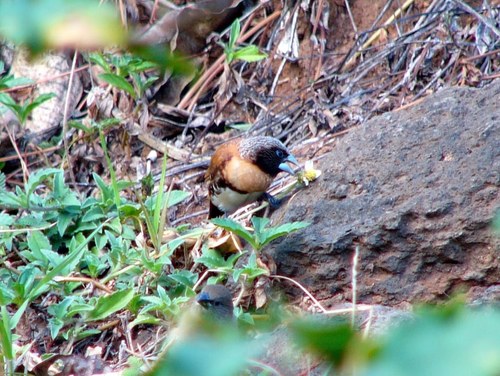 Chestnut-breasted Munia
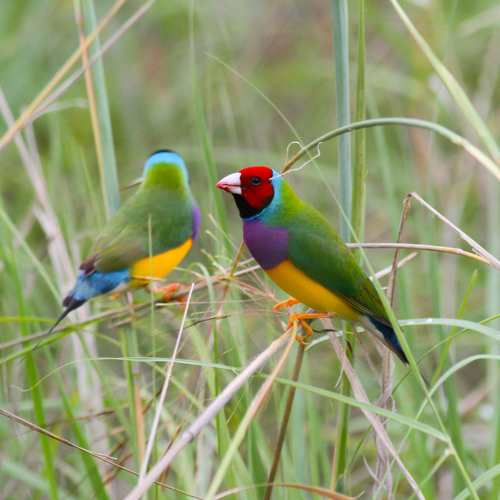 Gouldian Finch
In short
The most reliable field mark to separate Chestnut-breasted Munia from Gouldian Finch is the bold, broad chestnut (ferruginous) breast band and black face of the munia, contrasting with the Gouldian Finch’s striking multicolored head and body. Munias show a black face, greyish crown/nape, and a white belly below the chestnut band, while Gouldian Finches are renowned for their vibrant, patchwork colors—often with purple chest, yellow belly, and either red, black, or yellow head. Juvenile and immature plumages are not detailed for either species in the sources, so focus on adult plumage and face pattern. Both species are small, seed-eating finches, but their coloration and flocking behavior differ markedly in the field.
Identification tips
- Face pattern is diagnostic: Chestnut-breasted Munia always shows a black face with a greyish crown and nape, while Gouldian Finch has a brightly colored head (red, black, or yellow) with no black mask. This is the quickest field check for adults.
- Breast and belly contrast: Munia has a broad, rich chestnut breast band sharply set off from a white belly; Gouldian Finch has a purple chest and a yellow belly, with no chestnut band.
- Back and upperparts: Munia is uniformly brown-backed; Gouldian Finch has a green back, which stands out in good light.
- Bill color and shape: Both have stout, conical bills typical of seed-eaters, but bill color is not a reliable separator in the field from the available notes.
- Flank and nape details (regional): Some munia subspecies show scalloping on the flanks or nape, or paler/greyer head, but these are subtle and rarely needed for separation from Gouldian Finch.
- Juvenile/immature confusion: No distinctive juvenile or immature wing or body patterns are described for either species in the sources; focus on face and underpart color blocks for all ages.
- Flocking behavior: Large, mixed-species flocks (hundreds to thousands) in open country are more likely to be Gouldian Finches; smaller, single-species groups in dense grass or reeds suggest munia.
- Habitat context: Munias are more likely in reedbeds, grassy wetlands, or agricultural edges; Gouldians favor open, rocky, or sparsely vegetated slopes, especially in the breeding season.
- Sexual dimorphism: Both sexes of both species are similar enough that sex is not a reliable separator in the field.
- Subspecies variation: Munia subspecies may show subtle differences in head and flank color, but all retain the black face and chestnut breast band; Gouldian Finch always shows the multicolored pattern.
- No reliable size difference: Both are small finches; do not rely on size alone.
- No distinctive flight pattern or wing marks: Neither species is described as having unique flight or upperwing patterns for field separation.
- No vocalization differences described: Calls and songs are not detailed in the sources; do not use voice for separation.
- Plumage pitfalls: In poor light, the chestnut breast band of the munia may appear darker, but the absence of a multicolored head and body will still separate it from Gouldian Finch.
- Aviculture context: Gouldian Finches are popular cage birds and may be seen in non-native settings; Chestnut-breasted Munias are less often kept, but both can escape and appear in unexpected places.
Size
Chestnut-breasted Munia averages about 13 grams in body mass [wikidata], which is typical for a small munia. Gouldian Finch mass is not specified in the sources, but both are similar in overall size and structure in the field, so size alone is not a reliable separator between these two. Expect both to look like small, compact finches with short tails and conical bills.
Plumage
Adult Chestnut-breasted Munia is brown-backed with a black face, greyish crown and nape, and a broad chestnut breast band sharply set off from the white belly. Subspecies and regional variants may show subtle differences in head color (from grey to black) and flank scalloping, but the overall pattern is consistent: a strong, dark face and chestnut band. Gouldian Finch is unmistakable in adult plumage: males and females both have a bright purple chest, yellow belly, green back, and a head that is either red, black, or yellow depending on morph. No subspecies or age-related wing pattern differences are described for either species, and juvenile/immature plumages are not detailed in the sources. Thus, focus on the face and underpart color blocks for all ages seen in the field.
Behaviour
Gouldian Finches are highly social outside the breeding season, often forming large, mixed-species flocks with other grass-finches, sometimes numbering in the thousands. Chestnut-breasted Munias are also gregarious but are not noted for such massive flocks or mixed-species associations. In flight, both species move in tight, undulating groups, but the Gouldian’s flock size and tendency to mix with other finches can be a clue. Both species feed on seeds and are often seen foraging on or near the ground.
Habitat
Both species occur in northern and eastern Australia, but their habitat preferences differ. Chestnut-breasted Munia is found in a range of grassy habitats, including reedbeds, grasslands, and agricultural edges. Gouldian Finch prefers more open, sparsely vegetated areas, especially rocky slopes during the breeding season, and becomes more nomadic in the dry season, moving to find food and water. Gouldians are more likely to be seen in very large flocks in open country, while munias are usually in smaller groups in denser grass or reeds.