

Motmot

Chestnut-backed Antbird vs Bicoloured Antbird

Poliocrania exsul versus Gymnopithys bicolor

Play a quiz with Chestnut-backed Antbird and Bicoloured Antbird
Chestnut-backed Antbird (Poliocrania exsul) Chestnut-backed Antbird
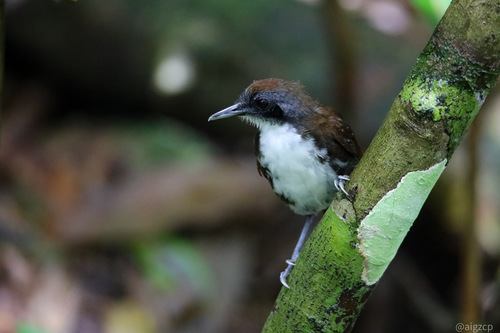
Bicoloured Antbird (Gymnopithys bicolor) Bicoloured Antbird

Media

Loading…

In short

The most reliable field mark to separate Chestnut-backed Antbird from Bicoloured Antbird is the color of the underparts: Chestnut-backed Antbird (especially males) shows mostly dark slate to blackish underparts, while Bicoloured Antbird always has a white throat and breast, separated from the brownish flanks by a distinct border. Both species share chestnut upperparts and bare blue skin around the eye, but the underpart contrast is clear in all ages and sexes. Subtle differences in head pattern, iris color, and female plumage can also help, but beware of regional variation and duller females. In the field, focus on the underparts and cheek/throat contrast, especially if the bird is perched and well-lit.

Identification tips

  1. Underpart color is the quickest check: Chestnut-backed Antbird males have slate-black to blackish underparts (throat, breast, belly), while Bicoloured Antbird always shows a white throat and breast, sharply separated from the brownish flanks. This works for all adults and is visible in perched birds.
  2. Female Chestnut-backed Antbird can be confusing: Females have brownish or rufous underparts (sometimes buff or cinnamon in certain subspecies), but never a clean white throat and breast. If you see a white throat and breast, it's Bicoloured.
  3. Face pattern: Bicoloured Antbird has a gray forehead, broad gray band behind the eye, and black cheeks, creating a more contrasting facial pattern. Chestnut-backed Antbird's face is more uniformly dark/slate, with less contrast.
  4. Iris color: Chestnut-backed Antbird has a reddish-brown iris, which can be seen at close range. Iris color for Bicoloured is not specified, so this is only a supporting mark if you see reddish eyes.
  5. Bare blue skin around the eye: Both species show this, so it's not helpful for separation.
  6. Upperparts: Both have chestnut upperparts, wings, and tail, so do not rely on this for ID.
  7. Wing coverts: Some Chestnut-backed Antbird subspecies (e.g., maculifer, cassini) have white-tipped wing coverts in males, but this is not a consistent mark across all populations and can be subtle.
  8. Cheek and throat contrast: On Bicoloured Antbird, the black cheek stands out against the white throat and gray forehead, while Chestnut-backed's face is more uniformly dark.
  9. Subspecies confusion: Female Chestnut-backed Antbird in some regions (e.g., occidentalis, cassini) can show brighter or buffier underparts, but still lack the white throat and breast of Bicoloured.
  10. No reliable flight or immature wing pattern difference: Neither species is described as having a unique upperwing or flight mark for juveniles or immatures, so focus on perched views.
  11. Size is not helpful: Both species are essentially the same size and weight in the field.
  12. Habitat overlap: Both occur in the same countries and similar forest habitats; do not use location alone for separation.
  13. Behavior is not diagnostic: Both behave like typical antbirds and may follow ant swarms.
  14. If in doubt, prioritize underpart and throat color: This is the most consistent and visible field mark across all ages and sexes.
  15. If you see a bird with a white throat and breast and chestnut upperparts, it's Bicoloured Antbird; if the underparts are dark slate or brownish (never white), it's Chestnut-backed Antbird. This works even with subspecies variation.

Size

Both species are very similar in size, with Chestnut-backed Antbird measuring 14–15 cm and weighing about 29 g, and Bicoloured Antbird ranging from 13.5–15 cm and 28–37 g. Any size difference is negligible in the field and not a reliable separation point.

Plumage

Age-specific wing or flight marks are not described for either species, so focus on perched birds. For adults, Chestnut-backed Antbird males have a slate-black head, neck, throat, breast, and belly, with deep chestnut upperparts and wings; females are similar but with duller head and brownish underparts. Bicoloured Antbird adults (both sexes) have a brownish chestnut crown, nape, back, wings, and tail, but a white throat and breast, with a brown band running from the cheek along the flanks. The face of Bicoloured Antbird shows a gray forehead and broad gray band behind the eye, with black cheeks, while Chestnut-backed Antbird has a more uniformly dark/slate face and reddish-brown iris. Subspecies variation in both can cause some confusion, especially in female Chestnut-backed Antbird, which may show rufous or buffy underparts, but never the clean white throat and breast of Bicoloured. Both have bare blue skin around the eye, but the iris of Chestnut-backed is reddish-brown, while iris color is not specified for Bicoloured.

Behaviour

No diagnostic behavioral differences are described in the provided notes. Both are typical antbirds and may behave similarly when foraging or following ant swarms.

Habitat

Both species share a similar range (Colombia, Costa Rica, Ecuador, Honduras, Nicaragua, Panama) and are found in comparable habitats. Habitat is not a reliable separator in the field within their overlapping range.

Submit a better description

Use the same sections as the comparison. Your text is published immediately.

The most reliable field mark to separate Chestnut-backed Antbird from Bicoloured Antbird is the color of the underparts: Chestnut-backed Antbird (especially males) shows mostly dark slate to blackish underparts, while Bicoloured Antbird always has a white throat and breast, separated from the brownish flanks by a distinct border. Both species share chestnut upperparts and bare blue skin around the eye, but the underpart contrast is clear in all ages and sexes. Subtle differences in head pattern, iris color, and female plumage can also help, but beware of regional variation and duller females. In the field, focus on the underparts and cheek/throat contrast, especially if the bird is perched and well-lit.

  1. Underpart color is the quickest check: Chestnut-backed Antbird males have slate-black to blackish underparts (throat, breast, belly), while Bicoloured Antbird always shows a white throat and breast, sharply separated from the brownish flanks. This works for all adults and is visible in perched birds.
  2. Female Chestnut-backed Antbird can be confusing: Females have brownish or rufous underparts (sometimes buff or cinnamon in certain subspecies), but never a clean white throat and breast. If you see a white throat and breast, it's Bicoloured.
  3. Face pattern: Bicoloured Antbird has a gray forehead, broad gray band behind the eye, and black cheeks, creating a more contrasting facial pattern. Chestnut-backed Antbird's face is more uniformly dark/slate, with less contrast.
  4. Iris color: Chestnut-backed Antbird has a reddish-brown iris, which can be seen at close range. Iris color for Bicoloured is not specified, so this is only a supporting mark if you see reddish eyes.
  5. Bare blue skin around the eye: Both species show this, so it's not helpful for separation.
  6. Upperparts: Both have chestnut upperparts, wings, and tail, so do not rely on this for ID.
  7. Wing coverts: Some Chestnut-backed Antbird subspecies (e.g., maculifer, cassini) have white-tipped wing coverts in males, but this is not a consistent mark across all populations and can be subtle.
  8. Cheek and throat contrast: On Bicoloured Antbird, the black cheek stands out against the white throat and gray forehead, while Chestnut-backed's face is more uniformly dark.
  9. Subspecies confusion: Female Chestnut-backed Antbird in some regions (e.g., occidentalis, cassini) can show brighter or buffier underparts, but still lack the white throat and breast of Bicoloured.
  10. No reliable flight or immature wing pattern difference: Neither species is described as having a unique upperwing or flight mark for juveniles or immatures, so focus on perched views.
  11. Size is not helpful: Both species are essentially the same size and weight in the field.
  12. Habitat overlap: Both occur in the same countries and similar forest habitats; do not use location alone for separation.
  13. Behavior is not diagnostic: Both behave like typical antbirds and may follow ant swarms.
  14. If in doubt, prioritize underpart and throat color: This is the most consistent and visible field mark across all ages and sexes.
  15. If you see a bird with a white throat and breast and chestnut upperparts, it's Bicoloured Antbird; if the underparts are dark slate or brownish (never white), it's Chestnut-backed Antbird. This works even with subspecies variation.

Both species are very similar in size, with Chestnut-backed Antbird measuring 14–15 cm and weighing about 29 g, and Bicoloured Antbird ranging from 13.5–15 cm and 28–37 g. Any size difference is negligible in the field and not a reliable separation point.

Age-specific wing or flight marks are not described for either species, so focus on perched birds. For adults, Chestnut-backed Antbird males have a slate-black head, neck, throat, breast, and belly, with deep chestnut upperparts and wings; females are similar but with duller head and brownish underparts. Bicoloured Antbird adults (both sexes) have a brownish chestnut crown, nape, back, wings, and tail, but a white throat and breast, with a brown band running from the cheek along the flanks. The face of Bicoloured Antbird shows a gray forehead and broad gray band behind the eye, with black cheeks, while Chestnut-backed Antbird has a more uniformly dark/slate face and reddish-brown iris. Subspecies variation in both can cause some confusion, especially in female Chestnut-backed Antbird, which may show rufous or buffy underparts, but never the clean white throat and breast of Bicoloured. Both have bare blue skin around the eye, but the iris of Chestnut-backed is reddish-brown, while iris color is not specified for Bicoloured.

No diagnostic behavioral differences are described in the provided notes. Both are typical antbirds and may behave similarly when foraging or following ant swarms.

Both species share a similar range (Colombia, Costa Rica, Ecuador, Honduras, Nicaragua, Panama) and are found in comparable habitats. Habitat is not a reliable separator in the field within their overlapping range.

Discard your changes?

You have unsaved edits. If you leave now, those changes will be lost.

Chestnut-backed Antbird · Bicoloured Antbird · My Tricky Birds