

Motmot

Cassin's Vireo vs Blue-headed Vireo

Vireo cassinii versus Vireo solitarius

Play a quiz with Cassin's Vireo and Blue-headed Vireo
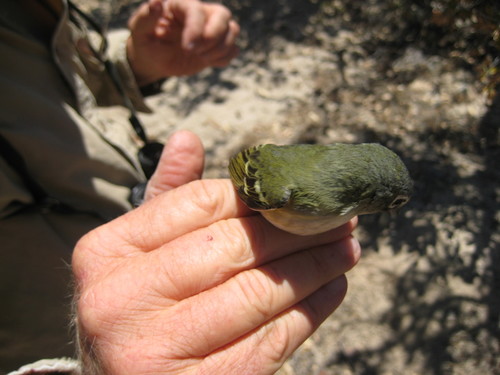
Cassin's Vireo (Vireo cassinii) Cassin's Vireo
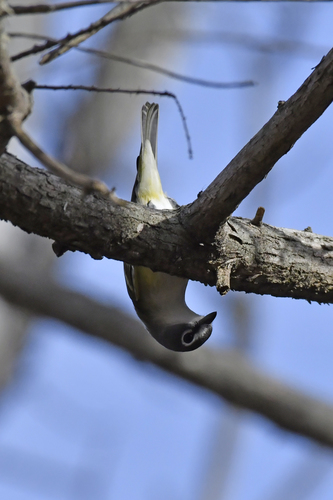
Blue-headed Vireo (Vireo solitarius) Blue-headed Vireo

Media

Loading…

In short

The most reliable field mark between Cassin's Vireo and Blue-headed Vireo is the color and contrast of the head: Cassin's has a grayish-olive or brownish-gray crown, while Blue-headed shows a deeper blue-gray crown that stands out sharply from the white spectacles and greenish back. Both species have bold white spectacles and wing bars, but Blue-headed's wing bars are more distinctly yellow, and its head is noticeably bluer. Juvenile and adult plumages are very similar within each species, so age is not a major separator. Bill shape and subtle differences in the amount and tone of yellow on the flanks can help, but are best used in combination with head color. Range and habitat are also strong clues, as their breeding distributions barely overlap.

Identification tips

  1. Head color is the single best field mark: Cassin's Vireo has a grayish-olive or brownish-gray crown, while Blue-headed Vireo shows a deep blue-gray crown that stands out from the white spectacles and greenish back. This contrast is most obvious in good light and on perched birds.
  2. Spectacles: Both species have bold white spectacles, so this mark alone does not separate them. Use in combination with head color.
  3. Wing bars: Blue-headed Vireo's wing bars are distinctly yellow, while Cassin's are white or only faintly yellowish. This is subtle but can help in bright light or photos.
  4. Flank color: Blue-headed Vireo usually shows brighter and more extensive yellow on the flanks, while Cassin's yellow is paler and more restricted.
  5. Bill shape: Cassin's has a smaller, thinner bill, especially compared to the larger-billed Blue-headed Vireo (alticola). This can be tricky to judge unless you have direct comparison or good views.
  6. Crown contrast: On Blue-headed, the blue-gray crown is sharply demarcated from the white spectacles and olive-green back; on Cassin's, the crown blends more smoothly into the back and spectacles.
  7. Juvenile plumage: Both species' juveniles look like adults, so age is not a reliable separator. No distinctive juvenile wing or flight marks are noted for either species.
  8. Range: Cassin's breeds in the western US and southern British Columbia; Blue-headed breeds in Canada and the eastern US. If you are outside the overlap zone, range is a strong clue.
  9. Habitat: Cassin's prefers open woodlands in western mountains and foothills; Blue-headed is found in mixed forests with evergreens and deciduous trees, mainly in the east.
  10. Song: Cassin's is known for long, persistent singing bouts with a 'question-and-answer' pattern. If you hear this, Cassin's is likely.
  11. Foraging height: Both species forage in the mid to lower canopy, so this is not a strong separator.
  12. Sex and season: Both species show little or no sexual dimorphism and do not change plumage significantly by season, so these are not useful for separation.
  13. Courtship behavior: Blue-headed males may build partial courtship nests, but this is rarely observed in the field and not a practical separator.
  14. Size: Blue-headed averages slightly larger and bulkier, but overlap is extensive and this is not a reliable field mark except in direct comparison.
  15. Pitfalls: Do not rely solely on spectacles or wing bars; always check head color and crown contrast in good light. Range and habitat are strong supporting clues, especially outside migration periods.

Size

Both species are small vireos with very similar overall size and structure. Cassin's Vireo averages about 14.6 g in body mass [wikidata], while Blue-headed Vireo ranges from 13–19 g [wikipedia]. Blue-headed Vireo is slightly longer (126–148 mm vs. Cassin's 110–140 mm) and may appear a bit bulkier, but these differences are subtle and rarely diagnostic in the field. Bill size can be a clue: Cassin's has a slightly smaller, thinner bill, especially compared to the larger-billed Blue-headed Vireo subspecies (alticola).

Plumage

Juvenile and adult plumages are similar within each species, so age is not a major separator. Both species show bold white spectacles, white underparts, and two wing bars. The key difference is in the head and wing bar color: Cassin's Vireo has a grayish-olive or brownish-gray crown and paler yellowish flanks, while Blue-headed Vireo has a deep blue-gray crown that contrasts sharply with the white spectacles and greenish back, and its wing bars are more distinctly yellow. The yellow on Blue-headed's flanks is usually brighter and more extensive. Juveniles of both species resemble adults, so these marks apply year-round.

Behaviour

Both species forage methodically in the mid to lower canopy, often pausing to scan for insects. Cassin's Vireo is known for its persistent, long bouts of singing, sometimes drawing in other birds. Blue-headed Vireo males build partial courtship nests and defend larger territories during breeding. Both species are deliberate movers, but behavioral differences are subtle and not usually diagnostic without vocal cues.

Habitat

Cassin's Vireo breeds in open woodlands of western mountains and foothills, especially in the Pacific states and southern British Columbia. Blue-headed Vireo breeds in large temperate forests with a mix of evergreen and deciduous trees, mostly in Canada and the eastern US. If you are in the far west, Cassin's is much more likely; in the northeast or southeast, Blue-headed is expected. Their ranges barely overlap except possibly during migration in the interior West.

Voice

Cassin's Vireo sings a persistent series of short, rough-whistled phrases, often with a 'question-and-answer' pattern (alternating high and low endings), sometimes described as 'cha-cha-cha.' Blue-headed Vireo's song is not described in detail here, but Cassin's is noted for its long, persistent singing. Both species use song for territory and mate attraction, but Cassin's extended singing bouts can be a clue.

Submit a better description

Use the same sections as the comparison. Your text is published immediately.

The most reliable field mark between Cassin's Vireo and Blue-headed Vireo is the color and contrast of the head: Cassin's has a grayish-olive or brownish-gray crown, while Blue-headed shows a deeper blue-gray crown that stands out sharply from the white spectacles and greenish back. Both species have bold white spectacles and wing bars, but Blue-headed's wing bars are more distinctly yellow, and its head is noticeably bluer. Juvenile and adult plumages are very similar within each species, so age is not a major separator. Bill shape and subtle differences in the amount and tone of yellow on the flanks can help, but are best used in combination with head color. Range and habitat are also strong clues, as their breeding distributions barely overlap.

  1. Head color is the single best field mark: Cassin's Vireo has a grayish-olive or brownish-gray crown, while Blue-headed Vireo shows a deep blue-gray crown that stands out from the white spectacles and greenish back. This contrast is most obvious in good light and on perched birds.
  2. Spectacles: Both species have bold white spectacles, so this mark alone does not separate them. Use in combination with head color.
  3. Wing bars: Blue-headed Vireo's wing bars are distinctly yellow, while Cassin's are white or only faintly yellowish. This is subtle but can help in bright light or photos.
  4. Flank color: Blue-headed Vireo usually shows brighter and more extensive yellow on the flanks, while Cassin's yellow is paler and more restricted.
  5. Bill shape: Cassin's has a smaller, thinner bill, especially compared to the larger-billed Blue-headed Vireo (alticola). This can be tricky to judge unless you have direct comparison or good views.
  6. Crown contrast: On Blue-headed, the blue-gray crown is sharply demarcated from the white spectacles and olive-green back; on Cassin's, the crown blends more smoothly into the back and spectacles.
  7. Juvenile plumage: Both species' juveniles look like adults, so age is not a reliable separator. No distinctive juvenile wing or flight marks are noted for either species.
  8. Range: Cassin's breeds in the western US and southern British Columbia; Blue-headed breeds in Canada and the eastern US. If you are outside the overlap zone, range is a strong clue.
  9. Habitat: Cassin's prefers open woodlands in western mountains and foothills; Blue-headed is found in mixed forests with evergreens and deciduous trees, mainly in the east.
  10. Song: Cassin's is known for long, persistent singing bouts with a 'question-and-answer' pattern. If you hear this, Cassin's is likely.
  11. Foraging height: Both species forage in the mid to lower canopy, so this is not a strong separator.
  12. Sex and season: Both species show little or no sexual dimorphism and do not change plumage significantly by season, so these are not useful for separation.
  13. Courtship behavior: Blue-headed males may build partial courtship nests, but this is rarely observed in the field and not a practical separator.
  14. Size: Blue-headed averages slightly larger and bulkier, but overlap is extensive and this is not a reliable field mark except in direct comparison.
  15. Pitfalls: Do not rely solely on spectacles or wing bars; always check head color and crown contrast in good light. Range and habitat are strong supporting clues, especially outside migration periods.

Both species are small vireos with very similar overall size and structure. Cassin's Vireo averages about 14.6 g in body mass [wikidata], while Blue-headed Vireo ranges from 13–19 g [wikipedia]. Blue-headed Vireo is slightly longer (126–148 mm vs. Cassin's 110–140 mm) and may appear a bit bulkier, but these differences are subtle and rarely diagnostic in the field. Bill size can be a clue: Cassin's has a slightly smaller, thinner bill, especially compared to the larger-billed Blue-headed Vireo subspecies (alticola).

Juvenile and adult plumages are similar within each species, so age is not a major separator. Both species show bold white spectacles, white underparts, and two wing bars. The key difference is in the head and wing bar color: Cassin's Vireo has a grayish-olive or brownish-gray crown and paler yellowish flanks, while Blue-headed Vireo has a deep blue-gray crown that contrasts sharply with the white spectacles and greenish back, and its wing bars are more distinctly yellow. The yellow on Blue-headed's flanks is usually brighter and more extensive. Juveniles of both species resemble adults, so these marks apply year-round.

Both species forage methodically in the mid to lower canopy, often pausing to scan for insects. Cassin's Vireo is known for its persistent, long bouts of singing, sometimes drawing in other birds. Blue-headed Vireo males build partial courtship nests and defend larger territories during breeding. Both species are deliberate movers, but behavioral differences are subtle and not usually diagnostic without vocal cues.

Cassin's Vireo breeds in open woodlands of western mountains and foothills, especially in the Pacific states and southern British Columbia. Blue-headed Vireo breeds in large temperate forests with a mix of evergreen and deciduous trees, mostly in Canada and the eastern US. If you are in the far west, Cassin's is much more likely; in the northeast or southeast, Blue-headed is expected. Their ranges barely overlap except possibly during migration in the interior West.

Cassin's Vireo sings a persistent series of short, rough-whistled phrases, often with a 'question-and-answer' pattern (alternating high and low endings), sometimes described as 'cha-cha-cha.' Blue-headed Vireo's song is not described in detail here, but Cassin's is noted for its long, persistent singing. Both species use song for territory and mate attraction, but Cassin's extended singing bouts can be a clue.

Discard your changes?

You have unsaved edits. If you leave now, those changes will be lost.

Cassin's Vireo · Blue-headed Vireo · My Tricky Birds