
Caspian Gull vs Caspian Tern
Larus cachinnans versus Hydroprogne caspia
Play a quiz with Caspian Gull and Caspian Tern
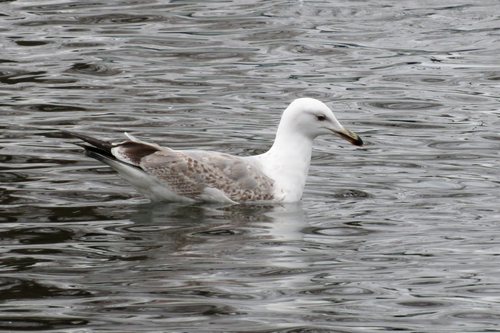 Caspian Gull
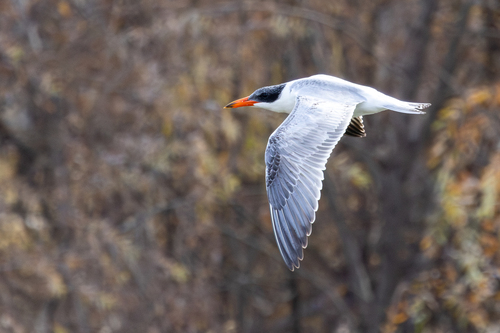 Caspian Tern
In short
The most reliable way to separate Caspian Gull from Caspian Tern is by overall structure and bill shape: Caspian Gull is a hefty, broad-winged gull with a long, slender bill and pale legs, while Caspian Tern is a sleeker, more angular bird with a thick, bright red-orange bill and black legs. Juvenile and first-winter Caspian Gulls show pale heads with dark neck streaking and two pale wingbars, while Caspian Terns (adults and immatures) have a striking black cap and white body, never showing the gull's streaked head or wingbars. In flight, Caspian Tern's wings are narrower and more pointed, with blackish wingtips below and a less forked tail. Caspian Gull is much heavier and bulkier, with a distinctly gull-like jizz, while Caspian Tern is more streamlined and tern-like, often seen plunge-diving or flying with more elastic wingbeats.
Identification tips
- Bill shape and color: Caspian Tern has a thick, bright red-orange bill with a black tip (all ages), while Caspian Gull has a long, slender, pale to yellowish bill (never bright red). This is the single most obvious field mark at close range.
- Leg color: Caspian Tern always has black legs; Caspian Gull's legs are pale pink to pale yellowish, never black.
- Head pattern (immatures): First-winter Caspian Gull shows a pale head with dark streaking on the nape; Caspian Tern (of any age) never shows this pattern, instead having a solid black cap (adults) or a streaked black cap (winter), but always a white face and throat.
- Wing pattern (immatures): Juvenile/first-winter Caspian Gull has two pale lines (wingbars) across the wing from the tips of the greater and median coverts; Caspian Tern never shows these wingbars.
- Upperwing color (adults): Caspian Gull's upperwings are pale grey with a large white tip and white 'tongue' on the outermost primary; Caspian Tern's upperwings are paler grey with blackish wingtips below, lacking the white tongue or large white tip.
- Tail shape: Caspian Tern's tail is less forked than other terns but still pointed; Caspian Gull's tail is square or slightly rounded, never forked.
- Body structure: Caspian Gull is bulkier, with a deeper chest, longer legs, and a more horizontal stance; Caspian Tern is slimmer, more upright, and more angular in profile.
- Flight jizz: Caspian Gull flies with steady, deep wingbeats and broad wings; Caspian Tern has narrower, more pointed wings and flies with more elastic, tern-like wingbeats.
- Plumage color: Caspian Tern is overall whiter, with a clean white body and black cap; Caspian Gull is more greyish above and never has a full black cap.
- Voice: Caspian Tern's call is a loud, harsh croak, unlike the laughing or cackling calls of Caspian Gull.
- Habitat: Caspian Tern is almost always near open water, often seen plunge-diving; Caspian Gull is more often found loafing on land or in mixed gull flocks.
- Size in mixed flocks: Even though both are large, Caspian Gull is heavier and bulkier than Caspian Tern—useful if both are present.
- Perched posture: Caspian Tern stands upright and appears sleek; Caspian Gull is more horizontal and robust.
- Seasonal head pattern: In winter, Caspian Tern's black cap becomes streaked but never forms the streaked nape of young Caspian Gull.
- Association: Caspian Tern is often with other terns, rarely with gulls; Caspian Gull is usually with other large gulls.
Size
Caspian Gull is substantially heavier (average adult mass 1154 g vs. 634 g for Caspian Tern [wikidata]), and also longer (56–68 cm vs. 48–60 cm) and broader-winged (wingspan 137–155 cm vs. 127–145 cm) [wikipedia]. In the field, Caspian Gull appears bulkier and more robust, with a deeper chest and longer legs, while Caspian Tern is slimmer and more elongated, with a narrower body and shorter legs. Even though Caspian Tern is the largest tern, it is still noticeably lighter and less massive than Caspian Gull.
Plumage
Juvenile and first-winter Caspian Gulls have a pale head with dark streaking on the nape, pale underparts, and a greyish back. Their greater and median wing coverts have whitish tips, forming two pale lines across the wing—these pale wingbars are a key field mark for young gulls. Adult Caspian Gulls have a pale grey back and wings, with a large white tip and white 'tongue' on the outermost primary. In contrast, Caspian Tern adults have a white head with a solid black cap (which becomes streaked in winter), a white neck, belly, and tail, and pale grey upperwings with blackish wingtips below. The tail is less forked than other terns but never square or rounded like a gull. Immature Caspian Terns are variable but never show the streaked nape or pale wingbars of young Caspian Gulls. The bill is always bright red-orange with a black tip in Caspian Tern, while Caspian Gull's bill is long, slender, and pale to yellowish, lacking any bright color.
Behaviour
Caspian Gull is typically seen loafing on the ground, perched on posts, or flying with steady, deep wingbeats. It often scavenges or forages along shorelines, showing the typical behavior of large gulls. Caspian Tern, in contrast, is more aerial and dynamic: it frequently hovers, plunge-dives for fish, and flies with more elastic, tern-like wingbeats. When perched, Caspian Tern stands more upright and appears sleeker, while Caspian Gull is bulkier and more horizontal. Caspian Tern often associates with other terns, while Caspian Gull is usually found with other large gulls.
Habitat
Both species can be found near large bodies of water, but Caspian Gull is more often seen at inland lakes, reservoirs, and coastal areas, frequently in mixed gull flocks or alone. Caspian Tern prefers open water, sandbars, and islands, and is usually seen in or near breeding colonies or feeding over water. While both may occur together, Caspian Tern is more strictly tied to aquatic habitats and rarely loafs on open ground far from water.
Voice
Caspian Gull gives typical gull calls—loud, laughing, and variable in pitch, often described as 'cackling' or 'laughing.' Caspian Tern has a distinctive, loud, heron-like croak, quite different from any gull call. If heard, the tern's voice is a strong clue: it is harsher and less melodious than the gull's.