

Carrion Crow vs Brown-necked Raven
Corvus corone versus Corvus ruficollis
Play a quiz with Carrion Crow and Brown-necked Raven
 Carrion Crow
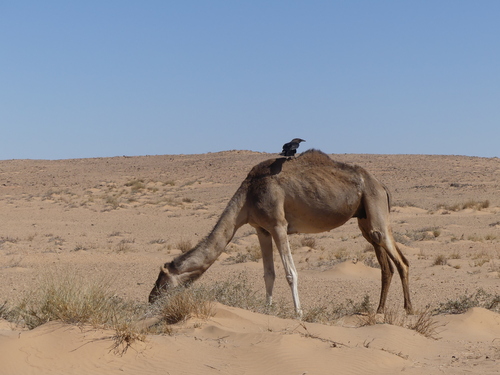 Brown-necked Raven
In short
The most reliable field mark between Carrion Crow and Brown-necked Raven is the distinct brownish-black coloration on the head and throat of the Brown-necked Raven, compared to the uniform black of the Carrion Crow. Brown-necked Raven is also noticeably larger, with a longer, more pointed wing profile and a relatively larger bill, though not as deep as a Common Raven's. In flight, the Brown-necked Raven's wings appear more pointed, and its overall structure is bulkier. Juvenile Carrion Crows can show brownish tones, but lack the contrasting brown neck of the raven. Voice and behavior can help, but plumage and structure are the most reliable in the field.
Identification tips
- Head and Throat Color (All Ages): Brown-necked Raven always shows a brownish-black head and throat, often contrasting with the glossier black body. Carrion Crow is uniform black except for juveniles, which may look browner overall but never show a distinct brown neck.
- Size and Structure: Brown-necked Raven is larger and bulkier, with a longer body and more pointed wings. Its bill is longer and heavier than the crow's, though not as deep as a Common Raven's. Carrion Crow is more compact and stockier, with a shorter bill.
- Wing Shape in Flight: Brown-necked Raven's wings are longer and more pointed, giving it a more raven-like silhouette. Carrion Crow's wings are broader and less pointed, with steadier wingbeats.
- Juvenile Plumage: Juvenile Carrion Crows can appear brownish overall and have blue eyes, but they lack the brownish-black head and throat of the Brown-necked Raven. Juvenile ravens may look even browner as their feathers fade, but the brown is concentrated on the neck and head.
- Gloss and Fading: Both species can show a sheen in good light, but the raven's gloss is more purplish-blue, while the crow's is greener. Brown-necked Raven's feathers fade to a brownish-black, especially on the head and neck, before molt.
- Bill Color and Shape: Both have black bills, but the raven's is longer and more robust. In side profile, the raven's bill looks heavier and slightly curved compared to the crow's straighter, shorter bill.
- Legs and Feet: Both species have black legs and feet; this is not a useful separation mark.
- Behavior: Carrion Crow is usually solitary or in pairs, especially outside winter, while Brown-necked Raven is more likely to be seen in pairs or small groups, often displaying aerial acrobatics.
- Flight Style: Brown-necked Raven often soars and glides, with deeper, slower wingbeats and a more buoyant flight. Carrion Crow's flight is steadier, with less soaring and more direct flapping.
- Voice: Carrion Crow's call is a deep, guttural 'kraa' in short bursts. Brown-necked Raven's calls are higher-pitched, harsher, and more varied, including 'karr-karr-karr' and 'kuerk-kuerk' notes.
- Habitat Context: In urban or temperate habitats, Carrion Crow is more likely. In arid, open, or rocky areas, especially in North Africa or the Middle East, Brown-necked Raven is the default.
- Perched Posture: Brown-necked Raven often appears longer-necked and bulkier when perched, with a heavier bill and a slightly wedge-shaped tail. Carrion Crow is more compact and shorter-necked.
- Tail Shape: Not strongly diagnostic between these two, but Brown-necked Raven may show a slightly more wedge-shaped tail in flight, though not as pronounced as Common Raven.
- Seasonal Variation: Brown-necked Raven's brownish tones are more obvious as feathers fade before molt; Carrion Crow remains black except in juveniles.
- Pitfalls: Beware of juvenile Carrion Crows, which can look brownish overall, but check for the lack of a brownish-black neck and the overall smaller, stockier build.
Size
Brown-necked Raven is consistently larger, measuring 52–56 cm in length, compared to Carrion Crow's 48–52 cm. The raven's wings are also longer and more pointed, and its overall build is bulkier, with a heavier bill (though not as deep as a Common Raven's). Carrion Crow is stockier and more compact, with a wingspan of 84–100 cm and a mass of 400–600 g. Brown-necked Raven's proportions are closer to a small raven than to a crow, and this difference is usually apparent when the two are seen side by side.
Plumage
For all ages, the Brown-necked Raven shows a distinct brownish-black head and throat, which contrasts with the rest of its plumage that is black with a purple, blue, or purplish-blue gloss. This brownish area can become more pronounced as the feathers fade, making the bird look even browner before molt. Carrion Crow, in all plumages except juveniles, is a uniform black with a green or purple sheen, lacking any contrasting brownish areas. Juvenile Carrion Crows may appear browner overall and have blue eyes, but they do not show a brown neck or head contrasting with the body. Both species have black bills, legs, and feet. In strong sunlight, both can look glossy, but only the Brown-necked Raven shows a brownish cast specifically on the head and throat.
Behaviour
Carrion Crow is typically more solitary or found in small groups, especially outside of winter roosts, while Brown-necked Raven often behaves more like a raven, being seen in pairs or small groups and displaying more aerial acrobatics. In flight, Brown-necked Raven has slower, deeper wingbeats and a more soaring, gliding style, with pointed wings. Carrion Crow's flight is steadier, with slower and more deliberate wingbeats compared to a rook, but less soaring than the raven. Both species can become tame near humans, but Carrion Crow is more likely to be seen in urban environments.
Habitat
Carrion Crow is native to western Europe and the eastern Palearctic, often found in a variety of habitats including mountains, forests, and cities. Brown-necked Raven, by contrast, is more typical of arid or semi-arid regions, often in open country, deserts, and rocky areas. While there is some overlap in their ranges, their preferred habitats are usually quite different, with Carrion Crow more urban and temperate, and Brown-necked Raven more rural and arid.
Voice
Carrion Crow has a guttural, deep croaked 'kraa' that is distinct from the higher-pitched calls of the rook. It often calls in short series, sometimes bowing its head and raising its shoulders. Brown-necked Raven's voice is similar to the Common Raven but higher in pitch, with harsh 'karr-karr-karr' notes and a 'kuerk-kuerk' call in flight. Both can be noisy and vocal, but the raven's calls are more varied and typically higher-pitched than the crow's deep croaks.