

Motmot

Carolina Wren vs Bewick's Wren

Thryothorus ludovicianus versus Thryomanes bewickii

Play a quiz with Carolina Wren and Bewick's Wren

Carolina Wren (Thryothorus ludovicianus) Carolina Wren
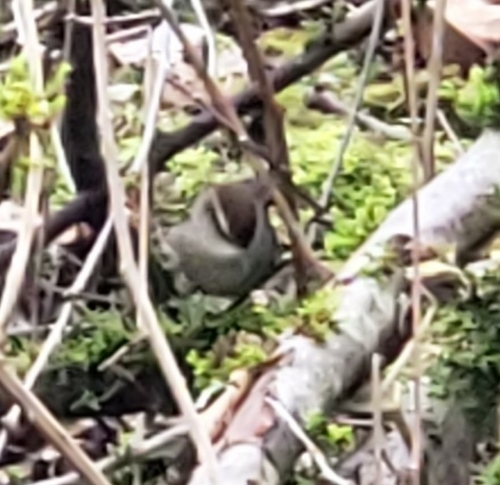
Bewick's Wren (Thryomanes bewickii) Bewick's Wren

Media

Loading…

In short

The most reliable field mark to separate Carolina Wren from Bewick's Wren is the tail: Bewick's Wren has a noticeably longer tail with bold white corners and black bars, which it frequently flicks and fans, while Carolina Wren's tail is shorter, rounder, and more uniformly barred. Juvenile and adult Bewick's Wrens both show white outer tail corners, a feature never present on Carolina Wren. Carolina Wren is bulkier, richer chestnut above, and has a bold white supercilium, but its underparts are warm buff rather than the clean white of Bewick's. Both have prominent eyebrows, but the overall coloration, tail pattern, and structure are the best field clues. Vocalizations are similar and can be confusing, so rely on visual marks first.

Identification tips

  1. Tail pattern is the most reliable mark: Bewick's Wren always shows white outer tail corners and strong black tail barring in all ages and seasons; Carolina Wren never has white tail corners, only even brown barring.
  2. Tail length and behavior: Bewick's Wren has a noticeably longer, thinner tail, which it frequently flicks and fans, often cocked above the back; Carolina Wren's tail is shorter, rounder, and usually held upright but not as expressive.
  3. Underpart color: Bewick's Wren is clean white below (from chin to belly), while Carolina Wren is warm buff to rufous below, especially on the flanks and belly.
  4. Upperpart tone: Carolina Wren is richer chestnut or reddish-brown above; Bewick's Wren is gray-brown to brown, lacking the warm chestnut tones.
  5. Supercilium (eyebrow): Both have a strong white supercilium, but Carolina Wren's is broader, bordered with black above and below, and extends well past the eye; Bewick's is narrower, crisp, and not as long.
  6. Bill shape: Both have long, slightly decurved bills, but Bewick's is finer and more slender; juvenile Bewick's may have a shorter, stubbier bill, but still thinner than Carolina Wren's.
  7. Wing coverts (juveniles): Juvenile Carolina Wrens have buff-tipped wing coverts and a paler supercilium; Bewick's juveniles look like adults but may have faint belly speckling and a shorter bill.
  8. Flight views: In flight, Bewick's Wren's white tail corners are obvious; Carolina Wren shows a plain, evenly barred tail with no white.
  9. Size and structure: Carolina Wren is bulkier, rounder, and heavier; Bewick's is slimmer and more elongated, especially due to the tail.
  10. Habitat context: In the east, Carolina Wren is common in dense, moist cover; Bewick's is now rare east of the Mississippi and prefers brushy, open, or arid habitats in the west.
  11. Vocalizations: Both sing loud, complex songs; do not rely on voice alone unless highly familiar with local dialects.
  12. Sex and season: Both species show little sexual dimorphism; all field marks above apply year-round and to both sexes.
  13. Subspecific variation: Carolina Wren subspecies may vary in tone (from rusty to dull brown), but never show white tail corners or clean white underparts.
  14. Perched posture: Carolina Wren often appears more compact and upright; Bewick's looks longer-tailed and more horizontal.
  15. Common pitfalls: Do not rely solely on supercilium or bill shape; always check tail pattern and underpart color for a confident ID.

Size

Carolina Wren is noticeably heavier and more robust, with a body mass averaging 19.3 g [wikidata], compared to Bewick's Wren's lighter build (8–12 g). Carolina Wren is the second largest wren in the US, measuring 12.5–14 cm in length with a 29 cm wingspan, while Bewick's Wren is slimmer, about 13–14 cm long but with a much shorter wingspan (18 cm). In the field, Carolina Wren appears chunkier and rounder, while Bewick's Wren is more slender and elongated, especially due to its longer tail.

Plumage

Juvenile and adult Bewick's Wrens are best recognized by their long, brown tails with strong black barring and prominent white outer corners, which are visible both perched and in flight. This tail pattern is unique among these two species and is never shown by Carolina Wren at any age. Bewick's Wrens are gray-brown above and clean white below, with a crisp white supercilium. Juvenile Bewick's may show faint speckling below and a shorter, stubbier bill, but the tail pattern remains diagnostic. Carolina Wrens, both adult and juvenile, are richer chestnut above with a buffy to warm underpart wash, a bold white supercilium bordered with black, and a shorter, rounder tail with fine, even barring but no white corners. Juvenile Carolina Wrens are paler and softer-textured, with buff-tipped wing coverts and a paler eyebrow, but still lack the white tail corners of Bewick's. Subspecific variation in Carolina Wren can affect overall tone (from rusty to dull brown), but not the key tail or underpart marks.

Behaviour

Bewick's Wren is highly active, frequently flicking and fanning its long tail, often cocked and swung side-to-side, making the white corners flash. It forages low in brush, often hanging upside down. Carolina Wren is more robust and tends to move with strong, bounding hops, often with its tail held up but not as long or expressive as Bewick's. Both species are inquisitive and vocal, but Carolina Wren is more likely to be seen probing dense tangles or singing from a prominent perch.

Habitat

Carolina Wren is common in the eastern United States, favoring dense cover in forests, farm edges, and suburban gardens. Its range extends into the southeast of Mexico and northern Central America, but it avoids very open or arid habitats. Bewick's Wren, historically widespread, is now rare east of the Mississippi and is most often found in thickets, brush piles, open woodlands, and scrubby areas, often near streams, especially in the western US. Overlap is limited, but where both occur, Carolina Wren prefers denser, moister cover, while Bewick's is more at home in open, brushy, or arid edge habitats.

Voice

Both species have loud, melodious songs and can be confusing by ear. Carolina Wren's song is variable, often a rolling series of repeated phrases, sometimes confused with Kentucky Warbler or Tufted Titmouse. Bewick's Wren's song is also loud and complex, but slightly more musical and less ringing. Calls are not reliably separable in the field for most observers, so visual marks are preferable.

Submit a better description

Use the same sections as the comparison. Your text is published immediately.

The most reliable field mark to separate Carolina Wren from Bewick's Wren is the tail: Bewick's Wren has a noticeably longer tail with bold white corners and black bars, which it frequently flicks and fans, while Carolina Wren's tail is shorter, rounder, and more uniformly barred. Juvenile and adult Bewick's Wrens both show white outer tail corners, a feature never present on Carolina Wren. Carolina Wren is bulkier, richer chestnut above, and has a bold white supercilium, but its underparts are warm buff rather than the clean white of Bewick's. Both have prominent eyebrows, but the overall coloration, tail pattern, and structure are the best field clues. Vocalizations are similar and can be confusing, so rely on visual marks first.

  1. Tail pattern is the most reliable mark: Bewick's Wren always shows white outer tail corners and strong black tail barring in all ages and seasons; Carolina Wren never has white tail corners, only even brown barring.
  2. Tail length and behavior: Bewick's Wren has a noticeably longer, thinner tail, which it frequently flicks and fans, often cocked above the back; Carolina Wren's tail is shorter, rounder, and usually held upright but not as expressive.
  3. Underpart color: Bewick's Wren is clean white below (from chin to belly), while Carolina Wren is warm buff to rufous below, especially on the flanks and belly.
  4. Upperpart tone: Carolina Wren is richer chestnut or reddish-brown above; Bewick's Wren is gray-brown to brown, lacking the warm chestnut tones.
  5. Supercilium (eyebrow): Both have a strong white supercilium, but Carolina Wren's is broader, bordered with black above and below, and extends well past the eye; Bewick's is narrower, crisp, and not as long.
  6. Bill shape: Both have long, slightly decurved bills, but Bewick's is finer and more slender; juvenile Bewick's may have a shorter, stubbier bill, but still thinner than Carolina Wren's.
  7. Wing coverts (juveniles): Juvenile Carolina Wrens have buff-tipped wing coverts and a paler supercilium; Bewick's juveniles look like adults but may have faint belly speckling and a shorter bill.
  8. Flight views: In flight, Bewick's Wren's white tail corners are obvious; Carolina Wren shows a plain, evenly barred tail with no white.
  9. Size and structure: Carolina Wren is bulkier, rounder, and heavier; Bewick's is slimmer and more elongated, especially due to the tail.
  10. Habitat context: In the east, Carolina Wren is common in dense, moist cover; Bewick's is now rare east of the Mississippi and prefers brushy, open, or arid habitats in the west.
  11. Vocalizations: Both sing loud, complex songs; do not rely on voice alone unless highly familiar with local dialects.
  12. Sex and season: Both species show little sexual dimorphism; all field marks above apply year-round and to both sexes.
  13. Subspecific variation: Carolina Wren subspecies may vary in tone (from rusty to dull brown), but never show white tail corners or clean white underparts.
  14. Perched posture: Carolina Wren often appears more compact and upright; Bewick's looks longer-tailed and more horizontal.
  15. Common pitfalls: Do not rely solely on supercilium or bill shape; always check tail pattern and underpart color for a confident ID.

Carolina Wren is noticeably heavier and more robust, with a body mass averaging 19.3 g [wikidata], compared to Bewick's Wren's lighter build (8–12 g). Carolina Wren is the second largest wren in the US, measuring 12.5–14 cm in length with a 29 cm wingspan, while Bewick's Wren is slimmer, about 13–14 cm long but with a much shorter wingspan (18 cm). In the field, Carolina Wren appears chunkier and rounder, while Bewick's Wren is more slender and elongated, especially due to its longer tail.

Juvenile and adult Bewick's Wrens are best recognized by their long, brown tails with strong black barring and prominent white outer corners, which are visible both perched and in flight. This tail pattern is unique among these two species and is never shown by Carolina Wren at any age. Bewick's Wrens are gray-brown above and clean white below, with a crisp white supercilium. Juvenile Bewick's may show faint speckling below and a shorter, stubbier bill, but the tail pattern remains diagnostic. Carolina Wrens, both adult and juvenile, are richer chestnut above with a buffy to warm underpart wash, a bold white supercilium bordered with black, and a shorter, rounder tail with fine, even barring but no white corners. Juvenile Carolina Wrens are paler and softer-textured, with buff-tipped wing coverts and a paler eyebrow, but still lack the white tail corners of Bewick's. Subspecific variation in Carolina Wren can affect overall tone (from rusty to dull brown), but not the key tail or underpart marks.

Bewick's Wren is highly active, frequently flicking and fanning its long tail, often cocked and swung side-to-side, making the white corners flash. It forages low in brush, often hanging upside down. Carolina Wren is more robust and tends to move with strong, bounding hops, often with its tail held up but not as long or expressive as Bewick's. Both species are inquisitive and vocal, but Carolina Wren is more likely to be seen probing dense tangles or singing from a prominent perch.

Carolina Wren is common in the eastern United States, favoring dense cover in forests, farm edges, and suburban gardens. Its range extends into the southeast of Mexico and northern Central America, but it avoids very open or arid habitats. Bewick's Wren, historically widespread, is now rare east of the Mississippi and is most often found in thickets, brush piles, open woodlands, and scrubby areas, often near streams, especially in the western US. Overlap is limited, but where both occur, Carolina Wren prefers denser, moister cover, while Bewick's is more at home in open, brushy, or arid edge habitats.

Both species have loud, melodious songs and can be confusing by ear. Carolina Wren's song is variable, often a rolling series of repeated phrases, sometimes confused with Kentucky Warbler or Tufted Titmouse. Bewick's Wren's song is also loud and complex, but slightly more musical and less ringing. Calls are not reliably separable in the field for most observers, so visual marks are preferable.

Discard your changes?

You have unsaved edits. If you leave now, those changes will be lost.

Carolina Wren · Bewick's Wren · My Tricky Birds