

Caribbean Elaenia vs Village Weaver
Elaenia martinica versus Ploceus cucullatus
Play a quiz with Caribbean Elaenia and Village Weaver
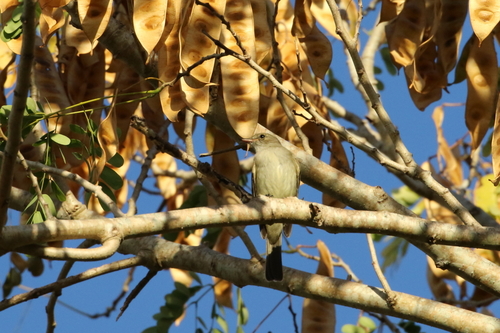 Caribbean Elaenia
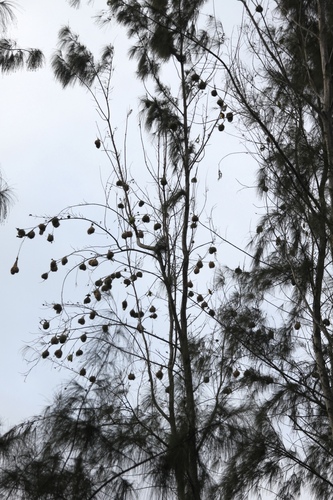 Village Weaver
In short
The most reliable field mark between Caribbean Elaenia and Village Weaver is overall structure and bill shape: the elaenia is a slender, crested flycatcher with a thin, straight bill, while the weaver is a chunky, heavy-bodied bird with a thick, conical bill. In all plumages, the elaenia shows two pale wingbars and a bushy crest with a pale central stripe, while the weaver (especially breeding males) displays strong yellow and black contrast and, in breeding season, a black or chestnut hood. Immature and female weavers are yellower and streakier, but still bulkier and shorter-tailed than the elaenia. Both species can occur in similar semi-open habitats on Caribbean islands, but their behavior and structure are distinct.
Identification tips
- Bill shape is diagnostic: Caribbean Elaenia has a thin, straight flycatcher bill, while Village Weaver has a thick, conical, finch-like bill. This is visible even at a distance and works for all ages and sexes.
- Crest and crown stripe: Elaenia always shows a bushy crest with a pale (white) central stripe, lacking in all weavers. If you see a raised crest with a pale stripe, it's an elaenia.
- Wingbars vs. color contrast: Elaenia has two pale wingbars on dusky wings with yellowish/whitish edges; weaver wings are boldly patterned yellow and black, lacking distinct wingbars but showing strong color contrast, especially in breeding males.
- Head pattern: Breeding male weavers have a black (sometimes chestnut-edged) hood or face, never shown by elaenia. Nonbreeding and female weavers have yellow heads, but never a pale central crown stripe or bushy crest.
- Upperparts and underparts: Elaenia is dull olive to brownish above, pale gray to yellowish below, always subtle and soft-toned. Weaver is much brighter yellow below, with yellow and black above (breeding male) or streaked olive (female/immature), and always more contrasting.
- Tail and posture: Elaenia is more slender, with a longer tail and upright posture. Weaver is stocky, short-tailed, and often appears hunched or heavy-bodied.
- Iris color: Both have dark eyes, so this is not useful.
- Legs and feet: Both have dark legs and feet; not a separating mark.
- Behavior: Elaenia is solitary or in pairs, sallying for insects. Weaver is gregarious, often in flocks or at colonial nests, and feeds on seeds as well as insects.
- Habitat context: Large, conspicuous hanging nests in a tree, especially in groups, point to Village Weaver. Elaenia nests are small, flimsy cups, usually not obvious.
- Juvenile confusion: Young weavers are browner but still show yellow and black wing contrast and are bulkier than any elaenia. Juvenile elaenias look like adults but are always dull and crested.
- Vocalizations: Not described in the notes, so not a reliable field mark here.
- Seasonal variation: Breeding male weavers are most striking with black hoods; nonbreeding and female/immature weavers are duller but still more contrasting and yellow than any elaenia.
- Geographic context: On Caribbean islands, both can occur, but elaenia is native and more likely in wooded or less urban areas; weaver is often near human habitation and in noisy colonies.
- Size impression: If the bird appears chunky and heavy, it's likely a weaver; if slim and upright, likely an elaenia.
Size
Village Weaver is substantially heavier (average 37.6 g) than Caribbean Elaenia (average 21.3 g) [wikidata], and appears more robust and stocky in the field. Length is similar (elaenia 14–18 cm, weaver 15–17 cm), but the weaver's greater mass and thickset build are obvious, especially when perched. The elaenia is more slender and upright, with a proportionally longer tail and smaller head. Bill shape is a key difference: the elaenia has a thin, straight flycatcher bill, while the weaver's bill is thick, conical, and finch-like.
Plumage
No age-specific wing pattern is described for either species, but the following contrasts are reliable across ages and sexes:
- Caribbean Elaenia (all ages/sexes): Dull olive to brownish upperparts, two pale wingbars, dusky wings with yellowish or whitish edges, bushy crest with a white central stripe, pale gray underparts with yellowish or whitish belly and undertail. Face is mottled gray-brown with a faint eyering and whitish lores. No strong color contrast or black mask/hood at any age.
- Village Weaver:
- Breeding male: Striking black head (sometimes edged chestnut), bright yellow underparts, black and yellow upperparts and wings. Southern birds may have more yellow on the crown/nape. Bill is always black.
- Nonbreeding male: Yellow head with olive crown, gray upperparts, whitish underparts, but wings remain yellow and black.
- Female: Streaked olive upperparts, yellow and black wings, pale yellow underparts. No black hood, but still much brighter yellow and more contrasting than elaenia.
- Juvenile: Like female but browner on back, still with yellow and black wing contrast.
The weaver never shows a bushy crest or pale central crown stripe, and always has a heavier, more contrasting appearance than the subtle, soft-toned elaenia.
Behaviour
Caribbean Elaenia is typically solitary or in pairs, perching upright in trees or shrubs, often sallying out to catch insects in flycatcher fashion. It is generally quiet and unobtrusive. Village Weaver is highly social, often seen in noisy flocks or colonies, especially around their large, hanging nests. Weavers are active, often feeding on the ground or in trees, and their colonial nesting and constant chattering are distinctive. The weaver's feeding is more seed/grain-oriented, while the elaenia is primarily insectivorous.
Habitat
Both species can be found in open or semi-open habitats, including gardens and villages on Caribbean islands. However, Caribbean Elaenia is native to the West Indies and adjacent mainland, favoring woodland edges, scrub, and forest clearings. Village Weaver is native to sub-Saharan Africa but has been introduced to several Caribbean islands; it prefers open areas, towns, and especially places with trees suitable for colonial nesting. Large groups of weavers and their conspicuous nests in urban or hotel grounds are a strong clue, while elaenias are more often encountered singly or in pairs in less disturbed habitats.