

Caribbean Elaenia vs Lesser Antillean Flycatcher
Elaenia martinica versus Myiarchus oberi
Play a quiz with Caribbean Elaenia and Lesser Antillean Flycatcher
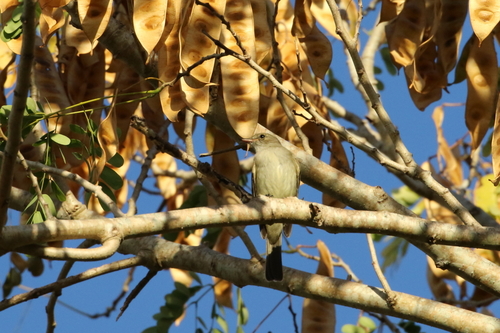 Caribbean Elaenia
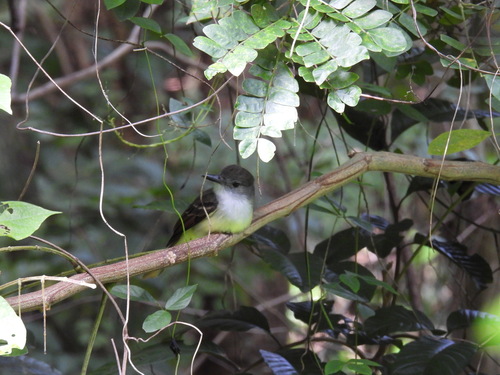 Lesser Antillean Flycatcher
In short
The most reliable field mark to separate Caribbean Elaenia from Lesser Antillean Flycatcher is overall structure and plumage tone: the elaenia is smaller, bushier-crested, and dull olive above with pale wingbars and little rufous, while the flycatcher is larger, longer-tailed, and shows extensive rufous in the wings and tail. In flight or perched, look for the elaenia’s yellowish-tinged underparts and crisp, pale wingbars versus the flycatcher’s bolder rufous edges and more saturated yellow belly. Both species can show a crest, but the elaenia’s is bushier and paler. Size, structure, and the presence or absence of rufous in the wings and tail are the most consistent field clues.
Identification tips
- Size and structure: The Lesser Antillean Flycatcher is substantially larger and heavier than the Caribbean Elaenia. If two birds are together, size difference is obvious, but even singly, the flycatcher’s longer tail and more robust body are good clues. This mark is reliable for all ages and sexes.
- Crest shape: Caribbean Elaenia has a bushy, prominent crest with a white central stripe, often raised and obvious. The flycatcher’s crest is less bushy and lacks a strong pale stripe. Use this when birds are alert or agitated.
- Wing pattern: Elaenia shows two crisp, pale wingbars (whitish tips to coverts) and yellowish to whitish edges on the flight feathers, but no rufous. The flycatcher’s wingbars are faint and may be grayish white or rufous, but the key is the presence of rufous edges on primaries and tertials—never seen in elaenia. This is most helpful on perched birds or in good flight views.
- Tail coloration: The flycatcher has a broad rufous stripe on the inner vanes of the tail feathers (except in one subspecies), while the elaenia’s tail is plain dusky with no rufous. Look for this when the tail is fanned or backlit.
- Upperparts color: Elaenia is dull olive to brownish olive, sometimes appearing almost drab; the flycatcher is darker olive-green, often with a richer tone and rufous uppertail coverts. Use this in good light.
- Underparts: Both have yellowish bellies, but the elaenia’s is paler and can be whitish to dull yellowish, while the flycatcher’s is more saturated yellow, sometimes with a greenish wash on the flanks. The flycatcher’s breast and throat are gray, paler on the throat; the elaenia’s throat is sooty gray and the breast pale gray.
- Bill color: Both have dark bills, but the elaenia’s lower mandible can show a dusky pinkish base, while the flycatcher’s bill is uniformly dark. This is subtle and best seen at close range.
- Iris color: Both have dark brown irises; not a separator.
- Legs and feet: Both species have dark legs and feet; not a separator.
- Behavior: Elaenia is often more active, flicking crest and tail, and appears more compact. The flycatcher sits more upright and can seem bulkier and less restless.
- Habitat: Overlap is extensive, but if seen in dense scrub or gardens, elaenia is more likely; in mature woodland, consider the flycatcher, but do not rely on this alone.
- Subspecies variation: Some flycatcher subspecies lack rufous in the tail (M. o. sclateri), so always check for rufous in the wings as well. Some elaenia subspecies are paler or darker, but never show rufous.
- Voice: Not described in the provided notes; do not use for separation.
- Season and sex: Both species are sexually monomorphic and do not have strong seasonal plumage changes; all marks above apply year-round and to both sexes.
- Pitfalls: Immature or worn elaenias may look especially drab and small, but never show rufous in wings or tail. Flycatchers may appear less colorful in poor light, but rufous edges are usually visible in good views.
Size
Lesser Antillean Flycatcher is noticeably larger and heavier (body mass ~35 g, length 19–22 cm) than Caribbean Elaenia (body mass ~21 g, length 14–18 cm) [wikidata]. The flycatcher’s proportions are more elongated, with a longer tail and slightly heavier bill. In the field, the elaenia often appears compact and short-tailed, while the flycatcher looks rangier and more robust.
Plumage
No age-specific juvenile or immature wing patterns are described for either species, so focus is on adult and general plumage. Caribbean Elaenia is dull olive to brownish olive above, with a bushy crest that has a white central stripe, and two pale wingbars formed by whitish tips to the coverts. Its wings are dusky with yellowish or whitish edges, but lack any rufous. Underparts are pale gray to whitish or dull yellowish, with yellowish undertail coverts. Lesser Antillean Flycatcher is darker olive-green above, with a crest but less bushy, and shows rufous edges on the primaries, tertials, and uppertail coverts. Its wingbars are faint and can be grayish white or rufous, but are less distinct than the elaenia’s. The tail has a broad rufous stripe on the inner vanes (absent in one subspecies), and the underparts are gray on the breast and throat, with a yellow belly and undertail coverts, often with a greenish wash on the flanks. The flycatcher’s rufous in the wings and tail is a key separator from the elaenia’s plain dusky wings and tail.
Behaviour
Both species are typical tyrant flycatchers, often sallying from exposed perches to catch insects. The elaenia may appear more active and restless, flicking its crest and tail, while the flycatcher tends to sit more upright and can seem bulkier. The flycatcher may also favor slightly higher or more open perches, but this is subtle and not always reliable.
Habitat
Both species occur in wooded and edge habitats on Caribbean islands, but the Lesser Antillean Flycatcher is more restricted to the Lesser Antilles, while Caribbean Elaenia is more widespread in the West Indies and adjacent mainland areas. Habitat overlap is significant, so location alone is not diagnostic, but the flycatcher may be more tied to mature woodland or forest edge, while the elaenia can be found in a broader range of scrub, gardens, and secondary growth.
Caribbean Elaenia · Lesser Antillean Flycatcher · My Tricky Birds