

Caribbean Elaenia vs Eastern Wood-Pewee
Elaenia martinica versus Contopus virens
Play a quiz with Caribbean Elaenia and Eastern Wood-Pewee
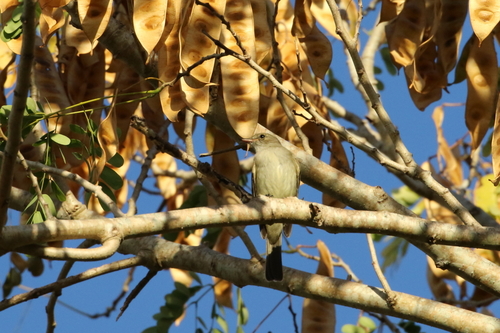 Caribbean Elaenia
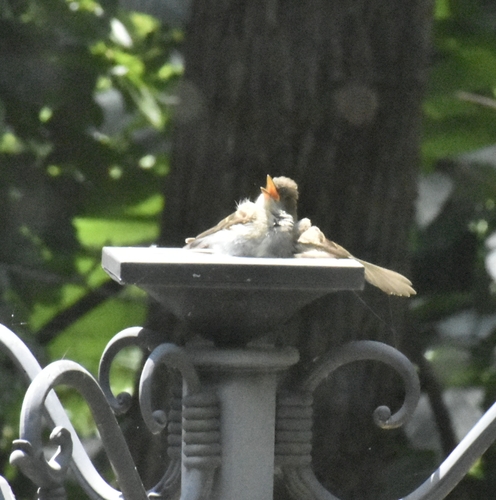 Eastern Wood-Pewee
In short
The most reliable field mark between Caribbean Elaenia and Eastern Wood-Pewee is the Caribbean Elaenia’s bushy crest with a pale central stripe, which the sleeker, flat-crowned Eastern Wood-Pewee always lacks. Both species show two pale wingbars, but the Pewee’s wings are longer and more pointed, especially in flight, while the Elaenia’s are shorter and rounder. The Pewee is slimmer, with a longer primary projection and a distinctively bicolored bill, whereas the Elaenia is bulkier with a dark bill and pinkish base. If you see a flycatcher with a bushy, streaked crest and a stocky look, it’s the Elaenia; if it’s slim, pointy-winged, and flat-headed, it’s the Pewee.
Identification tips
- Crest shape: Caribbean Elaenia has a bushy, often raised crest with a pale central stripe; Eastern Wood-Pewee has a flat, sleek crown with no crest or stripe. This is the fastest field check.
- Bill color: Pewee shows a bicolored bill (dark above, yellowish below); Elaenia’s bill is black with a dusky pinkish base to the mandible, but appears mostly dark in the field.
- Head and face pattern: Elaenia has a faint whitish eyering and paler lores, giving a more patterned face; Pewee’s face is plainer, lacking strong contrast or eyering.
- Wing shape and projection: Pewee’s wings are longer and more pointed, with a pronounced primary projection beyond the tertials, making the bird look slim and long-winged. Elaenia’s wings are shorter and rounder, with less projection.
- Wingbars: Both species have two pale wingbars, but on Pewee they may appear sharper and more contrasting against the darker wing; on Elaenia, the wingbars can be more diffuse and yellowish to whitish.
- Body shape: Elaenia is bulkier and rounder, often appearing large-headed and thick-necked. Pewee is slimmer, with a more upright, elongated posture.
- Tail: Pewee’s tail is longer and more squared-off; Elaenia’s tail is dusky and proportionally shorter.
- Underparts color: Elaenia’s underparts are pale gray to yellowish, with yellowish undertail coverts. Pewee’s underparts are light with an olive wash on the breast, but never yellowish.
- Behavior: Pewee often perches still and upright on exposed branches, sallying out for insects and returning to the same spot. Elaenia is more active, flicking wings and tail, and moves through foliage.
- Habitat: Pewee prefers mature woods, forest edges, and pine plantations; Elaenia is more often in shrubby, brushy habitats, gardens, and secondary growth.
- Voice: If you hear a clear 'pee-a'wee' or 'pe-wee' call, it’s the Pewee. Elaenia’s vocalizations are not described here, so silence is not diagnostic.
- Geography and season: In the Caribbean, Elaenia is resident and common in appropriate habitat; Pewee is present only as a migrant or winterer, and then usually in mature woodland.
- Sex and age: Both species are sexually monomorphic (males and females look alike). No age-specific wing pattern differences are described, so these marks work for all ages.
- Plumage pitfalls: Both can look drab and olive-gray, especially in poor light. Focus on crest, bill, and wing shape for separation.
- When in doubt: If you see a bushy crest and pale crown stripe, it’s always Elaenia. If the bird is slim, flat-headed, with a bicolored bill and pointy wings, it’s the Pewee.
Size
Caribbean Elaenia is slightly larger and heavier, averaging 21.3 g in body mass [wikidata], and measures 14–18 cm in length. Eastern Wood-Pewee is a bit smaller and lighter, at 13.5–15 cm in length and about 14 g in weight. In the field, the Elaenia often appears bulkier and rounder, while the Pewee is slimmer and more elongated, especially when perched or in flight.
Plumage
No age-specific wing pattern differences are noted for immatures or juveniles in either species, so focus is on adult plumage. Caribbean Elaenia adults have a dull olive to brownish olive crown with a distinctive white stripe down the center of their bushy crest, a faint whitish eyering, and yellowish to whitish wing feather edges forming two wingbars. Their underparts are pale gray to yellowish, with yellowish undertail coverts. Eastern Wood-Pewee adults are gray-olive above with light underparts and a subtle olive wash on the breast. They also have two pale wingbars, but their wings are longer and more pointed, and their bill is bicolored (dark above, yellowish below). The Pewee lacks any crest or crown stripe, and its face is plainer, without a strong eyering or contrasting lores. Both species have dark tails, but the Pewee’s tail is typically longer and more squared-off.
Behaviour
Eastern Wood-Pewee is often seen sallying from high, exposed perches, returning to the same spot after flycatching, and tends to sit upright and motionless for long periods. Caribbean Elaenia is more active and restless, often flicking its wings and tail and moving through foliage at mid-levels. The Elaenia’s crest is frequently raised, giving it a bushy-headed look, while the Pewee’s head remains flat and sleek. Pewees are more likely to be seen in open woodland or at forest edges, whereas Elaenias prefer denser, shrubby habitats.
Habitat
Caribbean Elaenia is found in the West Indies, parts of Central America, and nearby islands off northern South America, favoring shrubby areas, forest edges, and gardens. Eastern Wood-Pewee breeds in deciduous and mixed forests of eastern North America and migrates to Central America and the Caribbean for winter. In overlap zones, Pewees are more likely in mature woodland or pine plantations, while Elaenias stick to brushy, edge, or secondary growth. Range overlap is minimal except in migration or on some Caribbean islands.
Voice
Eastern Wood-Pewee gives a distinctive, plaintive whistled 'pee-a'wee' or 'pe-wee' with a rising end, which is a key field mark in season. Caribbean Elaenia’s vocalizations are not described in the provided notes, so voice is only diagnostic for Pewee if you hear its characteristic song.