

Motmot

Cape Teal vs White-cheeked Pintail

Anas capensis versus Anas bahamensis

Play a quiz with Cape Teal and White-cheeked Pintail
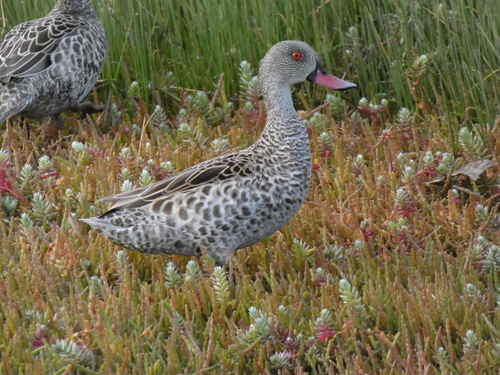
Cape Teal (Anas capensis) Cape Teal
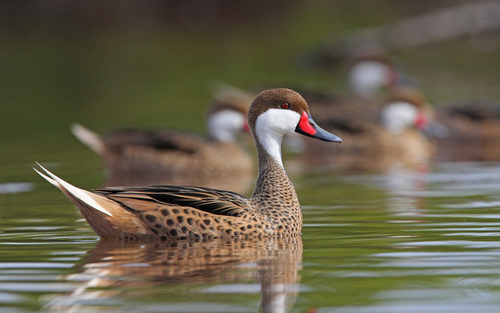
White-cheeked Pintail (Anas bahamensis) White-cheeked Pintail

Media

Loading…

In short

The most reliable way to separate Cape Teal from White-cheeked Pintail is by overall coloration and facial pattern: Cape Teal is a very pale, mostly grey duck with a plain face and pinkish bill (adults), while White-cheeked Pintail is distinctly brown with bold white cheeks and a red-based grey bill. In flight or at rest, the pintail's pointed tail and green wing speculum are strong clues, whereas Cape Teal has a more rounded tail and lacks the bold facial contrast. Juveniles of both species have duller bills, but the face pattern remains a key difference. Both are dabbling ducks, but their structure and plumage are quite different when seen well.

Identification tips

  1. Face pattern is the fastest check: White-cheeked Pintail always shows a bold white cheek patch on a brown face; Cape Teal's face is plain and pale grey at all ages.
  2. Overall color: Cape Teal is very pale grey, almost ghostly compared to the rich brown of the pintail.
  3. Bill color: Adult Cape Teal has a pinkish bill, while White-cheeked Pintail has a grey bill with a red base; both species' juveniles have duller bills, so this is most reliable in adults.
  4. Tail shape: White-cheeked Pintail has a slender, pointed tail (though less extreme than Northern Pintail), visible both at rest and in flight. Cape Teal's tail is more rounded.
  5. Wing pattern in flight: White-cheeked Pintail shows an iridescent green speculum; Cape Teal lacks this and appears uniformly pale in the wing.
  6. Juvenile confusion: Even young pintails retain the white cheek, and young Cape Teal remain pale and plain-faced. Bill color is less helpful in juveniles.
  7. Sex differences: Both species have similar sexes, but female pintails are slightly duller; this is subtle and not a primary field mark.
  8. Size and structure: Cape Teal is a bit larger and more compact, but this is hard to judge unless both are side by side. The pintail's longer, pointed tail is more useful.
  9. Habitat context: In the wild, range does not overlap. If seen together, it's likely in captivity or among escapees; rely on plumage and structure.
  10. Vocalizations: Not a reliable separator in the field; both are quiet outside breeding.
  11. Group size: Cape Teal may form large moulting flocks; pintails are more often in pairs or small groups, but this is not diagnostic.
  12. Pitfalls: Do not rely on bill color alone in juveniles. Always check for the white cheek on pintails and the overall pale look of Cape Teal.
  13. Perched vs. flight views: In flight, look for the pintail's green speculum and pointed tail; at rest, face pattern and overall color are best.
  14. Seasonal change: No strong seasonal plumage differences in either species; marks are reliable year-round.
  15. If uncertain: Prioritize face pattern (white cheek vs. plain), overall color (brown vs. pale grey), and tail shape (pointed vs. rounded) for the quickest and most reliable separation.

Size

Cape Teal is slightly larger, with a length of 44–46 cm [wikipedia]. White-cheeked Pintail varies by subspecies but is generally a bit smaller (male 474–710 g, female 505–670 g) [wikipedia]. In the field, size difference is subtle and not a reliable separator unless both species are together. Structure is more helpful: White-cheeked Pintail has a more slender, pointed tail, while Cape Teal is more compact with a rounded tail.

Plumage

Juvenile and adult Cape Teal are very pale grey overall, with a browner back and a plain face. Adults have a pinkish bill, while juveniles lack the pink. There is no bold face pattern at any age. White-cheeked Pintail of all ages is brown overall, with a striking white cheek patch that stands out even in juveniles. The bill is grey with a red base in adults, duller in juveniles. In flight, White-cheeked Pintail shows an iridescent green speculum on the wing, and a pointed tail; Cape Teal lacks these features and appears uniformly pale. The sexes are similar in both species, though female pintails are slightly duller.

Behaviour

Both species are dabbling ducks that feed by tipping up or dabbling for aquatic plants and small creatures. Cape Teal is generally quiet except during mating displays, and is rarely seen in large groups except during moult. White-cheeked Pintail behaves similarly, but is more likely to be seen in pairs or small groups. Neither species is particularly shy, but the pintail may appear more active and agile due to its slimmer build and longer tail.

Habitat

Cape Teal is found in open wetlands of sub-Saharan Africa and is essentially non-migratory, moving only opportunistically with rains. White-cheeked Pintail is patchily distributed in South America and the Caribbean, and is not found in Africa. Both nest on the ground near water under vegetation. Habitat overlap is not expected in the wild, but both can occur in wildfowl collections or as escapees.

Voice

Cape Teal is mostly silent, but breeding males give a clear whistle and females a weak 'quack.' White-cheeked Pintail's vocalizations are not described in detail in the notes, but are not a primary field mark for separation.

Submit a better description

Use the same sections as the comparison. Your text is published immediately.

The most reliable way to separate Cape Teal from White-cheeked Pintail is by overall coloration and facial pattern: Cape Teal is a very pale, mostly grey duck with a plain face and pinkish bill (adults), while White-cheeked Pintail is distinctly brown with bold white cheeks and a red-based grey bill. In flight or at rest, the pintail's pointed tail and green wing speculum are strong clues, whereas Cape Teal has a more rounded tail and lacks the bold facial contrast. Juveniles of both species have duller bills, but the face pattern remains a key difference. Both are dabbling ducks, but their structure and plumage are quite different when seen well.

  1. Face pattern is the fastest check: White-cheeked Pintail always shows a bold white cheek patch on a brown face; Cape Teal's face is plain and pale grey at all ages.
  2. Overall color: Cape Teal is very pale grey, almost ghostly compared to the rich brown of the pintail.
  3. Bill color: Adult Cape Teal has a pinkish bill, while White-cheeked Pintail has a grey bill with a red base; both species' juveniles have duller bills, so this is most reliable in adults.
  4. Tail shape: White-cheeked Pintail has a slender, pointed tail (though less extreme than Northern Pintail), visible both at rest and in flight. Cape Teal's tail is more rounded.
  5. Wing pattern in flight: White-cheeked Pintail shows an iridescent green speculum; Cape Teal lacks this and appears uniformly pale in the wing.
  6. Juvenile confusion: Even young pintails retain the white cheek, and young Cape Teal remain pale and plain-faced. Bill color is less helpful in juveniles.
  7. Sex differences: Both species have similar sexes, but female pintails are slightly duller; this is subtle and not a primary field mark.
  8. Size and structure: Cape Teal is a bit larger and more compact, but this is hard to judge unless both are side by side. The pintail's longer, pointed tail is more useful.
  9. Habitat context: In the wild, range does not overlap. If seen together, it's likely in captivity or among escapees; rely on plumage and structure.
  10. Vocalizations: Not a reliable separator in the field; both are quiet outside breeding.
  11. Group size: Cape Teal may form large moulting flocks; pintails are more often in pairs or small groups, but this is not diagnostic.
  12. Pitfalls: Do not rely on bill color alone in juveniles. Always check for the white cheek on pintails and the overall pale look of Cape Teal.
  13. Perched vs. flight views: In flight, look for the pintail's green speculum and pointed tail; at rest, face pattern and overall color are best.
  14. Seasonal change: No strong seasonal plumage differences in either species; marks are reliable year-round.
  15. If uncertain: Prioritize face pattern (white cheek vs. plain), overall color (brown vs. pale grey), and tail shape (pointed vs. rounded) for the quickest and most reliable separation.

Cape Teal is slightly larger, with a length of 44–46 cm [wikipedia]. White-cheeked Pintail varies by subspecies but is generally a bit smaller (male 474–710 g, female 505–670 g) [wikipedia]. In the field, size difference is subtle and not a reliable separator unless both species are together. Structure is more helpful: White-cheeked Pintail has a more slender, pointed tail, while Cape Teal is more compact with a rounded tail.

Juvenile and adult Cape Teal are very pale grey overall, with a browner back and a plain face. Adults have a pinkish bill, while juveniles lack the pink. There is no bold face pattern at any age. White-cheeked Pintail of all ages is brown overall, with a striking white cheek patch that stands out even in juveniles. The bill is grey with a red base in adults, duller in juveniles. In flight, White-cheeked Pintail shows an iridescent green speculum on the wing, and a pointed tail; Cape Teal lacks these features and appears uniformly pale. The sexes are similar in both species, though female pintails are slightly duller.

Both species are dabbling ducks that feed by tipping up or dabbling for aquatic plants and small creatures. Cape Teal is generally quiet except during mating displays, and is rarely seen in large groups except during moult. White-cheeked Pintail behaves similarly, but is more likely to be seen in pairs or small groups. Neither species is particularly shy, but the pintail may appear more active and agile due to its slimmer build and longer tail.

Cape Teal is found in open wetlands of sub-Saharan Africa and is essentially non-migratory, moving only opportunistically with rains. White-cheeked Pintail is patchily distributed in South America and the Caribbean, and is not found in Africa. Both nest on the ground near water under vegetation. Habitat overlap is not expected in the wild, but both can occur in wildfowl collections or as escapees.

Cape Teal is mostly silent, but breeding males give a clear whistle and females a weak 'quack.' White-cheeked Pintail's vocalizations are not described in detail in the notes, but are not a primary field mark for separation.

Discard your changes?

You have unsaved edits. If you leave now, those changes will be lost.

Cape Teal · White-cheeked Pintail · My Tricky Birds