

Cape Parrot vs Meyer's Parrot
Poicephalus robustus versus Poicephalus meyeri
Play a quiz with Cape Parrot and Meyer's Parrot
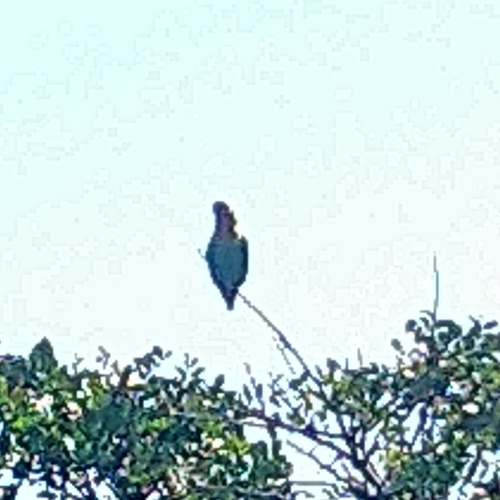 Cape Parrot
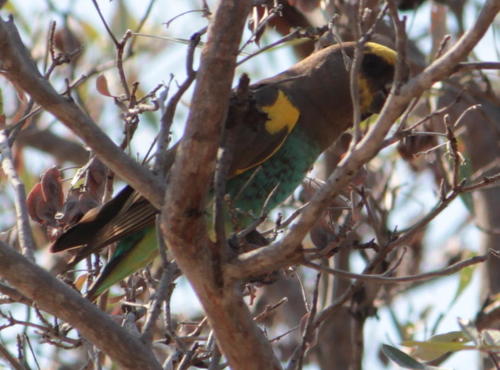 Meyer's Parrot
In short
The most reliable field mark between Cape Parrot and Meyer's Parrot is the presence of bright yellow at the carpal (wrist) joint and, in most subspecies, on the crown of Meyer's Parrot—features never shown by Cape Parrot. Cape Parrot is larger, with a noticeably massive bill and a short tail, and adult females and juveniles often show an orange or pinkish forehead patch. Meyer's Parrot is smaller, with a blue rump, turquoise belly, and a more compact, dark-headed look. Juvenile Cape Parrots may show a larger orange-pink forehead patch but lack the yellow wing and head markings of Meyer's. These differences are visible both perched and in flight, but flight views may emphasize the yellow carpal patch and blue rump of Meyer's. Both species are Poicephalus parrots, but their structure and coloration are distinct when carefully observed.
Identification tips
- Yellow carpal patch (Meyer's only): Look for a bright yellow patch at the bend of the wing; this is diagnostic for Meyer's Parrot of all ages and subspecies (though extent may vary), and never present on Cape Parrot.
- Yellow on crown (Meyer's, most subspecies): Most Meyer's show yellow on the top of the head; Cape Parrot never does. Absence of yellow does not rule out Meyer's, as some subspecies have less yellow.
- Blue rump and turquoise belly (Meyer's only): In flight or when preening, Meyer's Parrot shows a blue rump and turquoise belly. Cape Parrot lacks both features and is more uniformly greenish.
- Orange/pink forehead patch (Cape Parrot females and juveniles): Female and juvenile Cape Parrots often have a distinct orange or pinkish patch on the forehead; this is never present in Meyer's Parrot. Note that adult male Cape Parrots may lack this mark.
- Bill size and shape: Cape Parrot has a massive, pale bill, noticeably larger and more robust than the small, dark bill of Meyer's Parrot. This is visible even at a distance with binoculars.
- Tail length and shape: Cape Parrot has a short, squared tail, while Meyer's Parrot's tail is proportionally longer and more tapered.
- Overall size: Cape Parrot is distinctly larger and bulkier than Meyer's Parrot. If seen together or with experience, the size difference is obvious.
- Head color: Meyer's Parrot has a dark, almost blackish head, especially around the face, contrasting with the yellow and blue highlights. Cape Parrot's head is greenish and lacks strong contrast.
- Sexual dimorphism (Cape Parrot): Only Cape Parrot shows sexual dimorphism, with females usually having the orange forehead patch. Meyer's Parrot sexes are similar.
- Juvenile confusion: Juvenile Cape Parrots have a larger orange-pink forehead patch but never show yellow or blue; juvenile Meyer's resemble adults in pattern but may have duller colors.
- Habitat context: In temperate forest with yellowwood trees, expect Cape Parrot; in open woodland or savanna, especially outside South Africa, Meyer's is much more likely.
- Flight pattern: Cape Parrot flies with a slow, rowing motion, often in small groups to and from roosts; Meyer's is more likely to be seen in pairs or small flocks in open woodland.
- Plumage uniformity: Cape Parrot is more uniform greenish, lacking the contrasting yellow and blue of Meyer's.
- No yellow or blue in Cape Parrot: Any sign of yellow on the wing or head, or blue on the rump, rules out Cape Parrot.
- Plumage variability (Meyer's): Meyer's Parrot subspecies vary in the amount of yellow and blue, but all show at least some yellow at the carpal joint, which is the most reliable mark.
Size
Cape Parrot is the larger and more robust species, with a very large, powerful bill and a short tail. Meyer's Parrot is smaller and more compact, with a proportionally smaller bill and a more delicate appearance. The size difference is most obvious when seen side by side or with experience, but the Cape Parrot's bulk and bill size are usually apparent even at a distance.
Plumage
Juvenile and adult Cape Parrots never show yellow on the carpal joint or crown. Instead, adult females and juveniles often have an orange or pinkish patch on the forehead, which is absent in Meyer's Parrot. Meyer's Parrot is distinctive for its bright yellow carpal patch (visible in all ages and most subspecies), yellow on the crown (in most subspecies), blue rump, and turquoise belly. The rest of the plumage is mostly dark or brownish, with blackish feathers on the head. Cape Parrot is generally greenish with a large, pale bill, and lacks any blue or yellow highlights. Juvenile Cape Parrots have a larger orange-pink forehead patch but do not show the blue or yellow of Meyer's. In flight, Meyer's shows a blue rump and yellow carpal, while Cape Parrot appears more uniform and lacks these color flashes.
Behaviour
Both species are strong fliers and can be seen in noisy, mobile flocks. Cape Parrots are often seen flying slowly with a rowing motion, especially to and from roosts in temperate forests. Meyer's Parrots are more likely to be encountered in savanna or woodland settings, often in pairs or small groups. Both species are conspicuous when vocalizing or feeding, but Cape Parrots may be easier to count at forest edges due to their flight style and calls.
Habitat
Cape Parrot is a specialist of temperate, often montane forests in South Africa, closely tied to African yellowwood trees. Meyer's Parrot is a widespread species of African savanna and woodland, rarely found in dense forest. If the bird is in a closed-canopy temperate forest, Cape Parrot is much more likely; in open woodland or savanna, especially outside South Africa, Meyer's is the default.