

Cape Barren Goose vs Pallas's Sandgrouse
Cereopsis novaehollandiae versus Syrrhaptes paradoxus
Play a quiz with Cape Barren Goose and Pallas's Sandgrouse
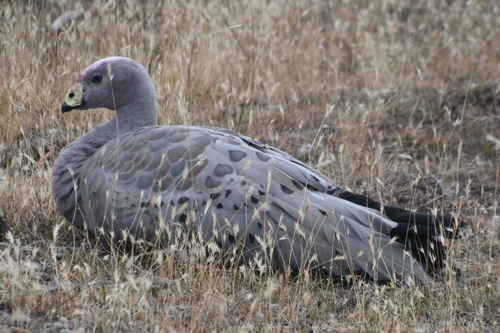 Cape Barren Goose
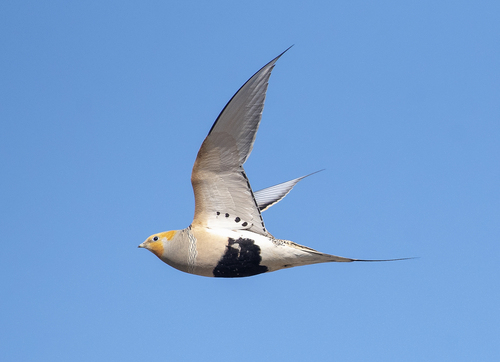 Pallas's Sandgrouse
In short
The most reliable separation between Cape Barren Goose and Pallas's Sandgrouse is overall size and structure: the goose is a massive, pale grey bird with a short, thick bill and pink legs, while the sandgrouse is much smaller, compact, and buff-coloured with a pigeon-like head and long, pointed wings and tail. In flight, adult Cape Barren Geese show a broad dark trailing edge on the wings and black tail, while Pallas's Sandgrouse displays long, pointed wings with pale underwings and a black belly patch. Juvenile Cape Barren Geese have heavier wing spotting and a pale yellow-green cere, while young sandgrouse are more subtly marked. The two species differ strongly in bill shape, leg colour, and habitat: Cape Barren Goose is terrestrial and grazes open grasslands, while Pallas's Sandgrouse frequents dry steppes and makes long, fast flights to water.
Identification tips
- Size and bulk: Cape Barren Goose is vastly larger and heavier than Pallas's Sandgrouse—if the bird looks goose-sized, it is not a sandgrouse. This is true for all ages and sexes.
- Bill shape and colour: The goose has a short, thick, triangular black bill with a large pale yellow-green cere covering much of the bill. The sandgrouse has a small, pigeon-like bill without a prominent cere.
- Legs and feet: Cape Barren Goose has long, pink legs with black feet, while Pallas's Sandgrouse has feathered legs and unique paw-like feet with fused front toes and no hind toe. The sandgrouse's legs are much less visible and adapted for walking on dry ground.
- Wing shape in flight: In flight, the goose has broad, rounded wings with a dark trailing edge (black tips to flight feathers) and a black tail. The sandgrouse has long, pointed wings and tail, with pale underwings and a black belly patch—look for the contrast between the pale underwing and dark belly.
- Juvenile plumage: Young Cape Barren Geese are paler grey with heavy spotting on the wings and scapulars, and their cere turns yellow-green as they age. Juvenile sandgrouse are more subtly marked and lack the bold wing spotting and cere of the goose.
- Head and face: Cape Barren Goose has a small head relative to its body, mostly grey with a whitish forehead and crown. Male sandgrouse have a grey head and breast, orange face, and a grey breast band; females are duller and more barred, with no breast band.
- Body and posture: The goose is heavy-bodied, with a slow, waddling walk. The sandgrouse is compact and upright, with a more delicate, pigeon-like jizz.
- Tail: Cape Barren Goose has a short, black tail; Pallas's Sandgrouse has a long, pointed tail, especially obvious in flight.
- Habitat: Cape Barren Goose is found in grassy, coastal habitats in southern Australia, often near water. Pallas's Sandgrouse is strictly a bird of dry, open steppes in central Asia, rarely near lush grass.
- Flocking and movement: Sandgrouse often gather in large flocks and make rapid, direct flights to water, sometimes over long distances. Geese are more sedentary and rarely fly far unless disturbed.
- Feet visibility: If you see feathered, paw-like feet with no hind toe, it is Pallas's Sandgrouse. If the feet are pink and unfeathered, it is Cape Barren Goose.
- Flight style: Cape Barren Goose flies with slow, deep wingbeats and appears heavy in the air. Pallas's Sandgrouse is swift and agile, with rapid wingbeats and a streamlined silhouette.
- Sex differences: Male sandgrouse have a breast band and orange face; females are more barred and lack the band. Cape Barren Goose shows little sexual dimorphism except in size (males larger).
- Vocalization: Not diagnostic based on available notes.
- Pitfalls: Immature Cape Barren Geese with heavy wing spotting might be confused with sandgrouse at a distance, but size, bill, and leg colour are always reliable. Sandgrouse never show the goose's broad, dark trailing edge or black tail.
Size
Cape Barren Goose is dramatically larger, weighing around 4530 g and measuring 75–100 cm in length, with a heavy, goose-like build. Pallas's Sandgrouse is much smaller (30–41 cm), with a compact, pigeon-like body, long pointed wings, and a slender appearance. The difference in bulk and length is immediately apparent, even at a distance.
Plumage
Juvenile Cape Barren Geese are pale grey with heavy spotting on the wings and scapulars, and a developing yellow-green cere; adults have pale grey plumage with fine pale margins on the breast and back feathers, and a distinctive black tail and dark trailing edge to the wings in flight. The upperwing coverts and scapulars have brownish grey spots. Pallas's Sandgrouse, by contrast, is buff-coloured and barred above, with a black belly patch and pale underwings visible in flight. Males have a grey head and breast with an orange face and a grey breast band, while females are duller and more barred, lacking the breast band. The sandgrouse's wings are long and pointed, and the tail is also long and pointed, unlike the goose's broad, rounded wings and short tail. The sandgrouse's feet are feathered and paw-like, lacking a hind toe, which is unique if seen well.
Behaviour
Cape Barren Goose is mostly terrestrial, grazing on grasslands and rarely flying unless disturbed. It walks with a slow, heavy gait and is often seen in pairs or small groups. Pallas's Sandgrouse is highly mobile, flying rapidly in large flocks to water sources at dawn and dusk, sometimes covering great distances. Its flight is swift and direct, with long, pointed wings, and it spends much time on the ground in open, dry habitats.
Habitat
Cape Barren Goose is found in southern Australia, typically on offshore islands and coastal grasslands, where it grazes openly. Pallas's Sandgrouse inhabits the dry steppes of central Asia, breeding on open ground and making daily long-distance flights to water. The sandgrouse is adapted to arid environments, while the goose prefers lush, grassy areas near water.