

Canebrake Wren vs Riverside Wren
Cantorchilus zeledoni versus Cantorchilus semibadius
Play a quiz with Canebrake Wren and Riverside Wren
 Canebrake Wren
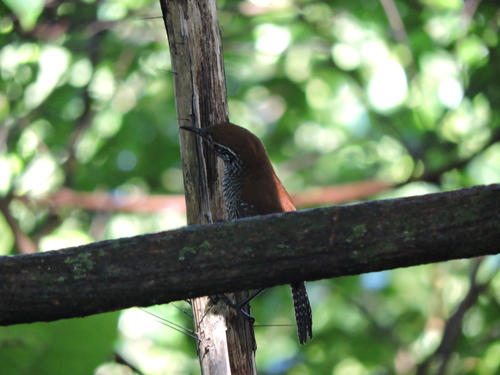 Riverside Wren
In short
The most reliable field mark between Canebrake Wren and Riverside Wren is the strong difference in head and upperpart coloration: Riverside Wren shows a bright orange-brown crown and chestnut back, while Canebrake Wren is overall brownish-gray with an olivaceous rump. Riverside Wren's face is boldly patterned with black-and-white streaks and a black-over-white supercilium, contrasting with the Canebrake Wren's white supercilium and more subdued, mottled face. In all plumages, Riverside Wren's underparts are pale gray with narrow black barring, while Canebrake Wren lacks this barring and appears plainer below. Juveniles of both species are duller, but the facial and underpart differences persist. Habitat overlap is possible in Costa Rica and Panama, so careful attention to these plumage details is essential.
Identification tips
- Crown and Upperparts: Riverside Wren has a bright orange-brown crown and chestnut back/rump, while Canebrake Wren is brown-crowned with brownish-gray upperparts and an olivaceous gray rump. This is the quickest visual cue in good light.
- Facial Pattern: Riverside Wren's face is boldly streaked and spotted black-and-white, with a black-over-white supercilium. Canebrake Wren has a white supercilium, gray-brown eye-stripe, and mottled gray/off-white cheeks, giving a much plainer look.
- Underparts: Riverside Wren shows narrow black barring across pale gray underparts from throat to vent, becoming buffy toward the rear. Canebrake Wren is off-white on the throat, gray on the chest, and gray-buff on the lower belly, with no barring.
- Tail Pattern: Canebrake Wren's tail is olivaceous brown with well-defined darker bars. Riverside Wren's tail is blackish with buff-white bars, but this may be subtle in the field.
- Juvenile Plumage: Juvenile Riverside Wrens have fine black scaling on the crown and less crisp barring below, but still show the general pattern of adults. Juvenile Canebrake Wrens are duller and have less distinct facial markings, but lack the black scaling and barring of Riverside Wren.
- Supercilium: Both species have a prominent supercilium, but Riverside Wren's is black-over-white and more sharply defined, while Canebrake Wren's is plain white.
- Face Contrast: If the face looks boldly patterned or streaked, suspect Riverside Wren; if it looks softly mottled and plain, suspect Canebrake Wren.
- Underpart Barring: Any sign of black barring on the underparts points to Riverside Wren, as Canebrake Wren is always plain below.
- Habitat Context: In dense riverside or swampy vegetation, especially on the Pacific slope, Riverside Wren is more likely. Away from water or in drier thickets, Canebrake Wren is more probable, but overlap occurs.
- Group Behavior: Riverside Wren is often seen in pairs or family groups, sometimes at ant swarms. Canebrake Wren's social behavior is less documented, so this is a weak separator.
- Size and Structure: Both are similar in size and structure; do not rely on bulk or length for separation.
- Vocalizations: Only Riverside Wren's song and calls are described, but without comparative data, do not use voice as a primary field mark.
- Season and Age: Both species' juveniles are duller, but the main pattern differences (face, crown, underpart barring) remain useful at all ages.
- Lighting and View: In poor light, focus on the contrast of the face and any hint of barring below; in bright light, the crown and back color differences become more obvious.
- Pitfalls: Beware of dull juveniles—look for even faint black barring (Riverside) or the lack thereof (Canebrake), and check for the boldness of the facial pattern.
Size
Both species are very similar in length, with Canebrake Wren at about 14 cm and Riverside Wren ranging from 13 to 14 cm. Riverside Wren is slightly heavier on average (17 g), but this difference is not likely to be apparent in the field. Structurally, both are typical wrens with no strong differences in bill or tail shape noted in the sources.
Plumage
Juvenile Canebrake Wrens have duller underparts and less distinct facial markings, but still show a white supercilium and mottled cheeks. Juvenile Riverside Wrens are also duller overall, but show fine black scaling on the crown and less crisp black barring below. In adults, Canebrake Wren is brown-crowned with brownish-gray upperparts and olivaceous gray rump, a white supercilium, and a plain grayish chest and belly. Its tail is olivaceous brown with clear dark bars. Riverside Wren adults have a much brighter orange-brown crown, chestnut nape/back/rump, and a blackish tail with buff-white bars. The face is strikingly patterned with a black-over-white supercilium and black-and-white streaks and spots. Underparts are pale gray with narrow black barring from throat to vent, becoming buffy toward the rear. These underpart bars are absent in Canebrake Wren. In both species, juveniles are duller but the main pattern differences remain visible.
Behaviour
Riverside Wren often forages near the ground in pairs or family groups, sometimes joining mixed-species flocks at army ant swarms. Canebrake Wren's behavior is not detailed in the sources, but both species are typical active wrens, moving through dense vegetation. Riverside Wren is noted for constructing elaborate nests and roosting 'dormitory' nests, but this is not a field separation.
Habitat
Both species occur in Costa Rica and Panama, but Canebrake Wren also ranges into Nicaragua. Riverside Wren is restricted to the Pacific slope, favoring dense vegetation along watercourses, swampy woodland edges, or steep slopes, from sea level up to 1,200 m. Canebrake Wren's habitat is less specifically described, but overlap is possible in lowland and foothill thickets. If seen away from water or in drier thickets, Canebrake Wren is more likely, but habitat alone is not diagnostic where both occur.
Voice
Riverside Wren has a loud, ringing song with repeated phrases and a variety of calls, including harsh churrs and clear tinkling notes. No vocal details are given for Canebrake Wren in the sources, so voice is not a reliable separator with the information at hand.