

Canada Goose vs Sandhill Crane
Branta canadensis versus Antigone canadensis
Play a quiz with Canada Goose and Sandhill Crane
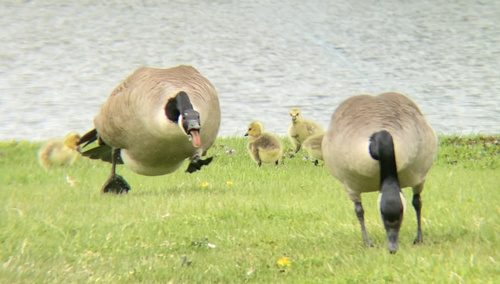 Canada Goose
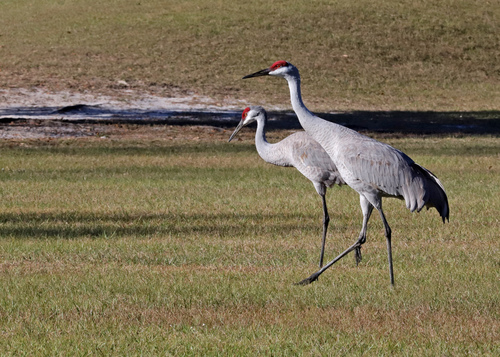 Sandhill Crane
In short
The most reliable way to separate Canada Goose from Sandhill Crane is by overall structure and posture: Canada Goose is a hefty, short-legged waterfowl with a black neck and white chinstrap, while Sandhill Crane is a tall, long-legged bird with a slim neck, gray plumage, and a red forehead. In flight, cranes show trailing legs and straight necks, while geese keep their necks extended but legs tucked. Juvenile Sandhill Cranes lack the red forehead but are still grayish and lanky, never showing the brown body and black neck of Canada Goose. Mistakes are most likely when both species are seen at a distance or in silhouette, but careful attention to shape and plumage will resolve nearly all confusion.
Identification tips
- Head and neck pattern: Canada Goose always has a black head and neck with a bold white chinstrap; Sandhill Crane has a gray neck and head, with a red forehead and white cheeks in adults, and never shows a chinstrap. This is the single most reliable field mark at any age.
- Body color: Canada Goose is brown-bodied; Sandhill Crane is gray (sometimes ochre-stained in breeding season). Juvenile cranes are reddish-brown above and gray below, never brown like a goose.
- Legs: Sandhill Crane has long, dark legs that trail far behind the tail in flight and are obvious when walking; Canada Goose has short legs, barely visible in flight, and walks with a waddling gait.
- Bill shape: Sandhill Crane has a long, straight, pointed bill (almost heron-like); Canada Goose has a shorter, triangular, duck-like bill. This is visible at moderate range with binoculars.
- Posture and jizz: Sandhill Crane stands tall and upright, often towering over geese, with a slender profile; Canada Goose is more horizontal and compact.
- Flight silhouette: In flight, cranes show long necks and legs both extended straight, with slow, deep wingbeats or soaring; geese fly with necks outstretched but legs tucked, and do not soar for long periods.
- Wing pattern: No distinctive juvenile upperwing marks for either species, but overall wing color is diagnostic: cranes are gray, geese are brown.
- Red forehead: Only adult Sandhill Cranes show a red patch on the forehead; Canada Goose never does. Juvenile cranes lack this but still do not resemble geese.
- Voice: Listen for the difference: geese honk, cranes bugle. The crane's call is longer, more musical, and carries farther.
- Group behavior: Canada Geese often swim or graze in tight flocks, sometimes in urban parks; cranes are more likely to be seen walking in open fields or shallow marshes, sometimes in very large migratory flocks.
- Habitat: If the bird is on open water, it's almost certainly a goose; if it's striding through a wet meadow or agricultural field, especially with a tall, upright posture, it's likely a crane.
- Size impression: Cranes are taller and more slender, often appearing 'leggy' even at a distance; geese are stockier and lower to the ground.
- Juvenile confusion: Juvenile Sandhill Cranes lack the red forehead but remain grayish and never develop a chinstrap or brown body; juvenile geese look like smaller, duller versions of adults but retain the black-and-white head pattern.
- Aggression: Canada Geese may hiss and charge when approached near nests; cranes are less aggressive toward humans but may dance or display to each other.
- Pitfalls: Distant or backlit views can make both birds look dark and similar in size, but careful attention to neck length, leg projection, and head pattern will resolve most confusion.
Size
Canada Goose is a large goose, but Sandhill Crane is even taller and longer-winged. Canada Goose averages 3564 g in body mass [wikidata], with a length of 75–110 cm and wingspan of 127–185 cm [wikipedia]. Sandhill Crane is heavier on average (males 4.57 kg, females 4.02 kg), stands 80–136 cm tall, and has a wingspan of about 200 cm, often appearing taller and more slender than any goose [wikipedia]. Canada Goose is bulkier and more compact, while Sandhill Crane is lanky and long-limbed.
Plumage
Juvenile and immature Sandhill Cranes are reddish-brown above and gray below, lacking the red forehead of adults but still showing a mostly gray, uniform look; they never have the black neck or white chinstrap of Canada Goose. Adult Sandhill Cranes are gray overall, sometimes stained ochre, with a red forehead and white cheeks. In contrast, all Canada Geese (regardless of age or subspecies) have a brown body, black neck and head, and a distinctive white chinstrap. Canada Goose never shows red on the head or overall gray plumage. In flight, Sandhill Cranes show long trailing legs and gray wings, while Canada Geese have shorter legs (not visible in flight), brown upperwings, and a more compact body. Sexes are similar in both species.
Behaviour
Canada Geese are typically seen swimming or grazing near water, often in family groups or large flocks, and may be aggressive when defending territory. They fly in V-formations with steady wingbeats. Sandhill Cranes are often found walking in open fields or shallow wetlands, foraging with a slow, deliberate gait. In flight, cranes soar on thermals with outstretched necks and trailing legs, often in loose groups or large migratory flocks. Their posture is upright and elegant compared to the hunched, horizontal stance of geese.
Habitat
Both species can be found near water, but Canada Goose is more closely associated with lakes, ponds, and rivers, often in urban parks and grassy areas. Sandhill Crane prefers open wetlands, marshes, bogs, and agricultural fields, especially during migration. Cranes are less likely to be found on open water and more often in shallow, reedy or grassy areas. Overlap occurs in migration stopover areas, but habitat preference and behavior usually differ.
Voice
Canada Goose gives a familiar honking call (deep in males, higher-pitched in females), often heard in flight or when alarmed. Sandhill Crane has a loud, trumpeting call with a rolling 'r' quality, carrying over long distances; pairs perform synchronized unison calls. The crane's call is more resonant and bugling, while the goose's is nasal and honking. These vocalizations are distinct and diagnostic when heard.