

California Quail vs Gambel's Quail
Callipepla californica versus Callipepla gambelii
Play a quiz with California Quail and Gambel's Quail
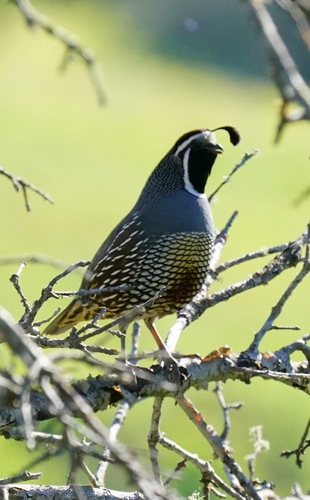 California Quail
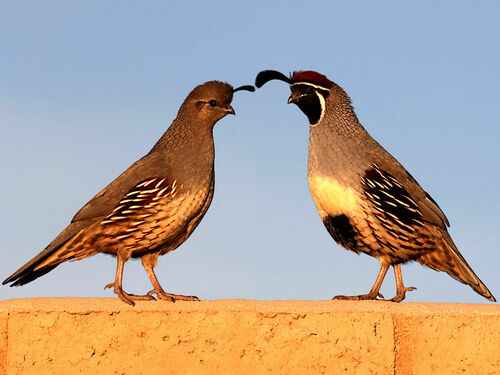 Gambel's Quail
In short
The most reliable field mark for separating California Quail from Gambel's Quail is the presence of a bold black patch on the lower breast of male Gambel's Quail, which California Quail males lack. Both species have a forward-drooping topknot (plume), but Gambel's Quail males show a coppery crown, while California Quail males have a more uniformly gray and brown head with a black face bordered by white. Females of both species are plainer, but California Quail females are generally browner and lack the copper crown. In the field, Gambel's Quail typically appear slightly larger and longer-legged, and are more likely to be found in arid desert habitats, while California Quail favor brushy, chaparral, or suburban edges. Juvenile and immature plumages are similar and not strongly diagnostic by wing pattern, so focus on adult male breast and head pattern for quick separation.
Identification tips
- Male breast patch: The single most reliable mark—male Gambel's Quail have a bold black patch on the lower breast, absent in California Quail males. Use this whenever you have a clear view of the front of an adult male.
- Crown color (males): Gambel's Quail males show a rich coppery-red crown, while California Quail males have a gray or brownish crown. This is visible in good light and at moderate distance.
- Facial pattern (males): California Quail males have a black face crisply bordered by white stripes, while Gambel's Quail males have a black face but less sharply defined white borders, and the copper crown stands out more.
- Topknot (plume): Both species have a forward-drooping topknot, but it is often longer and more prominent in Gambel's Quail, especially in males. Females of both species have a shorter, less distinct topknot.
- Female plumage: Females of both species are plainer, but California Quail females are browner overall and lack the copper crown. Both have scaly underparts, so focus on overall tone and head color.
- Belly/underparts: Both species have scaly bellies, but Gambel's Quail is generally more bluish-gray, while California Quail is browner. This is subtle and best used in combination with other marks.
- Size and structure: Gambel's Quail is slightly larger and longer-legged, which can be apparent when birds are running or standing upright. California Quail is more compact and rounded.
- Habitat: In the field, consider habitat—Gambel's Quail is almost always in arid desert or desert scrub, while California Quail prefers brushy, chaparral, or suburban edge habitats. In overlap zones, this can be a useful clue.
- Behavior: Both species form coveys and flush explosively, but Gambel's Quail may seem more agile and quick-footed in open terrain.
- Juveniles/immatures: Young birds of both species are very similar—drab, scaly below, lacking strong head or breast markings. Do not rely on juvenile plumage for separation.
- Flight views: No distinctive wing or upperwing pattern differences are described for any age; both show short, rounded wings and rapid, whirring flight.
- Voice: Not described in the provided notes; do not use for separation here.
- Range: If you are outside the core range of one species, this can be a strong clue, but both can occur in California and parts of the Southwest—use plumage and habitat first in these areas.
- Roadside behavior: California Quail are more likely to be seen feeding at the edge of roads, especially near suburban areas, while Gambel's Quail are more strictly desert birds.
- Covey size and season: Both species form coveys outside the breeding season; this is not a reliable separator.
Size
Gambel's Quail is slightly larger on average, measuring about 28 cm (11 in) in length with a wingspan of 36–41 cm (14–16 in), while California Quail is 24–27 cm (9.4–10.6 in) long with a wingspan of 32–37 cm (13–15 in) [wikipedia]. Both are small, round-bodied quail, but Gambel's can look a bit longer and leggier, especially when moving on the ground. Weight overlaps considerably, so is not a reliable field mark.
Plumage
There are no distinctive age-specific upperwing or flight marks described for either species, so separation relies on adult plumage, especially in males.
- Adult males: Gambel's Quail males have a coppery-red crown, a bold black face, and a large black patch on the lower breast. California Quail males have a gray and brown head, a black face bordered by crisp white stripes, and lack the black breast patch. Both have a forward-curving topknot, but it is often longer and more prominent in Gambel's Quail.
- Females: Both are plainer brown, but California Quail females are browner overall and lack the copper crown. Both have a topknot, but it is shorter and less distinct than in males.
- Underside: Gambel's Quail show a more bluish-gray body with a scaly pattern on the belly, while California Quail are more brownish-gray and also show scaly underparts, but with a generally browner tone.
- Juveniles/Immatures: Not strongly separable by plumage or wing pattern; both are drab and scaly below, lacking strong head or breast markings.
Behaviour
Both species are ground-dwelling, highly sociable, and often seen in coveys outside the breeding season. California Quail are especially tolerant of suburban edges and disturbed areas, often seen dust-bathing in sunny spots or feeding along roadsides. Gambel's Quail are more strictly desert-adapted, moving quickly on foot through brush and open ground, and are rarely seen in flight except when flushed. Both explode into short, rapid flights when startled, but prefer to run. Gambel's Quail may appear more agile and longer-legged when running.
Habitat
California Quail are most common in brushy, chaparral, oak woodland, and suburban edge habitats of western North America, and have been introduced to several other regions. Gambel's Quail are tightly linked to arid desert regions of the Southwestern US and northwestern Mexico, especially areas with mesquite, cactus, and open desert scrub. In overlap zones (e.g., southeastern California), habitat can be a clue: Gambel's favors drier, more open desert, while California Quail prefers denser, moister brush.