

Bushtit vs Ruby-crowned Kinglet
Psaltriparus minimus versus Corthylio calendula
Play a quiz with Bushtit and Ruby-crowned Kinglet
 Bushtit
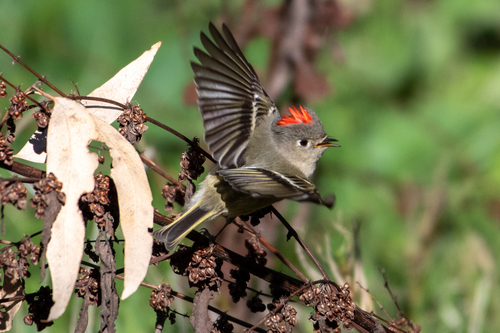 Ruby-crowned Kinglet
In short
The most reliable field mark to separate Bushtit from Ruby-crowned Kinglet is the presence of bold white wingbars and a broken white eye-ring on the kinglet, which are completely absent in Bushtit. Bushtit is a tiny, plain gray-brown bird with a long tail and no wingbars or eye-ring, while Ruby-crowned Kinglet is slightly larger, olive-green, and shows two distinct white wingbars and a broken eye-ring; adult males may show a concealed red crown patch. In flight or perched, the kinglet's wing pattern and more active, wing-flicking behavior are strong clues. Both species are small, but Bushtit is even smaller and rounder, often moving in tight, chattering flocks, while kinglets are solitary or in loose mixed flocks and are more restless. If you see a bird with no wingbars and a long, thin tail, it's a Bushtit; if you see wingbars and a broken eye-ring, it's a Ruby-crowned Kinglet.
Identification tips
- Wingbars: Ruby-crowned Kinglet always shows two crisp white wingbars on each wing (including immatures and females); Bushtit never shows wingbars at any age. If you see wingbars, it's a kinglet.
- Eye-ring: Kinglet has a broken white eye-ring, giving a spectacled appearance; Bushtit lacks any eye-ring or facial markings. This is visible in all plumages.
- Crown Patch: Adult male kinglets sometimes show a scarlet-red crown patch, but this is often hidden. Females and immatures lack the patch, so absence of red does not rule out kinglet.
- Overall Color: Bushtit is plain gray-brown above and below, with no contrast. Kinglet is olive-green above and olive-buff below, with more contrast and a brighter overall look.
- Bill Shape: Bushtit has a very short, stubby bill; kinglet's bill is slightly longer and more pointed, though still fine and small.
- Tail: Bushtit has a proportionately long, thin tail that is often cocked or flicked; kinglet's tail is shorter and less prominent.
- Body Shape: Bushtit appears extremely small, round, and plump-headed, with a large head for its body and a compact, fluffy look. Kinglet is more elongated and less round.
- Behavior: Bushtits move in tight, noisy flocks, often hanging upside down or moving acrobatically through branches. Kinglets are solitary or in loose groups, always flicking their wings and moving restlessly.
- Flight Style: Kinglets have a swift, jerky, and erratic flight with rapid wingbeats; Bushtits fly weakly and tend to move in short, fluttering hops between shrubs.
- Habitat: Bushtits prefer open woodlands with scrubby understory, especially in the West; kinglets breed in coniferous forests but winter in a variety of wooded habitats, sometimes overlapping with Bushtit.
- Flock Size: If you see a group of 10+ tiny birds moving together, it's likely Bushtit. Kinglets are rarely in such large, tight flocks.
- Vocalizations: Not diagnostic from the provided notes, but in practice, Bushtit gives high, thin, lisping calls, while kinglet's calls are higher-pitched, more varied, and include rapid "jidit-jidit" notes.
- Seasonal Context: In the breeding season, kinglets are in coniferous forests, often away from Bushtit habitat. In winter, both may occur together in gardens and parks in the West.
- Nest Structure: Not visible in the field, but Bushtit builds a distinctive hanging nest; kinglet's nest is a cup, often hidden in conifers.
- Pitfalls: Immature kinglets still show wingbars and eye-ring; Bushtit never does. Do not rely on the presence or absence of the red crown patch alone.
Size
Bushtit is among the smallest North American passerines, noticeably tinier than Ruby-crowned Kinglet. Bushtit has a very short, stubby bill and a long, narrow tail that accentuates its tiny, round body. Ruby-crowned Kinglet is still very small (9–11 cm long, 5–10 g) but is slightly larger and more elongated, with a proportionately shorter tail and a slightly larger, more pointed bill. In direct comparison, Bushtit appears more diminutive, with a smaller head and shorter wings relative to body size. [wikipedia][avonet]
Plumage
Juvenile and adult Bushtits of all ages are plain gray-brown above and below, with no wingbars, no eye-ring, and no facial markings. Their plumage is uniform and lacks contrast, making them appear soft and featureless. Ruby-crowned Kinglet of all ages (including immatures and females) shows two crisp white wingbars on each wing, with the greater covert bar being broader and set off by a dark band. The kinglet also has a broken white eye-ring, giving a spectacled look. Adult males may show a concealed scarlet-red crown patch, but this is often hidden; females and immatures lack the crown patch but otherwise look identical. The kinglet's plumage is olive-green above and olive-buff below, with a plain face apart from the eye-ring. In flight, the kinglet's wingbars are especially obvious, while Bushtit remains uniformly plain. [wikipedia]
Behaviour
Bushtits are highly social, moving in tight, chattering flocks of 10–40 birds, often seen acrobatically foraging in shrubs and trees, sometimes hanging upside down. They are generally quiet except for their high-pitched calls and rarely flick their wings. Ruby-crowned Kinglets are more solitary or in loose mixed-species flocks, extremely active, and constantly flick their wings while foraging. Their movement is described as swift, jerky, and erratic, with frequent short hops and bursts of rapid wingbeats. Kinglets are less likely to be seen in tight groups and more likely to be seen alone or with a few other small insectivores. [wikipedia]
Habitat
Bushtits are typically found in mixed open woodlands, especially with oaks and chaparral, but also occur in gardens and parks in the western US and into Central America. They prefer areas with dense, low vegetation. Ruby-crowned Kinglets breed in spruce-fir forests of northern and mountainous North America but are widespread migrants and winter in a variety of wooded habitats, including deciduous and mixed forests, parks, and gardens. In winter, kinglets are more likely to be found in a wider range of habitats, including those used by Bushtits, but Bushtits are generally absent from coniferous forests where kinglets breed. [wikipedia]