

Burchell's Courser vs Temminck's Courser
Cursorius rufus versus Cursorius temminckii
Play a quiz with Burchell's Courser and Temminck's Courser
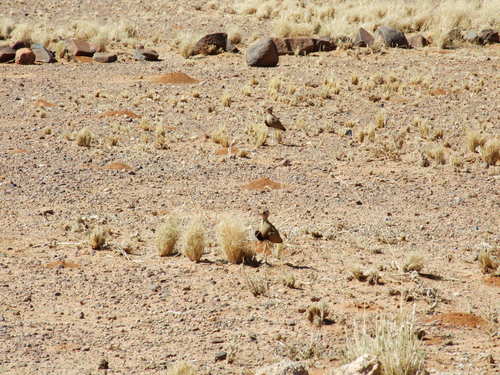 Burchell's Courser
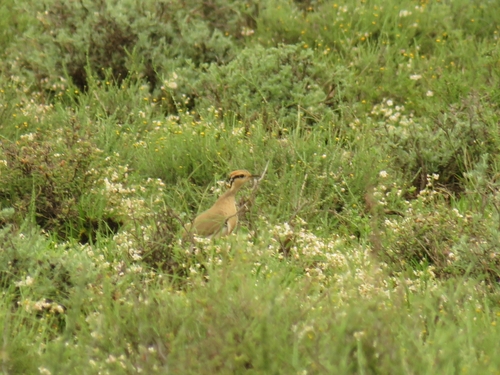 Temminck's Courser
In short
The most reliable field mark to separate Burchell's Courser from Temminck's Courser is the blue-grey hind crown on Burchell's, which Temminck's lacks. Adult Burchell's also show a more pronounced pale rufous coloration and a horizontal black band across the lower breast, setting off a white underbelly. Both species have similar upright, slender builds and facial patterns, but the head and underpart differences are key. Juvenile Burchell's lack the adult's rufous tones and facial stripes, appearing mottled and barred, which may cause confusion with Temminck's, especially at a distance or in poor light.
Identification tips
- Blue-grey hind crown (adult Burchell's only): Look for a distinct blue-grey patch on the hind crown of Burchell's Courser; Temminck's Courser lacks this feature. This is the single most reliable field mark for adults.
- Horizontal black breast band: Burchell's shows a sharp, horizontal black band separating the white underbelly from the rufous breast; Temminck's Courser does not have this strong demarcation.
- Overall rufous coloration: Adult Burchell's is paler and more rufous overall, while Temminck's tends to be less rufous and more uniform.
- Facial pattern: Both have white supercilia above black eye lines, but in Burchell's these lines and the supercilia form a double V at the nape, accentuated by the blue-grey crown. In Temminck's, the head pattern is similar but lacks the blue-grey and may appear less sharply defined.
- Juvenile confusion: Juvenile Burchell's Courser lacks the adult's rufous tones and facial stripes, appearing mottled with black and beige barring. This can look similar to Temminck's Courser, especially at a distance. If you see a mottled, less distinctly marked courser in the right habitat, consider age as well as species.
- Underwing pattern (adults): Burchell's Courser has mostly white secondaries, black underwing, and brown to grey coverts. Underwing pattern for Temminck's is not described, so use with caution.
- Leg color: Burchell's Courser has creamy white legs, which may contrast with the ground. Leg color for Temminck's is not specified but is likely similar; use only as a supporting mark.
- Bill shape: Both have long, slightly decurved dark bills, not useful for separation.
- Feet projection in flight: Burchell's Courser's feet extend past the tail in flight, typical for coursers and likely not diagnostic between these two.
- Habitat context: In arid, gravelly semi-desert or open, overgrazed grassland, Burchell's is more likely. In recently burnt savannah, especially where dark eggs may be found, Temminck's is favored.
- Geographic range: Burchell's is more restricted to southern Africa (South Africa, Namibia, SW Angola, Botswana), while Temminck's is widespread in sub-Saharan Africa.
- Behavior: Both species run to catch insects and may be solitary or in small groups; behavior is not diagnostic.
- Sex differences: Males and females are similar in both species; do not use sex for separation.
- Size: Both are similar in size and structure; do not rely on size for identification.
- Vocalizations: No distinguishing calls or songs are described in the available sources.
Size
Both species are very similar in size, with Burchell's Courser averaging 75 g and Temminck's Courser slightly lighter at 71 g [wikidata]. In the field, this difference is negligible and unlikely to be useful for separation. Both have long legs and a graceful, upright stance typical of coursers.
Plumage
For adults, Burchell's Courser is distinguished by its blue-grey hind crown, a feature absent in Temminck's. Burchell's also shows a horizontal black band separating a white underbelly from the rest of its pale rufous body, while Temminck's lacks this sharp demarcation. The face of Burchell's is marked by white supercilia above black eye lines, forming a double V at the nape; Temminck's has similar facial striping but without the blue-grey crown. Juvenile Burchell's Courser is notably different from adults: it lacks the rufous tones and facial stripes, and instead is mottled with black and beige barring, which can superficially resemble Temminck's, especially in poor viewing conditions. Underwing pattern is described for Burchell's as mostly white secondaries with a black underwing and brown to grey coverts; Temminck's underwing is not detailed in the sources, so this may not be reliable for separation.
Behaviour
Both species are diurnal, terrestrial, and run to catch insect prey. Burchell's Courser is described as locally nomadic, often solitary or in small flocks, and forages by running and digging with its long bill. Temminck's Courser is also a ground-dweller and forager, with similar habits. In flight, Burchell's Courser's feet extend past the tail, a trait typical of coursers and likely shared with Temminck's.
Habitat
Burchell's Courser favors warm, dry regions in southern Africa, especially deserts or semi-deserts with gravel, open grasslands with short grass, and areas with sparse, burnt, or overgrazed vegetation. Its range is mainly in South Africa, Namibia, southwest Angola, and Botswana (Kalahari Basin). Temminck's Courser is more widespread in sub-Saharan Africa and is especially noted for breeding in burnt savannahs, where it lays dark eggs among charred vegetation. While their ranges can overlap, Burchell's is more tied to arid, gravelly habitats, whereas Temminck's is often found in recently burnt grasslands.