

Bullock's Oriole vs Scott's Oriole
Icterus bullockii versus Icterus parisorum
Play a quiz with Bullock's Oriole and Scott's Oriole
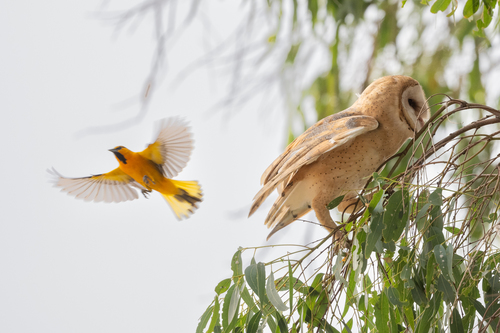 Bullock's Oriole
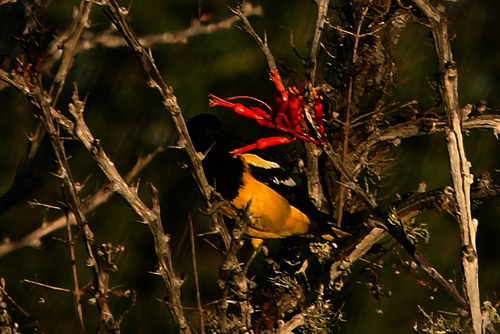 Scott's Oriole
In short
The most reliable field mark to separate Bullock's Oriole from Scott's Oriole is the pattern and color contrast on the head and underparts in adults: Bullock's Oriole males show a bold black crown, eye-line, and throat patch with bright orange-yellow underparts, while Scott's Oriole males have a fully black head, breast, and back with sharply contrasting lemon-yellow belly and rump. Females and immatures are trickier, but Bullock's Oriole females and juveniles lack the extensive black on the head and breast typical of Scott's, and show more uniform yellow or orange below. In flight or perched, note the tail and wing patterns: Scott's Oriole has a mostly black tail with yellow bases and white tips (especially on outer feathers), while Bullock's has a long, square, jet-black tail in males. Both species overlap in range in the southwestern US, but habitat and subtle plumage details help clinch identification.
Identification tips
- Adult male head pattern: Bullock's Oriole males have a black crown, eye-line, and throat patch, but orange-yellow face and underparts; Scott's Oriole males have the entire head, throat, and breast solid black. This is the most reliable mark in spring and summer.
- Underparts color: Bullock's Oriole males are orange-yellow below; Scott's Oriole males are lemon yellow below, with a sharp contrast at the black breast. Females of Bullock's are dull yellow to orange below, while Scott's females are pale olive-yellow, often with a black throat and upper breast.
- Tail pattern: Bullock's Oriole males have a long, square, jet-black tail; Scott's Oriole has a mostly black tail with yellow bases and white tips, especially prominent on the outer feathers. This is visible in perched birds and in flight.
- Wing pattern: Bullock's Oriole shows a white wing patch (on coverts); Scott's Oriole has two distinct white wing bars (median and greater coverts) and yellowish lesser coverts forming an epaulet. In flight, Scott's wing bars and yellow epaulet stand out, while Bullock's shows a single white patch.
- Female and immature head/throat: Bullock's Oriole females and juveniles lack the extensive black on the head and breast seen in Scott's Oriole females, though older female Bullock's may have a small dark throat patch. Scott's Oriole females usually have a black chin, throat, and upper breast, even in non-breeding plumage.
- Juvenile bill color: Juvenile Bullock's Orioles have a pinkish or whitish bill, while Scott's Oriole juveniles have a black or bluish-black bill with a gray base to the mandible. This is subtle but can help in close views.
- Back color and streaking: Bullock's Oriole females and immatures are gray-brown above with little streaking; Scott's Oriole females are grayish olive above with darker streaks, especially on the back and scapulars.
- Size and structure: Scott's Oriole is larger, longer, and often appears more lanky and long-tailed than Bullock's, which is more compact. This is most apparent when both species are seen together or in familiar habitats.
- Habitat context: In the Southwest, a bright oriole in open desert, especially near yuccas or agaves, is likely Scott's; in riparian woodlands or suburban areas with large deciduous trees, Bullock's is more probable.
- Vocalizations: Bullock's Oriole's song is fast, sweet, and somewhat harsh, similar to Baltimore Oriole. Scott's Oriole's song is more musical and less harsh, but this is subtle and not always diagnostic.
- Sexual dimorphism: Both species show sexual dimorphism, but it is more pronounced in Bullock's Oriole, where only males have the full black crown and eye-line. In Scott's, both sexes can show black on the throat and breast, though males are more extensively black.
- Wing bars vs. patch: In the field, Scott's Oriole's two white wing bars and yellow epaulet are distinctive; Bullock's Oriole's single white wing patch is broader but less sharply defined.
- Tail in flight: Scott's Oriole's tail pattern (yellow bases, white tips) is especially visible in flight, while Bullock's Oriole's tail remains uniformly black in adult males.
- Bill color: Adult Bullock's Oriole has a black bill with a bluish-gray base to the lower mandible; Scott's Oriole has a black or bluish-black bill with a gray base, but this is subtle and not always visible in the field.
- Pitfalls: Immature Bullock's Orioles can be confused with Scott's females, but lack the extensive black on the throat and breast and have a paler, pinkish bill. Always check for head/throat pattern and habitat context.
Size
Scott's Oriole is noticeably larger and longer than Bullock's Oriole. Scott's measures about 23 cm (9.1 in) in length with a 32 cm (13 in) wingspan, while Bullock's Oriole is smaller at 17–19 cm (6.7–7.5 in) long and a 31 cm (12.2 in) wingspan. Weight overlaps but Scott's averages slightly heavier (32–41 g vs. Bullock's 28–43 g). In the field, Scott's often appears lankier and longer-tailed, especially when perched upright on yuccas or open branches.
Plumage
For adults, male Bullock's Orioles have a striking black crown, eye-line, and throat patch, with orange-yellow face, breast, and underparts, and a white wing patch. Their tail is long, square, and jet black. Male Scott's Orioles, in contrast, have a fully black head, back, and breast, with a sharply defined lemon-yellow belly and rump, and their tail is mostly black with yellow bases and white tips (especially on outer feathers). Females and immatures are more subtle: Bullock's Oriole females are gray-brown above with dull yellow below, sometimes with a small dark throat patch but never a full black head or breast. Scott's Oriole females are grayish olive above with darker streaks, pale olive-yellow below, and most have a black chin, throat, and upper breast. Juvenile Bullock's resemble adult females but with darker wings and a pinkish or whitish bill, lacking the black throat and breast of Scott's. Both species show wing bars, but Scott's has two distinct white wing bars (median and greater coverts) and yellowish lesser coverts forming an epaulet, while Bullock's shows a white patch on the wing coverts.
Behaviour
Both species are active, but Scott's Oriole is often seen foraging higher in yuccas, agaves, or open arid slopes, sometimes singing from exposed perches. Bullock's Oriole is more likely to be seen in riparian woodlands, orchards, or open deciduous forests, weaving pendant nests. In flight, Scott's may appear longer-tailed and more buoyant, while Bullock's is more compact. Both species sing, but Scott's is more likely to be heard in arid, open country.
Habitat
Bullock's Oriole is widespread in western North America, favoring riparian corridors, open woodlands, and suburban areas with large deciduous trees. Scott's Oriole is more closely tied to arid, open habitats with yuccas, agaves, or desert slopes, especially in the southwestern US and Mexico. Overlap occurs in the Southwest, but Scott's is rarely found in the lush riparian zones preferred by Bullock's.
Voice
Both species sing, but Bullock's Oriole has a song similar to Baltimore Oriole—sweet, fast, and somewhat harsh. Scott's Oriole's song is not described in detail in the notes, but is generally considered more musical and less harsh than Bullock's. Females of both species sing, but Bullock's females are noted as more prolific singers, with a less sweet voice than males.