

Brown Noddy vs Black Noddy
Anous stolidus versus Anous minutus
Play a quiz with Brown Noddy and Black Noddy
 Brown Noddy
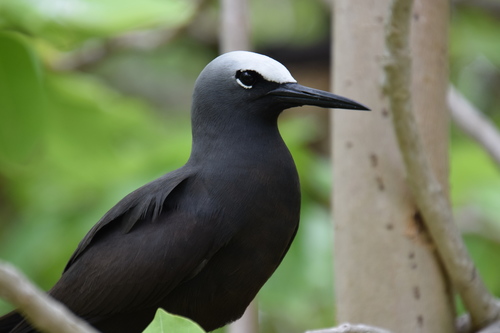 Black Noddy
In short
The most reliable field mark between Brown Noddy and Black Noddy is overall plumage color: Brown Noddy is distinctly dark brown, while Black Noddy is truly blackish. Both have a pale cap, but Brown Noddy's is more grayish or white and contrasts less with the rest of the head. Size is also a strong clue, as Brown Noddy is noticeably larger and longer-winged. Tail shape and subtle facial details (like the eye-ring and lores) can help, but beware overlap in poor light or at distance. Immature and adult birds show similar contrasts, as neither species has distinctive age-specific upperwing patterns.
Identification tips
- Overall color: Brown Noddy is dark brown, not black; Black Noddy is truly blackish. This is most obvious in good light or when seen side-by-side.
- Crown/cap: Both have a pale crown, but Brown Noddy's is pale gray or white and less sharply defined, while Black Noddy's is a bright white cap that stands out against the black plumage.
- Eye-ring and facial marks: Brown Noddy shows a narrow, incomplete white eye-ring; Black Noddy has a small white crescent under each eye and a white spot above, but lacks a full eye-ring. The lores are pale in Brown Noddy and dark in Black Noddy.
- Tail shape: Brown Noddy has a long, wedge-shaped tail; Black Noddy's tail is shorter and more squared off (truncated). This is best seen when perched or in slow flight.
- Size: Brown Noddy is noticeably larger and bulkier, with a longer wingspan. If you see both together, the difference is obvious; alone, use this with caution.
- Feet color: Both usually have dark feet, but some Black Noddy subspecies (e.g., melanogenys) have orange feet. This is rarely visible in the field but can help in close views.
- Bill: Both have a long, pointed black bill; this is not a reliable separator.
- Flight style: Brown Noddy may appear heavier and more deliberate in flight, while Black Noddy is more buoyant and agile, but this is subtle and best used as supporting evidence.
- Juvenile/immature birds: No distinctive age-specific upperwing or flight marks are described for either species, so rely on overall color and structure at all ages.
- Perched posture: Brown Noddy often appears longer-bodied and more upright; Black Noddy is more compact.
- Lighting pitfalls: In poor light, Brown Noddy can appear blackish, and Black Noddy's pale cap can seem less distinct. Always try to view in good light.
- Habitat overlap: Both species can occur together on tropical islands; do not rely on location alone.
- Season/sex: No marked seasonal or sexual dimorphism is noted for either species; all field marks apply year-round and to both sexes.
- Vocalizations: Not described as diagnostic in the available notes; do not rely on voice for separation.
- Context: If you see a group, check for size variation and compare individuals directly when possible.
Size
Brown Noddy is the largest noddy: 38–45 cm in length with a 75–86 cm wingspan [wikipedia]. Black Noddy is smaller, at 35–37 cm long and a 66–72 cm wingspan. In the field, Brown Noddy appears bulkier and longer-winged, while Black Noddy is more compact and lighter. This size difference is usually obvious when both species are seen together, but can be subtle at a distance or without direct comparison.
Plumage
- Adults and immatures: Brown Noddy is dark chocolate-brown overall, with a pale gray or white crown and forehead, and a narrow incomplete white eye-ring. Black Noddy is blackish overall, with a white cap, a small white crescent under each eye, and a white spot above the eye. The lores (area between bill and eye) are pale in Brown Noddy but dark in Black Noddy. Both have long wings, but Brown Noddy's tail is long and wedge-shaped, while Black Noddy's is more truncated. Both have dark legs and feet, though some Black Noddy subspecies have orange feet. No distinctive juvenile or immature upperwing patterns are described for either species, so these contrasts apply to all ages.
- In flight: Both species show similar flight profiles, but Brown Noddy's brown coloration is visible even at a distance, while Black Noddy appears blackish. The pale crown is visible on both, but contrasts more sharply on Black Noddy.
Behaviour
Both species are colonial seabirds, often seen flying low over the water or perched on cliffs, trees, or shrubs. Brown Noddy tends to nest on elevated sites such as cliffs or low trees, while Black Noddy is also colonial but may show more variation in perch choice. In flight, Brown Noddy may appear heavier and more languid, while Black Noddy is slightly more buoyant and agile due to its smaller size.
Habitat
Both species are tropical seabirds with overlapping ranges in the Pacific, Indian, and Atlantic Oceans. Brown Noddy has a broader global distribution and is more likely to be found on elevated nesting sites. Black Noddy is also widespread but may be more closely associated with coral islands and may show some subspecies variation in habitat preference. Both are seen over open ocean and around islands.