

Brown-necked Raven vs Fan-tailed Raven
Corvus ruficollis versus Corvus rhipidurus
Play a quiz with Brown-necked Raven and Fan-tailed Raven
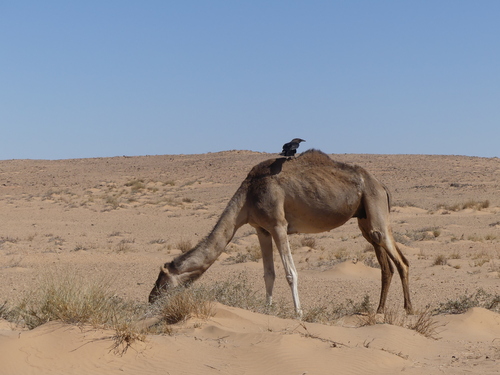 Brown-necked Raven
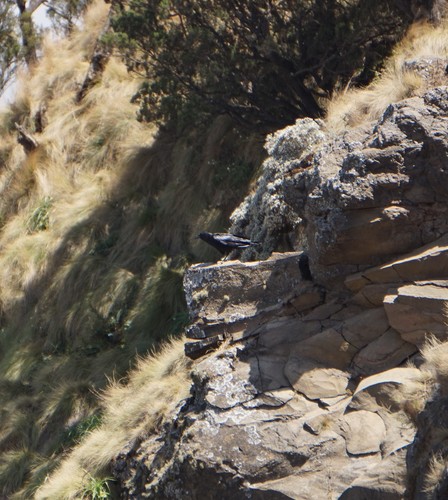 Fan-tailed Raven
In short
The most reliable field mark between Brown-necked Raven and Fan-tailed Raven is the distinctly brownish-black head and throat of the Brown-necked Raven, contrasting with the Fan-tailed Raven's entirely black plumage. Brown-necked Raven is also noticeably larger and longer-tailed, with a more pointed wing profile in flight, while Fan-tailed Raven is smaller, with a shorter, more squared or 'fan-shaped' tail and proportionally larger wings. Both species can appear somewhat brownish when worn, but only Brown-necked Raven shows a consistent brownish cast to the neck and head. Bill structure and flight style further aid separation, especially at a distance or in mixed flocks.
Identification tips
- Head and throat color: Brown-necked Raven shows a distinct brownish-black head and throat, often visible even at a distance or in worn plumage. Fan-tailed Raven is entirely black; any brownish tinge is uniform and never concentrated on the head or neck.
- Overall size: Brown-necked Raven is noticeably larger (52–56 cm) than Fan-tailed Raven (47–51 cm). Use this when birds are side by side or with known species (e.g., Carrion Crow for scale).
- Tail shape and length: Brown-necked Raven has a longer, more wedge-shaped tail, while Fan-tailed Raven's tail is shorter and more squared or 'fan-shaped,' especially obvious in flight or when the tail is spread.
- Wing shape: Brown-necked Raven's wings are pointed in profile, giving a more streamlined look in flight. Fan-tailed Raven has relatively larger wings for its body size, aiding in its buoyant, soaring flight.
- Bill structure: Fan-tailed Raven has a proportionally thicker, heavier bill compared to the less deep, less massive bill of Brown-necked Raven. This is best seen at close range or in photos.
- Gloss and feather wear: Both species can appear brownish when worn, but only Brown-necked Raven develops a consistent brownish cast, especially on the head and neck. Fan-tailed Raven may look slightly coppery-brown overall when worn, but never with a brown neck.
- Throat hackles: Fan-tailed Raven has shorter throat hackles than most ravens, but this is a subtle feature and not easily seen unless close.
- White feather bases: Only Fan-tailed Raven has white at the base of the upper neck feathers, but this is not a field mark unless the wind exposes it or the bird is handled.
- Flight style: Fan-tailed Raven is more aerial, often soaring and gliding like a vulture, and may be seen playing in thermals. Brown-necked Raven is heavier and more direct in flight.
- Habitat context: Fan-tailed Raven is more strictly desert-adapted, often in rocky, barren areas with cliffs; Brown-necked Raven is more flexible but overlaps in range.
- Voice: Brown-necked Raven's calls are higher-pitched croaks ('karr-karr-karr', 'kuerk-kuerk'), while Fan-tailed Raven's are more guttural and frog-like. Use with caution, as both can be variable.
- Association: Both species may roost together, so check multiple field marks if seen in a mixed group.
- Juvenile/immature plumage: No distinctive juvenile or immature upperwing patterns are described for either species, so rely on structural and plumage marks for all ages.
- Perched vs. flight: Tail shape and length, as well as overall size, are often easiest to judge in flight or when birds are perched in the open.
- Plumage pitfalls: Do not rely solely on overall gloss or slight brownish tinge in worn birds—focus on the location of brown (head/neck for Brown-necked Raven) and structural features.
Size
Brown-necked Raven is the larger of the two, measuring 52–56 cm in length, while Fan-tailed Raven is smaller at 47–51 cm—about the size of a Carrion Crow. Brown-necked Raven has proportions similar to Common Raven but with a less massive bill and slightly more pointed wings. Fan-tailed Raven, though smaller, has a relatively thick bill, a shorter tail, and larger wings for its size, giving it a different silhouette in flight.
Plumage
No age-specific upperwing or flight pattern differences are described for these species, so focus is on general plumage. Brown-necked Raven adults and immatures show a distinct brownish-black coloration on the head and throat, which is often visible even at a distance and gives the species its name. The rest of the plumage is glossy black with purple or blue highlights, but all feathers can fade to a brownish-black before molt, making the whole bird look browner with wear. Fan-tailed Raven is uniformly black with a purplish-blue gloss in fresh plumage and can show a slight coppery-brown tinge when worn, but never has a consistently brownish head or neck. The base of the neck feathers is white, but this is only visible if the feathers are blown apart or on close inspection—not a field mark. Both species have black bills, legs, and feet. Fan-tailed Raven's throat hackles are shorter than in most ravens, but this is subtle unless seen at close range.
Behaviour
Fan-tailed Raven is notably more aerial, often soaring and gliding on thermals in a vulture-like manner, and is considered one of the most aerial of all ravens. It frequently travels great distances in search of food and is more likely to be seen soaring high or playing in the wind. Brown-necked Raven also soars but typically appears heavier and less buoyant in flight, with a steadier, more direct flight style. Both species may associate at roosts, but Fan-tailed Raven's flight is more acrobatic and less ponderous.
Habitat
Both species inhabit arid and semi-arid regions of North Africa, the Middle East, and parts of East Africa. Fan-tailed Raven is more strictly associated with open desert or dry country, especially where there are cliffs or crags for nesting. Brown-necked Raven shares much of this range but may be found in a broader range of open habitats. Both may be seen around human habitation, but Fan-tailed Raven is more likely to be found in the most barren, rocky areas.
Voice
Both species have croaking calls typical of ravens, but Brown-necked Raven's voice is higher-pitched than Common Raven, with a harsh 'karr-karr-karr' and a 'kuerk-kuerk' in flight. Fan-tailed Raven's calls are described as guttural croaks mixed with frog-like sounds. Both are capable of mimicry, but this is rarely observed in the wild. Voice is a subtle distinction and best used in combination with visual marks.