

Brown-headed Gull vs Brown-necked Raven
Chroicocephalus brunnicephalus versus Corvus ruficollis
Play a quiz with Brown-headed Gull and Brown-necked Raven
 Brown-headed Gull
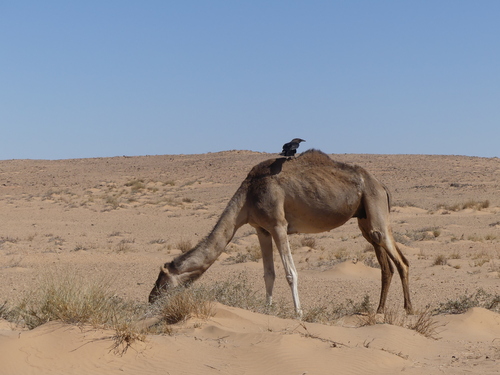 Brown-necked Raven
In short
The most reliable field mark to separate Brown-headed Gull from Brown-necked Raven is the wing and tail pattern in flight, especially in immature birds: juvenile and first-year Brown-headed Gulls show a black terminal tail band and more dark areas in the wings, while Brown-necked Ravens are uniformly dark with no such contrasting patterns. Structurally, Brown-headed Gull is a compact, small gull with a red bill and legs, while Brown-necked Raven is a much larger, heavy-billed corvid with a distinctly wedge-shaped tail and all-black bare parts. Adult Brown-headed Gulls in summer have a pale brown hood, but lose this in winter, whereas Brown-necked Raven's head and throat are always brownish-black, fading to brown with wear. The two species differ drastically in size, structure, flight style, and habitat preference, making confusion unlikely except at a great distance or in poor conditions.
Identification tips
- Juvenile/first-winter Brown-headed Gull shows a black terminal tail band and more dark in the wings—look for these in flight; Brown-necked Raven never shows such patterns at any age.
- Adult Brown-headed Gull in summer has a pale brown hood (not dark brown or black), with a pale grey body and red bill/legs; in winter, the hood is lost, replaced by dark streaks—Brown-necked Raven always has a brownish-black head and throat, with no seasonal hood.
- Wing pattern in flight: Brown-headed Gull has black-tipped primaries with conspicuous white 'mirrors' (adults), and a grey underwing with black flight feathers; Brown-necked Raven is uniformly dark above and below, with no white or pale areas.
- Bill color and shape: Gull's bill is red (adults) and slender; raven's is black, thick, and heavy, with a strong curve—this is visible even at a distance.
- Leg color: Gull has red legs (adults), raven has black legs and feet.
- Tail shape: Gull's tail is short and square or slightly rounded; raven's tail is long and wedge-shaped, especially obvious when fanned in flight.
- Size and structure: Brown-headed Gull is small and compact, with a short neck and tail; Brown-necked Raven is much larger, with a long neck, heavy bill, and long, wedge-shaped tail.
- Flight style: Gull flies with rapid, shallow wingbeats and glides on flat wings; raven soars and glides with deep, slow wingbeats, often holding wings in a shallow dihedral.
- Plumage gloss: Raven's plumage is black with purple or blue gloss, fading to brownish-black; gull is pale grey and white with dark wingtips and (in season) a pale brown hood.
- Bare part color: Gull's red bill and legs (adults) are distinctive; raven's are always black.
- Habitat: Gull is tied to water—lakes, coasts, rivers; raven is found in arid, open country, deserts, and steppe, rarely near water.
- Flock size: Gull is often in large, noisy flocks; raven is usually solitary or in small groups.
- Vocalization: Gull gives typical gull calls; raven gives croaks and harsh calls, very different in tone and rhythm.
- Context: If seen scavenging in towns or at water's edge, likely gull; if soaring over desert or perched on rocks, likely raven.
- Seasonal confusion: In winter, gull loses its hood but still shows pale body and red bill/legs; raven's plumage may look browner with wear but never shows a hood or pale body.
Size
Brown-headed Gull is a small gull, noticeably smaller and more compact than any raven. Brown-necked Raven is a large corvid, 52–56 cm in length, with a much heavier build and longer wings and tail. Even at a distance, the raven's size and bulk are apparent, especially when seen alongside other birds. The gull is delicate and short-billed by comparison, with a proportionally shorter neck and tail.
Plumage
Juvenile and first-winter Brown-headed Gulls show a black terminal tail band and more extensive dark markings in the wings, especially visible in flight. These contrasting patterns are absent in Brown-necked Raven of any age, which is uniformly dark, with plumage that can fade to a brownish-black overall. Adult Brown-headed Gulls in summer have a pale brown hood (lighter than the black-headed gull's) and a pale grey body, with black-tipped primaries featuring conspicuous white 'mirrors'. In winter, the hood is lost, replaced by dark vertical streaks on the head. The underwing is grey with black flight feathers. Brown-necked Raven always has a brownish-black head and throat, with the rest of the plumage black glossed purple or blue; with wear, the entire bird can appear brownish. The raven's bill, legs, and feet are always black, while the gull's are red in adults. No seasonal hood or wing pattern changes in the raven.
Behaviour
Brown-headed Gull is highly gregarious, especially in winter, often seen in large flocks feeding or roosting, and is bold and opportunistic around water, fields, and even towns. It is rarely seen far from water. Brown-necked Raven is typically seen singly or in small groups, often soaring or gliding with deep, slow wingbeats, and is much less tied to water. Its flight is powerful and direct, with a wedge-shaped tail often fanned. The raven is more likely to be seen in arid or semi-arid landscapes, often far from water, and is less likely to be found in dense flocks.
Habitat
Brown-headed Gull breeds in high plateau wetlands, reedbeds, or on islands in lakes, and winters along coasts and large inland lakes, rarely venturing far from water. Brown-necked Raven prefers arid and semi-arid regions, deserts, and open country, and is not associated with water bodies. If you see a bird over open desert or dry steppe, it is almost certainly the raven; over lakes, rivers, or coasts, the gull is much more likely.
Voice
Brown-headed Gull is noisy, especially at colonies, with typical gull-like calls. Brown-necked Raven has a voice similar to the common raven, mainly croaks but higher-pitched, and a harsh 'karr-karr-karr'; in flight, it gives a 'kuerk-kuerk'. The raven is also capable of mimicry, though this is rare in the wild. The two species' calls are entirely different and diagnostic if heard well.