

Brown-breasted Pygmy-Tyrant vs Flavescent Warbler
Hemitriccus obsoletus versus Myiothlypis flaveola
Play a quiz with Brown-breasted Pygmy-Tyrant and Flavescent Warbler
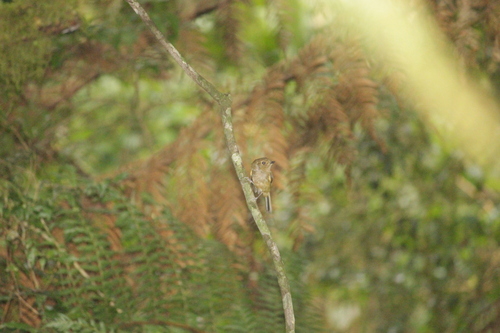 Brown-breasted Pygmy-Tyrant
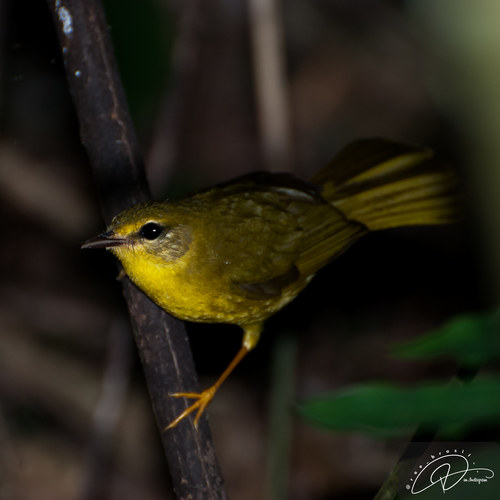 Flavescent Warbler
In short
The most reliable field mark to separate Brown-breasted Pygmy-Tyrant from Flavescent Warbler is overall coloration and face pattern: the pygmy-tyrant is a plain, brownish-olive bird with a subtle buffy eye-ring, while the flavescent warbler is brighter with strong yellow underparts and a bold yellow supercilium. The warbler is also noticeably larger and longer-tailed, with a more active, ground-foraging behavior. Both species can appear olive above, but the warbler's yellow face and underparts stand out at a distance. Immature-specific wing patterns are not described for either species, so focus on adult plumage and structure.
Identification tips
- Face pattern: Flavescent Warbler has a bold yellow supercilium and yellow crescent under the eye, plus a dusky eye-stripe—much stronger facial contrast than the pygmy-tyrant's plain brownish face with only a faint buffy eye-ring and spot above the lores. This is reliable at all ages.
- Underparts color: Warbler is bright yellow below (throat, breast, belly), while pygmy-tyrant is dingy buff to ochraceous, never truly yellow. If the bird looks bright yellow underneath, it's the warbler.
- Back and upperparts: Both can appear olive above, but the warbler is more greenish-olive, while the pygmy-tyrant is browner and plainer. Subtle, but useful in good light.
- Size and structure: Warbler is noticeably larger and longer-tailed, with a more robust body and longer bill. Pygmy-tyrant is small, compact, and short-tailed. Use this when birds are seen well or with other species for scale.
- Bill color: Warbler has a blackish or dusky bill (sometimes paler in subspecies), while pygmy-tyrant has a gray maxilla and pinkish mandible. Subtle, but visible at close range.
- Leg color: Warbler's legs are orange-pink; pygmy-tyrant's are light gray. This can help in good light.
- Iris color: Pygmy-tyrant has a reddish-brown iris; warbler's is dark. Useful if seen at close range.
- Wing and tail pattern: Both species lack strong wingbars or contrasting panels; neither shows distinctive juvenile or immature wing patterns. Do not rely on this for separation.
- Behavior: Warbler is active, often on the ground or low in vegetation, hopping and flipping leaves. Pygmy-tyrant is more likely to perch quietly in bamboo or dense undergrowth.
- Habitat: In dense bamboo, especially montane, prioritize pygmy-tyrant; in more open or varied forest/edge, warbler is more likely.
- Vocalizations: If you hear very high 'tic' notes or a buzzy wing sound, suspect pygmy-tyrant. Warbler's song is not described here.
- Geographic range: If outside Argentina or Brazil, it's almost certainly warbler; within those countries, check habitat and plumage.
- Sex and season: Both species are sexually monomorphic and do not have strong seasonal plumage changes, so these are not useful for separation.
- Pitfalls: In poor light, the warbler's yellow can look dull, and the pygmy-tyrant's buff can look yellowish. Always check face pattern and size if possible.
- Mixed flocks: Warbler does not join mixed-species flocks; pygmy-tyrant's flocking behavior is not described, but it is likely solitary or in pairs.
Size
Flavescent Warbler is distinctly larger (body mass ~13.1g, length ~14.5cm) than Brown-breasted Pygmy-Tyrant (~11.6g, length ~11cm). In the field, the warbler looks longer and more robust, with a proportionally longer tail, while the pygmy-tyrant is compact and small-billed. This size difference is usually obvious when seen side by side or with experience.
Plumage
No age-specific wing or flight patterns are described for either species, so focus on adult plumage. Brown-breasted Pygmy-Tyrant is plain brownish-olive above, with a dingy buff throat and breast, a faint buffy crescent on the upper breast, and buffy ochraceous belly and crissum. Its face is subdued, with a buffy spot above the lores and a pale buffy eye-ring, but otherwise brownish. The wings and tail are plain brownish olive to dusky, lacking strong contrast. In contrast, Flavescent Warbler is brighter: olive-green above, with a bold yellow supercilium that extends past the eye, a dusky eye-stripe, yellow underparts, and a yellow crescent under the eye. Its wings and tail are olive-green, matching the back, and the face is much more patterned and colorful than the pygmy-tyrant. The warbler's bill is darker (blackish or dusky), and its legs are orange-pink, while the pygmy-tyrant has a gray maxilla, pinkish mandible, and light gray legs. Both sexes are similar in each species.
Behaviour
Flavescent Warbler is an active, ground-foraging bird, often seen hopping on the ground or low in vegetation, flipping leaves to find insects. It forages singly or in pairs and does not join mixed-species flocks. Brown-breasted Pygmy-Tyrant is less described behaviorally, but as a typical Hemitriccus, it is likely to be more retiring, perching quietly in low or mid-level bamboo or forest undergrowth, and less likely to be seen foraging on the ground. The warbler's movement is more energetic and conspicuous.
Habitat
Both species overlap in Argentina and Brazil, but Flavescent Warbler has a wider range (also in Bolivia, Colombia, Guyana, Paraguay, Venezuela). Brown-breasted Pygmy-Tyrant is more restricted and closely associated with bamboo in montane forests, especially Chusquea bamboo. Flavescent Warbler is found in a broader range of forest and edge habitats, including more open and varied environments. If seen in dense bamboo thickets, especially in montane areas, suspect pygmy-tyrant; in more open or diverse undergrowth, warbler is more likely.
Voice
Brown-breasted Pygmy-Tyrant gives an irregular series of very high 'tic' notes and a buzzy 'brrrrrr' with its wings. Flavescent Warbler's vocalizations are not described in the provided notes, so voice is only useful if the pygmy-tyrant's high 'tic' or wing-buzz is heard. In general, warblers in this genus have more musical or complex songs, but this is not diagnostic here.
Brown-breasted Pygmy-Tyrant · Flavescent Warbler · My Tricky Birds