

Brown-breasted Flycatcher vs Brown-streaked Flycatcher
Muscicapa muttui versus Muscicapa williamsoni
Play a quiz with Brown-breasted Flycatcher and Brown-streaked Flycatcher
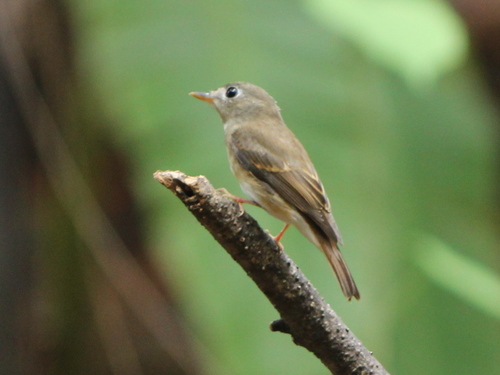 Brown-breasted Flycatcher
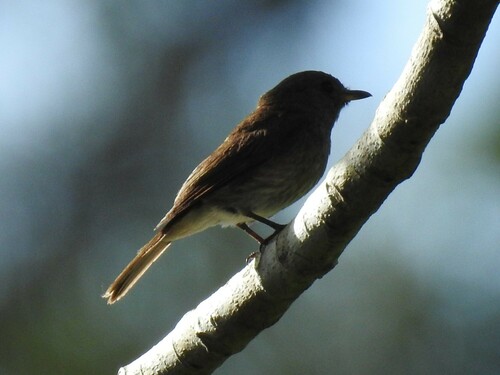 Brown-streaked Flycatcher
In short
The most reliable field mark to separate Brown-breasted Flycatcher from Brown-streaked Flycatcher is the leg color: Brown-breasted has pale flesh-colored legs, while Brown-streaked (like Asian Brown Flycatcher) is expected to have darker legs, though this is not explicitly confirmed for Brown-streaked. Brown-breasted also shows a conspicuous pale eye-ring and pale lores, with a distinct brown breast contrasting a buffy white belly. Brown-streaked Flycatcher is rufescent in breeding plumage but becomes drab at other times, potentially overlapping with Brown-breasted in dullness. Both species are small, plain Muscicapa flycatchers, and confusion is most likely when viewing birds in non-breeding plumage or in shaded forest understorey. Focus on leg color, eye-ring, and subtle plumage tones for best separation.
Identification tips
- Leg color: Brown-breasted Flycatcher has pale flesh-colored legs, a key field mark; Brown-streaked is likely to have darker legs (like Asian Brown Flycatcher), but this is not explicitly confirmed. Always check leg color in good light.
- Eye-ring: Brown-breasted shows a conspicuous pale eye-ring, which is often obvious in the field. The eye-ring of Brown-streaked is not described, but if less distinct, this can be a helpful separator.
- Lores: Pale lores are characteristic of Brown-breasted; check for this subtle mark in close views.
- Breast color: Brown-breasted has a pale brown breast contrasting with a buffy white belly. Brown-streaked may be more uniformly brown or rufescent, especially in breeding plumage, and less sharply demarcated.
- Rufous tones: Brown-breasted shows brighter rufous on upper tail coverts and flight feather edges; look for these in good light. Brown-streaked is described as rufescent in breeding season, so this mark is not always reliable.
- Streaking: Brown-streaked's name suggests some streaking on the breast, but this is not detailed in the notes. If visible, streaking would favor Brown-streaked, but absence does not rule it out.
- Seasonal plumage: Brown-streaked is rufescent in breeding season and drab otherwise; Brown-breasted is more consistently olive-brown. In non-breeding season, both can appear dull, so rely on structural and facial marks.
- Size and structure: Both are small, compact flycatchers of similar size and shape. Do not use size as a separator.
- Flight and wing pattern: No distinctive age-specific wing or flight pattern marks are described for either species. Do not rely on upperwing pattern for separation.
- Voice: Only Brown-breasted's call is described (very faint, high-pitched notes). If you hear this, it may support Brown-breasted, but silence or unfamiliar calls do not confirm Brown-streaked.
- Habitat and range: Use range as a supporting clue: Brown-breasted is more likely in northern India, China, and Sri Lanka; Brown-streaked in southern Myanmar, Thailand, Malaysia, and Borneo. In overlap zones, do not rely on range alone.
- Context: Both species prefer forest understorey and forage low. Behavioral context is not helpful for separation.
- Pitfalls: Dull or non-breeding Brown-streaked can closely resemble Brown-breasted. Always check multiple features, especially leg color and facial pattern, before making an identification.
- Sex and age: No sex-specific or juvenile marks are described for either species. Assume all ages and sexes are similar in field marks.
- Lighting and viewing conditions: Subtle marks like leg color and eye-ring can be hard to see in shade. Try to observe from multiple angles and in good light for best results.
Size
Brown-breasted Flycatcher averages 12 g in body mass and measures 13–14 cm in length [wikidata][wikipedia]. No direct measurement is available for Brown-streaked Flycatcher, but as a close Muscicapa relative, it is likely similar in size. In field conditions, size alone is not a reliable separator between these two species.
Plumage
Juvenile and immature plumages are not described in detail for either species, so no age-specific upperwing or flight pattern marks are available to separate them. For adults, Brown-breasted Flycatcher has olive-brown upperparts with brighter rufous on the upper tail coverts and flight feather edges, and a pale brown breast that contrasts with a buffy white belly. The pale lores and conspicuous eye-ring are notable. Brown-streaked Flycatcher is rufescent (reddish-brown) in breeding plumage but becomes drab outside the breeding season, potentially resembling the muted tones of Brown-breasted. The degree of streaking on the breast is not described for Brown-streaked, but its name suggests some streaking may be present. In summary, Brown-breasted is more likely to show a clear pale eye-ring, pale lores, and a distinct brown breast, while Brown-streaked may appear more uniformly brown or rufescent when breeding, and less distinctive when drab.
Behaviour
Both species are typical Muscicapa flycatchers, foraging for insects below the forest canopy and often close to the forest floor. No behavioral differences are described that would reliably separate them in the field.
Habitat
Brown-breasted Flycatcher breeds in northeastern India, central and southern China, northern Burma, and Thailand, and winters in southern India and Sri Lanka [wikipedia]. Brown-streaked Flycatcher is found in southern Myanmar, southern Thailand, northern peninsular Malaysia, and northeast Borneo [wikipedia]. Their ranges overlap in southern Myanmar and Thailand, but Brown-streaked is more southeastern and Brown-breasted more northern and western. Both favor forested habitats, especially below the canopy, so habitat alone is not diagnostic where their ranges overlap.
Voice
Brown-breasted Flycatcher gives a very faint 'tseet' or a series of 'chi-chi-chi-chi' notes ending with a low 'chit-chit' [wikipedia]. No vocal description is available for Brown-streaked Flycatcher. Vocalizations are unlikely to be useful for separation unless Brown-streaked is confirmed to sound distinctly different.
Brown-breasted Flycatcher · Brown-streaked Flycatcher · My Tricky Birds