

Broad-tailed Hummingbird vs Bumblebee Hummingbird
Selasphorus platycercus versus Selasphorus heloisa
Play a quiz with Broad-tailed Hummingbird and Bumblebee Hummingbird
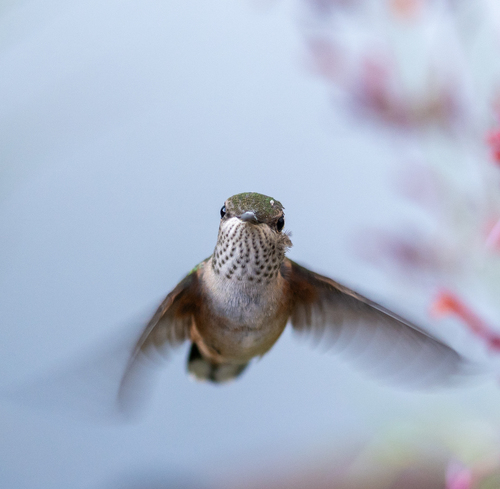 Broad-tailed Hummingbird
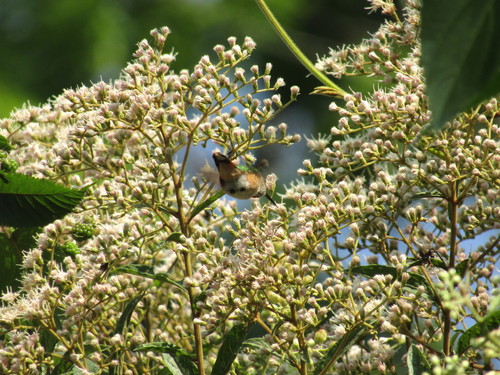 Bumblebee Hummingbird
In short
The most reliable field mark to separate Broad-tailed from Bumblebee Hummingbird is size: Broad-tailed is distinctly larger and heavier, with a noticeably longer body and wings. In the field, Broad-tailed shows a prominent white eye ring and a more rounded, projecting black tail, while Bumblebee Hummingbird is tiny, compact, and has a short, straight bill and a small white spot behind the eye. Males of both species have iridescent gorgets, but the color and shape differ: Broad-tailed males show a rose-red gorget, while Bumblebee males have a magenta-purple to bluish or amethyst gorget with flared hind feathers. Females and immatures are best separated by size, tail pattern, and the Broad-tailed’s white eye ring versus the Bumblebee’s white post-ocular spot. If you see a very small, bee-like hummingbird with a cocked tail and complex tail pattern, it is almost certainly a Bumblebee Hummingbird.
Identification tips
- Size is the fastest separator: Broad-tailed is much larger and heavier; Bumblebee is truly tiny, even for a hummingbird. If the bird looks bee-sized and compact, suspect Bumblebee.
- White eye ring vs. white spot: Broad-tailed shows a clear, full white eye ring in both sexes and ages. Bumblebee has only a small white spot behind the eye, never a full ring.
- Tail shape and projection: Broad-tailed has a rounded, black tail that projects well beyond the wing tips when perched. Bumblebee’s tail is shorter, with a complex pattern (bronzy green, cinnamon, black, and white tips), and does not project as far.
- Gorget color and shape (males): Broad-tailed males have a bright rose-red gorget, flat and not flared. Bumblebee males have a metallic magenta-purple to bluish or amethyst gorget, with longer hind feathers that flare out and back, especially during display.
- Female/immature throat and flank pattern: Broad-tailed females have cinnamon flanks and spotted cheeks, with a plain white throat. Bumblebee females have a white throat with many metallic bronze spots and more cinnamon or buff on the flanks and undertail.
- Tail pattern (especially in Bumblebee): Bumblebee Hummingbird’s tail is multicolored: central feathers bronzy green with cinnamon at the base, outer feathers with reddish cinnamon and black, often with a bronzy green band and a wide white or off-white tip. Broad-tailed’s tail is more uniformly black and rounded.
- Bill structure: Both have straight, blackish bills, but Bumblebee’s is proportionally shorter and stubbier relative to its tiny size.
- Behavior in flight and at flowers: Bumblebee often feeds low to mid-level, hovers with tail cocked up, and can sneak into territories of larger hummingbirds. Broad-tailed is more robust, territorial, and less likely to cock its tail so sharply.
- Wing sounds (males especially): Broad-tailed males produce a loud, mechanical wing trill during display, audible at a distance. Bumblebee males make a high-pitched, insect-like buzz, especially during display, but it is less mechanical and more like a bee.
- Vocalizations: Broad-tailed’s call is a sharp, repeated "cheet"; Bumblebee’s song is a high, thin, whining "sss ssssssssis" or "seeuuuuu" from a perch, and calls are high chips.
- Habitat and range context: Outside Mexico, Bumblebee is a rarity; Broad-tailed is widespread in western North America. In Mexico, both can occur, but Bumblebee is more likely in forest edges and clearings with abundant flowers.
- Upperparts color: Both are green above, but Bumblebee is more bronzy or golden, especially in good light.
- Sexual dimorphism: Both species show sexual dimorphism, but the gorget color and throat spotting are key: Broad-tailed male is rose-red, female plain; Bumblebee male is magenta to amethyst, female has metallic throat spots.
- Jizz and impression: Broad-tailed feels medium-sized, robust, with a long, projecting tail and confident flight. Bumblebee is tiny, quick, often with a cocked tail and a bee-like, darting flight.
- Pitfalls: Immature Broad-tailed can look paler and smaller, but will still show the full white eye ring and larger size. Female Bumblebee can be confused with other small hummingbirds, but the combination of size, tail pattern, and throat spots is distinctive.
Size
Broad-tailed Hummingbird is medium-sized for a hummingbird: about 10 cm (4 in) long, with a wingspan of 13.3 cm (5.25 in), and weighs around 3.6 g. Bumblebee Hummingbird is one of the smallest hummingbirds, only 5.9–7.5 cm (2.3–3.0 in) long and weighing 2–2.7 g. The size difference is striking in direct comparison: Broad-tailed appears much larger and bulkier, while Bumblebee is tiny, compact, and noticeably lighter. Even at a distance, Bumblebee Hummingbird’s smallness is apparent, especially if seen near other hummingbirds.
Plumage
No age-specific upperwing or flight pattern marks are described for either species, so focus is on body and tail plumage. Adult male Broad-tailed Hummingbirds have a bright rose-red gorget, iridescent green back, white eye ring, and a rounded black tail that projects beyond the wing tips. Females are paler, with cinnamon flanks and spotted cheeks. Bumblebee Hummingbird males have a metallic magenta-purple to bluish or amethyst gorget, with longer hind feathers that flare out, and a complex tail pattern: central tail feathers bronzy green with cinnamon at the base, outer feathers with reddish cinnamon and black, often with a bronzy green band and a wide white tip. Females have white throats with metallic bronze spots, more cinnamon or buff on the flanks and undertail, and a tail with more black and off-white tips. The Broad-tailed’s white eye ring is consistent in both sexes, while Bumblebee has only a small white spot behind the eye. Female Bumblebee has smaller metallic throat spots and more buff or cinnamon on the flanks and undertail than Broad-tailed. Both species have green upperparts, but Bumblebee’s is more bronzy or golden.
Behaviour
Bumblebee Hummingbird is often dominated by larger hummingbirds and tends to feed at lower to mid-levels in vegetation, sometimes sneaking into territories due to its tiny size. It often hovers with its tail cocked up, which is a useful behavioral clue. Broad-tailed Hummingbird is more robust and territorial, with males producing loud wing trills during courtship and defending territories more aggressively. In flight, Broad-tailed appears more substantial and less bouncy than the tiny, bee-like Bumblebee.
Habitat
Broad-tailed Hummingbird is found in highland regions from the western US and Canada south through Mexico and Guatemala, often in open woodlands and mountain meadows. Bumblebee Hummingbird is endemic to Mexico, with rare vagrants in the US, and is found in a variety of habitats but generally favors forest edges, clearings, and areas with abundant flowers. If you are outside Mexico, Bumblebee is extremely unlikely except as a rare vagrant; in Mexico, both can overlap in highland areas, but Broad-tailed is more widespread northward.
Voice
Broad-tailed Hummingbird gives a sharp, repeated "cheet" call and, notably, males produce a loud wing trill during display flights, audible at a distance. Bumblebee Hummingbird’s song is a high, thin, whining "sss ssssssssis" or "seeuuuuu," fading at the end, sung from a perch; calls are high chips, similar to other Selasphorus. The male Bumblebee’s wings make a loud, insect-like buzz in flight, especially during display, but this is higher-pitched and more insect-like than Broad-tailed’s trill.
Broad-tailed Hummingbird · Bumblebee Hummingbird · My Tricky Birds