
Broad-billed Sandpiper vs Sharp-tailed Sandpiper
Calidris falcinellus versus Calidris acuminata
Play a quiz with Broad-billed Sandpiper and Sharp-tailed Sandpiper
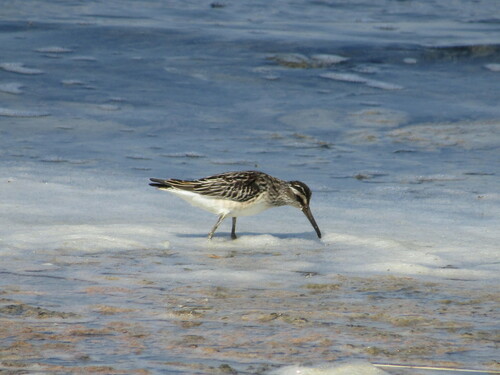 Broad-billed Sandpiper
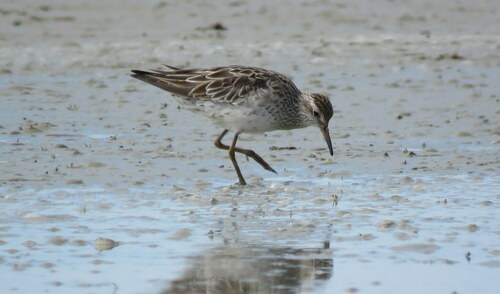 Sharp-tailed Sandpiper
In short
The most reliable field mark between Broad-billed and Sharp-tailed Sandpiper is the head pattern: Broad-billed shows a striking double (split) supercilium and a pale crown stripe, while Sharp-tailed has a single strong supercilium and a rich chestnut cap. Juvenile and autumn birds are often confused, but Broad-billed juveniles have a white belly and brown-streaked breast, while Sharp-tailed juveniles show a buffy chest and bright chestnut crown. Structurally, Broad-billed is smaller, with a distinctly kinked bill tip and shorter legs, whereas Sharp-tailed is bulkier with a straight bill and a pot-bellied look. In flight or at rest, focus on head pattern and underpart markings for the most consistent separation.
Identification tips
- Head pattern is key: Broad-billed Sandpiper always shows a double (split) supercilium and a pale crown stripe, visible in all ages and seasons. Sharp-tailed Sandpiper has a single, strong supercilium and a rich chestnut cap, especially vivid in juveniles and breeding adults.
- Juvenile underparts: Juvenile Broad-billed has a white belly and flanks with brown-streaked breast; Sharp-tailed juvenile shows a buffy chest and sides with sharper, brighter markings and a more extensive chestnut crown.
- Bill shape: Broad-billed's bill is long, straight with a distinctly kinked-down tip, and appears slightly broader at the base (though this is subtle in the field). Sharp-tailed's bill is straight, dark, and not kinked.
- Leg color and length: Broad-billed has shorter legs than Sharp-tailed. Sharp-tailed's legs are olive to yellowish and appear longer, contributing to its bulkier jizz.
- Overall structure: Broad-billed is smaller, more delicate, and compact. Sharp-tailed is bulkier, with a pot-bellied look, flat back, and drawn-out rear end.
- Mantle stripes: Both species can show pale mantle stripes as juveniles, but in Broad-billed these are less contrasting than the bright white stripes of Sharp-tailed juveniles.
- Breast pattern: Broad-billed (all ages) shows a brown-streaked breast with a white belly; Sharp-tailed has a more uniform, buffy chest with '>'-shaped marks on the flanks and less contrast between breast and belly.
- Crown color: Broad-billed's crown is pale with a central stripe; Sharp-tailed's is rich chestnut, especially in juveniles and breeding adults.
- Winter plumage: Both species become duller, but Broad-billed retains its double supercilium and crown stripe, while Sharp-tailed's head pattern becomes less vivid but remains single and chestnut-toned.
- Flight views: No distinctive upperwing or flight pattern marks are described for either species, so rely on head and underpart patterns even in flight.
- Size in mixed flocks: If both species are present, Sharp-tailed will look noticeably larger and heavier than Broad-billed.
- Foraging behavior: Broad-billed often picks at the surface with a more delicate action; Sharp-tailed appears more robust and deliberate.
- Voice: If heard, Broad-billed gives a dry, whistling 'dree-it' and clicking 'dik dik'; Sharp-tailed's call is not described here.
- Geographic context: Broad-billed is rare in western Europe and more likely in Southeast Asia and Australasia in winter; Sharp-tailed is regular in Australasia and rare but possible in North America.
- Pitfalls: Juvenile Sharp-tailed can look very bright and contrasty, but always check for the single vs. double supercilium and the color of the crown for confirmation.
Size
Broad-billed Sandpiper is noticeably smaller and lighter, with an average body mass of 37.0 g, compared to the Sharp-tailed Sandpiper's 66.9 g [wikidata]. Broad-billed also has shorter legs and a more delicate build, while Sharp-tailed appears portly with a flat back and a drawn-out rear end. This size difference can be subtle in mixed flocks but is usually apparent when both species are seen side by side.
Plumage
Juvenile and first-autumn birds are the main confusion point. Juvenile Broad-billed Sandpipers have pale 'tramlines' down the mantle, a white belly and flanks, and a brown-streaked breast. Their head pattern is diagnostic: a pale crown stripe and a double supercilium. Juvenile Sharp-tailed Sandpipers are brighter overall, with a rich chestnut crown, a single strong supercilium, and a buffy chest with sharp markings. Their mantle stripes are white and contrast with the crown. In adult breeding plumage, Broad-billed shows dark brown upperparts with narrow pale fringes, white underparts with blackish breast markings, and retains the double supercilium and crown stripe. Sharp-tailed adults have a mottled chestnut-brown upper body, chestnut cap, and a more uniform, less streaked breast with '>'-shaped marks on the flanks. In winter, both species become duller, but Broad-billed keeps its distinct head pattern, while Sharp-tailed's crown and supercilium become less vivid but still single and chestnut-toned.
Behaviour
Both species are gregarious and often join mixed flocks of waders, especially during migration and on wintering grounds. Broad-billed Sandpiper tends to forage by picking at the surface, using its slightly decurved bill, and is often seen in smaller groups within larger flocks. Sharp-tailed Sandpiper is also social but appears bulkier and more deliberate in movement, sometimes giving a pot-bellied impression as it feeds. Both species are strongly migratory, but their migration routes and timing differ.
Habitat
Broad-billed Sandpiper breeds in wet taiga bogs of northern Scandinavia and Siberia, and winters from eastern Africa through South and Southeast Asia to Australasia, favoring soft mud on marshes and coastal areas. Sharp-tailed Sandpiper breeds in eastern Siberian tundra and migrates mainly to Australasia, frequenting similar marshy and coastal habitats in winter. Both can occur together on passage, but Broad-billed is much rarer in western Europe, while Sharp-tailed is a rare but regular migrant to Australasia and occasionally North America.
Voice
Broad-billed Sandpiper gives a dry, whistling 'dree-it, dree-it' and a clicking 'dik dik', similar to Little Stint. Sharp-tailed Sandpiper's calls are not described in the provided notes, so voice is not a reliable separator based on current information.
Broad-billed Sandpiper · Sharp-tailed Sandpiper · My Tricky Birds